PUBLISHER: Mordor Intelligence | PRODUCT CODE: 2116005

PUBLISHER: Mordor Intelligence | PRODUCT CODE: 2116005
Middle-East And Africa Liquified Natural Gas (LNG) Bunkering - Market Share Analysis, Industry Trends & Statistics, Growth Forecasts (2026 - 2031)
According to Mordor Intelligence, the middle-East and Africa liquified natural gas bunkering market size in terms of nameplate capacity is expected to grow from 37.95 Thousand metric tons in 2025 to 59.28 Thousand metric tons in 2026 and is forecast to reach 149.11 Thousand metric tons by 2031 at 20.26% CAGR over 2026-2031.
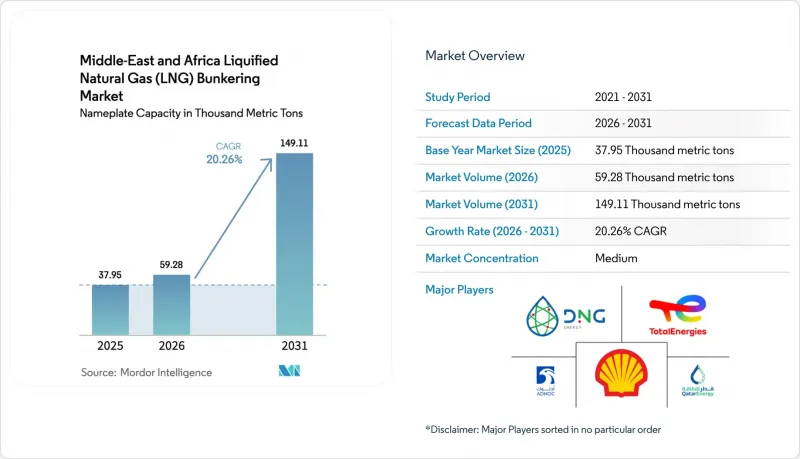
This report is Segmented by End User (Tanker Fleet, Container Fleet, Bulk and General Cargo Fleet, Ferries and OSV, and Other End-Users) and Geography (United Arab Emirates, Saudi Arabia, Oman, Qatar, Bahrain, Rest of Middle East, South Africa, Egypt, Nigeria, Kenya, and Rest of Africa). The Market Sizes and Forecasts are Provided in Terms of Volume (Metric Tons).
Middle-East And Africa Liquified Natural Gas (LNG) Bunkering Market Trends and Insights
Stricter IMO Sulphur and GHG Mandates Accelerate LNG Adoption
The IMO reduced the global sulphur limit in marine fuels from 3.5% to 0.5% in 2020, forcing operators to choose between costly scrubbers, low-sulphur fuel oil, or LNG. By 2025, more than 600 ships were running on LNG, and the IMO 2023 greenhouse-gas strategy, targeting net-zero shipping by 2050, cemented LNG as the most accessible compliance pathway until ammonia or hydrogen supply chains mature. The finalized life-cycle assessment credits LNG with a 20% lower well-to-wake carbon intensity versus heavy fuel oil, driving CMA CGM, MSC, and others to place large dual-fuel orders. The EU placed maritime emissions under its ETS in 2024, and prices climbed to EUR 85 per t, making high-sulphur fuels uneconomic on long Europe-bound voyages. Consequently, shipowners increasingly lock in LNG bunkering contracts to mitigate their carbon cost exposure.
Mega Middle-East Liquefaction Additions Lower Bunker Prices and Boost Supply
Qatar's North Field East, South, and West phases will collectively add 88 billion m3 per year of liquefaction by 2027, lifting the nation to 142 million tpa and reinforcing its leadership in the LNG bunkering market. Saudi Arabia's planned Ras Al-Khair terminal and the UAE's Ruwais project together contribute a further 20 million tpa by 2029. Oversupply has already compressed spot LNG prices; the Platts JKM averaged USD 11.20 per MMBtu in H1 2025 against USD 17.50 in 2024, undercutting VLSFO on a per-voyage basis. Hub operators such as ADNOC and Shell now offer multi-year fixed-price bunker deals, reducing owners' fuel-cost uncertainty and encouraging dual-fuel fleet expansion.
High Capex for Cryogenic Storage and Bunkering Assets
A shore-based LNG bunker terminal typically costs USD 100 million to USD 150 million, covering tanks, vaporization, and safety systems, which deters investment at ports with unclear demand. A dedicated LNG bunkering vessel ranges from USD 50 million to USD 80 million, and financiers often insist on offtake commitments for 70% capacity before funding. Durban's 2025 feasibility study projected an extra 18 months for land acquisition and permitting, delaying revenue and inflating interest costs. Lagos postponed its bunker project after failing to secure 10-year customer contracts. Smaller East-African ports also lack throughput to justify standalone terminals, reinforcing the chicken-and-egg dilemma that slows the LNG bunkering market rollout.
Other drivers and restraints analyzed in the detailed report include:
- Regional LNG Bunkering Hubs Backed by Incentives
- ESG-Driven Preference for Low-Carbon LNG
- LNG Price Volatility Versus VLSFO Undermines Cost Savings
For complete list of drivers and restraints, kindly check the Table Of Contents.
Segment Analysis
Container vessels held 41.1% of demand in 2025, while the tanker and bulk carrier categories lag. Within the container segment, CMA CGM's 22-ship LNG program and MSC's retrofit plan underscore long-term confidence in the fuel. This segment commands the highest LNG bunkering market share because liner operators can pass bunker costs through in freight rates and face strict ESG requirements from cargo owners. The container fleet is projected to grow at 23.4% annually to 2031, making it the largest contributor to the LNG bunkering market size through the forecast period.
Tankers and bulkers remain cautious. DHT Holdings and Euronav ordered LNG-ready VLCCs in 2024, yet widespread uptake is limited by freight-rate volatility and fragmented ownership. Ferries and OSVs trail even further; regional voyages rarely recoup the capital required for cryogenic tanks, though Norway's Fjord Line demonstrates technical feasibility with its LNG-powered ferry delivered in 2024. Cruise operators such as Carnival already run 11 LNG-powered ships and could accelerate adoption once more ports add bunker capability. Overall, the LNG bunkering industry remains container-centric, but progressive infrastructure roll-outs and carbon-pricing signals may broaden participation across vessel classes later in the decade.
Complete Report Scope:
- By End User
- Tanker Fleet
- Container Fleet
- Bulk and General Cargo Fleet
- Ferries and OSV
- Other End-Users
- By Geography
- Middle East
- United Arab Emirates
- Saudi Arabia
- Oman
- Qatar
- Bahrain
- Rest of Middle East
- Africa
- South Africa
- Egypt
- Nigeria
- Kenya
- Rest of Africa
- Middle East
List of Companies Covered in this Report:
- QatarEnergy
- Royal Dutch Shell plc
- TotalEnergies SE
- ADNOC Logistics & Services plc
- DNG Energy
- Oman LNG LLC
- BP plc
- Mitsui O.S.K. Lines (MOL)
- Nakilat (Qatar Gas Transport Co.)
- Kanfer Shipping
- JGC Holdings Corporation
- McDermott International Inc.
- Technip Energies N.V.
- BW Group
- SEA-LNG Ltd
- GasLog Ltd
- Wartsila Oyj
- MAN Energy Solutions
- Samsung Heavy Industries
- Hudong-Zhonghua Shipbuilding
Additional Benefits:
- The market estimate (ME) sheet in Excel format
- 3 months of analyst support
TABLE OF CONTENTS
1 Introduction
- 1.1 Study Assumptions & Market Definition
- 1.2 Scope of the Study
2 Research Methodology
3 Executive Summary
4 Market Landscape
- 4.1 Market Overview
- 4.2 Recent Trends & Developments
- 4.3 Market Drivers
- 4.3.1 Stricter IMO sulphur/GHG mandates accelerate LNG adoption
- 4.3.2 Mega Middle-East liquefaction additions lower bunker prices & boost supply
- 4.3.3 Regional LNG bunkering hubs (Sohar, Fujairah, Durban) backed by incentives
- 4.3.4 Security-driven Cape route shift raises demand at African ports
- 4.3.5 ESG-driven preference for low-carbon LNG (CCUS, e-drive trains)
- 4.3.6 Modular small-scale FSRU & LNGBV roll-outs enable secondary-port supply
- 4.4 Market Restraints
- 4.4.1 High capex for cryogenic storage & bunkering assets
- 4.4.2 LNG price volatility versus VLSFO undermines cost savings
- 4.4.3 Incoming methane-slip rules may erode LNG's green advantage
- 4.4.4 Skilled-labor shortage for LNG handling in several African ports
- 4.5 Supply-Chain Analysis
- 4.6 Regulatory Landscape
- 4.7 Technological Outlook
- 4.8 Porter's Five Forces
- 4.8.1 Bargaining Power of Suppliers
- 4.8.2 Bargaining Power of Buyers
- 4.8.3 Threat of New Entrants
- 4.8.4 Threat of Substitutes
- 4.8.5 Competitive Rivalry
5 Market Size & Growth Forecasts
- 5.1 By End User
- 5.1.1 Tanker Fleet
- 5.1.2 Container Fleet
- 5.1.3 Bulk and General Cargo Fleet
- 5.1.4 Ferries and OSV
- 5.1.5 Other End-Users
- 5.2 By Geography
- 5.2.1 Middle East
- 5.2.1.1 United Arab Emirates
- 5.2.1.2 Saudi Arabia
- 5.2.1.3 Oman
- 5.2.1.4 Qatar
- 5.2.1.5 Bahrain
- 5.2.1.6 Rest of Middle East
- 5.2.2 Africa
- 5.2.2.1 South Africa
- 5.2.2.2 Egypt
- 5.2.2.3 Nigeria
- 5.2.2.4 Kenya
- 5.2.2.5 Rest of Africa
- 5.2.1 Middle East
6 Competitive Landscape
- 6.1 Market Concentration
- 6.2 Strategic Moves (M&A, Partnerships, PPAs)
- 6.3 Market Share Analysis (Market Rank/Share for key companies)
- 6.4 Company Profiles (includes Global level Overview, Market level overview, Core Segments, Financials as available, Strategic Information, Products & Services, and Recent Developments)
- 6.4.1 QatarEnergy
- 6.4.2 Royal Dutch Shell plc
- 6.4.3 TotalEnergies SE
- 6.4.4 ADNOC Logistics & Services plc
- 6.4.5 DNG Energy
- 6.4.6 Oman LNG LLC
- 6.4.7 BP plc
- 6.4.8 Mitsui O.S.K. Lines (MOL)
- 6.4.9 Nakilat (Qatar Gas Transport Co.)
- 6.4.10 Kanfer Shipping
- 6.4.11 JGC Holdings Corporation
- 6.4.12 McDermott International Inc.
- 6.4.13 Technip Energies N.V.
- 6.4.14 BW Group
- 6.4.15 SEA-LNG Ltd
- 6.4.16 GasLog Ltd
- 6.4.17 Wartsila Oyj
- 6.4.18 MAN Energy Solutions
- 6.4.19 Samsung Heavy Industries
- 6.4.20 Hudong-Zhonghua Shipbuilding
7 Market Opportunities & Future Outlook
- 7.1 White-space & Unmet-need Assessment

