PUBLISHER: Mordor Intelligence | PRODUCT CODE: 2116023

PUBLISHER: Mordor Intelligence | PRODUCT CODE: 2116023
United States Dry-Type Transformer - Market Share Analysis, Industry Trends & Statistics, Growth Forecasts (2026 - 2031)
According to Mordor Intelligence, the United States dry-Type transformer market size was valued at USD 2.11 billion in 2025 and estimated to grow from USD 2.28 billion in 2026 to reach USD 3.4 billion by 2031, at a CAGR of 8.31% during the forecast period (2026-2031).
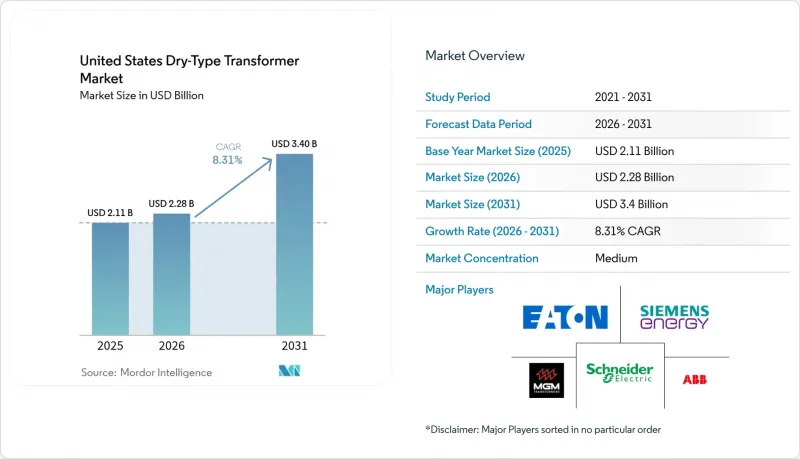
This report is Segmented by Power Rating (Large, Medium, and Small), Phase (Single-Phase and Three-Phase), Transformer Type (Power and Distribution), and End-User (Power Utilities, Industrial, Commercial, and Residential). The Market Sizes and Forecasts are Provided in Terms of Value (USD).
United States Dry-Type Transformer Market Trends and Insights
DOE Efficiency Rule Phase-2 Drives Retrofit Acceleration
The Department of Energy has set 2029 as the compliance deadline for the second phase of transformer efficiency rules, replacing the earlier 2027 date. The rule demands efficiency gains that are unattainable through minor design tweaks, forcing the outright replacement of many aging dry-type units. A four-year compliance window prompts utilities, campuses, and industrial plants to expedite their procurement strategies. Ancillary upgrades-such as larger termination compartments and improved ventilation-add to project scope and spending. Facilities operating multiple units must synchronize replacements to avoid downtime, elevating batch-order volumes. These dynamics elevate baseline demand across all ratings, creating premium pricing opportunities for suppliers capable of delivering high-efficiency models within compressed lead times.
Behind-the-Meter Storage Transforms Distribution Requirements
California surpassed 2,000 MW of behind-the-meter storage capacity in 2024, with Texas and Northeast states following suit. Bidirectional power flow and rapid cycling stress conventional transformer designs drive the adoption of vacuum-pressure-impregnated (VPI) coils, which offer enhanced thermal margins. Storage-coupled transformers are specified at capacity ratings 15-20% above nominal load to ride through frequent charge-discharge events. Grid-code revisions that privilege dry-type designs over oil-filled units, primarily for fire safety, further amplify uptake. Manufacturers offering pre-certified bidirectional units gain first-mover advantage, while utilities refine protection schemes to manage harmonics introduced by inverter-based storage.
Material Price Volatility Pressures Margins
Aluminum averaged USD 2,100 per metric ton on the London Metal Exchange in 2024, 15% above the 2023 level, and trading bands indicate continued fluctuations through 2025. Raw materials account for up to 60% of the transformer manufacturing cost, yet supply contracts often fix selling prices months in advance. Price spikes compress margins for OEMs locked into legacy bids, while buyers face surcharges or re-quotations. Copper volatility compounds risk, prompting a shift toward aluminum windings where thermal specs allow. Some utilities adopt cost-adjustment clauses to share risk, but smaller contractors remain exposed, which can stall project awards during high-price intervals.
Other drivers and restraints analyzed in the detailed report include:
- Data Center Tax Incentives Fuel Infrastructure Investment
- Supply Chain Reshoring Creates Capacity Constraints
- UL-1561 Certification Creates Deployment Bottlenecks
For complete list of drivers and restraints, kindly check the Table Of Contents.
Segment Analysis
Small transformers, up to 10 MVA, accounted for 84.68% of 2025 shipments, translating to USD 1.79 billion of the US dry-type transformer market size. Their dominance stems from a distributed architecture that favors numerous localized installations over a few centralized assets. The segment is projected to grow at an 8.46% CAGR, benefiting from residential electrification and retrofit programs. Behind-the-meter storage and industrial heat-pump projects drive specification changes, requiring higher overload capacity and improved cooling. Standardized frame sizes enable economies of scale, but the increasing customization of storage and VFD-driven loads introduces engineering complexity. OEMs able to balance modularity with customization capture premium margins while meeting volume commitments.
Medium transformers (10-100 MVA) service utility substations and critical industrial feeders. Although representing approximately 12.15% of the US dry-type transformer market share in value, growth moderates to 7.05% as utilities focus capital expenditures on distribution-level modernization rather than capacity expansion. Large transformers above 100 MVA remain niche, aligning with transmission-level or hyperscale data center interconnects. Suppliers in this tier emphasize advanced insulation systems and partial-discharge monitoring to meet reliability targets.
Three-phase models retained a 66.82% share in 2025, underpinned by industrial motor loads and large commercial buildings. However, single-phase units are expected to clock a 8.92% CAGR to 2031, reflecting the boom in EV charging and heat pumps in residential neighborhoods. Utilities in California and New York are forecasting double-digit annual replacements of pole-top single-phase transformers to accommodate higher 240V loads. Level-2 EV chargers and induction cooktops drive peak currents that exceed the ratings of legacy transformers, necessitating proactive replacements. Residential rooftops with solar plus storage further compel bidirectional capability, a specification more commonly available in new single-phase offerings.
Three-phase demand continues in process industries, shifting toward high-efficiency configurations that align with DOE Phase 2 requirements. Vendors differentiate through core material innovations and embedded sensors that enable real-time thermal modeling. Growth softens as energy-intensive industries plateau, yet service-replacement cycles support a steady baseline of orders.
Complete Report Scope:
- By Power Rating
- Large (Above 100 MVA)
- Medium (10 to 100 MVA)
- Small (Up to 10 MVA)
- By Phase
- Single-Phase
- Three-Phase
- By Transformer Type
- Power
- Distribution
- By End-User
- Power Utilities (includes, Renewables, Non-renewables, and T&D)
- Industrial
- Commercial
- Residential
List of Companies Covered in this Report:
- ABB Ltd.
- Schneider Electric SE
- Siemens Energy Inc.
- Eaton Corporation plc
- Hitachi Energy USA
- MGM Transformer Company
- Duke Energy (Utility Dry-type Spec)
- Hammond Power Solutions
- Virginia Transformer Corp.
- Power Partners Inc.
- ERMCO
- Federal Pacific (Electro-Mechanical Corp.)
- GE Vernova
- Federal Signal Transformer
- Schneider (Square-D)
- ABB (T&B)
Additional Benefits:
- The market estimate (ME) sheet in Excel format
- 3 months of analyst support
TABLE OF CONTENTS
1 Introduction
- 1.1 Study Assumptions & Market Definition
- 1.2 Scope of the Study
2 Research Methodology
3 Executive Summary
4 Market Landscape
- 4.1 Market Overview
- 4.2 Market Drivers
- 4.2.1 DOE efficiency rule phase-2 (2027) boosts retrofit demand
- 4.2.2 Surge in behind-the-meter battery storage deployments
- 4.2.3 Federal tax incentives for data-center energy security
- 4.2.4 Reshoring of medium-voltage equipment supply chains
- 4.2.5 Mandated fire-safe transformers in high-rise codes
- 4.2.6 Electrification of low-carbon industrial heat processes
- 4.3 Market Restraints
- 4.3.1 Volatile copper & aluminium prices
- 4.3.2 Lengthy UL-1561 certification lead-times
- 4.3.3 Real-estate constraints in legacy substations
- 4.3.4 OEM capacity bottlenecks for VPI coils
- 4.4 Supply-Chain Analysis
- 4.5 Regulatory Landscape
- 4.6 Technological Outlook
- 4.7 Porter's Five Forces
- 4.7.1 Threat of New Entrants
- 4.7.2 Bargaining Power of Suppliers
- 4.7.3 Bargaining Power of Buyers
- 4.7.4 Threat of Substitutes
- 4.7.5 Industry Rivalry
- 4.8 PESTLE Analysis
5 Market Size & Growth Forecasts
- 5.1 By Power Rating
- 5.1.1 Large (Above 100 MVA)
- 5.1.2 Medium (10 to 100 MVA)
- 5.1.3 Small (Up to 10 MVA)
- 5.2 By Phase
- 5.2.1 Single-Phase
- 5.2.2 Three-Phase
- 5.3 By Transformer Type
- 5.3.1 Power
- 5.3.2 Distribution
- 5.4 By End-User
- 5.4.1 Power Utilities (includes, Renewables, Non-renewables, and T&D)
- 5.4.2 Industrial
- 5.4.3 Commercial
- 5.4.4 Residential
6 Competitive Landscape
- 6.1 Market Concentration
- 6.2 Strategic Moves (M&A, Partnerships, PPAs)
- 6.3 Market Share Analysis (Market Rank/Share for key companies)
- 6.4 Company Profiles (includes Global level Overview, Market level overview, Core Segments, Financials as available, Strategic Information, Products & Services, and Recent Developments)
- 6.4.1 ABB Ltd.
- 6.4.2 Schneider Electric SE
- 6.4.3 Siemens Energy Inc.
- 6.4.4 Eaton Corporation plc
- 6.4.5 Hitachi Energy USA
- 6.4.6 MGM Transformer Company
- 6.4.7 Duke Energy (Utility Dry-type Spec)
- 6.4.8 Hammond Power Solutions
- 6.4.9 Virginia Transformer Corp.
- 6.4.10 Power Partners Inc.
- 6.4.11 ERMCO
- 6.4.12 Federal Pacific (Electro-Mechanical Corp.)
- 6.4.13 GE Vernova
- 6.4.14 Federal Signal Transformer
- 6.4.15 Schneider (Square-D)
- 6.4.16 ABB (T&B)
7 Market Opportunities & Future Outlook
- 7.1 White-Space & Unmet-Need Assessment

