PUBLISHER: Mordor Intelligence | PRODUCT CODE: 2116044

PUBLISHER: Mordor Intelligence | PRODUCT CODE: 2116044
Europe Non-Destructive Testing - Market Share Analysis, Industry Trends & Statistics, Growth Forecasts (2026 - 2031)
According to Mordor Intelligence, the Europe non-Destructive testing market size is estimated at USD 7.02 billion in 2026, and is expected to reach USD 10.42 billion by 2031, at a CAGR of 8.22% during the forecast period (2026-2031).
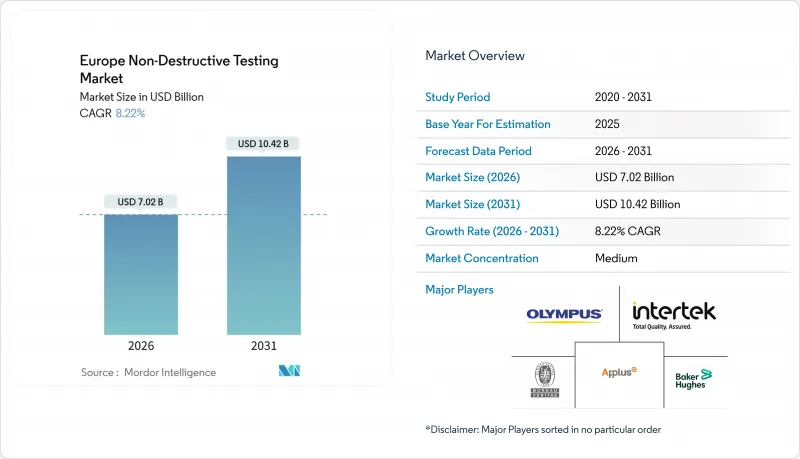
This report is Segmented by Testing Method (Radiography, Ultrasonic, Magnetic Particle, and More), Component Type (Equipment, Software and Analytics Platforms, and Services), Service Mode (In-House, Outsourced, and More), End-User Industry (Oil and Gas, Aerospace and Defense, Automotive and Transportation, and More), and Geography. The Market Forecasts are Provided in Terms of Value (USD).
Europe Non-Destructive Testing Market Trends and Insights
Stringent EU Directives on Industrial Safety and Product Liability
Revisions to the Pressure Equipment Directive, Machinery Regulation, and the Roadworthiness Package have widened the scope and tightened the cadence of mandatory inspections. Commercial vehicles older than 12 years now face annual structural checks, adding roughly 1.2 million inspections across Germany, France, and Spain each year. Updated product-liability rules shift the burden of proof onto manufacturers, compelling the creation of auditable, non-destructive testing records in aerospace and medical-device production lines. As compliance becomes non-negotiable, Europe Non-Destructive Testing market demand remains insulated from macro-economic slowdowns and pricing pressure on legacy techniques.
Rising Capital Expenditure in European Aerospace and Defense MRO Facilities
Between 2024 and 2026, GE Aerospace, Safran, and other maintenance organizations committed more than USD 1.25 billion to expand ultrasonic and computed-tomography capacity, shortening engine overhaul cycles and enabling same-shift re-inspection of additive-manufactured parts. The spending wave aligns with Airbus forecasts indicating USD 130 billion in cumulative European MRO outlays to 2031, with NDT accounting for 8% of total costs. High throughput facilities that integrate inspection data into enterprise asset-management systems now enjoy preferential contract terms, accelerating software adoption and pushing the Europe Non-Destructive Testing market toward predictive analytics.
Persistent Shortage of Level-III Certified NDT Personnel
Pan-European demand for Level-III ultrasonic and radiographic specialists outstrips supply by 15%, pushing day rates near USD 870 and delaying complex weld inspections. The five-year experiential requirement embedded in ISO 9712 prolongs the talent gap, while competition from the nuclear sector intensifies scarcity. Automation mitigates routine tasks, but regulatory frameworks still mandate human sign-off, constraining throughput and nudging Europe Non-Destructive Testing market participants to invest in internal academies.
Other drivers and restraints analyzed in the detailed report include:
- Ageing Oil and Gas Assets in the North Sea Demanding Life-Extension Inspections
- Mandatory Periodic Testing of On-Road Commercial Vehicles under EU Roadworthiness Package
- High Ownership Cost of Phased-Array Ultrasonic and Digital Radiography Systems for SMEs
For complete list of drivers and restraints, kindly check the Table Of Contents.
Segment Analysis
Ultrasonic solutions accounted for 30.11% of Europe Non-Destructive Testing market share in 2025, favored for detecting subsurface flaws in thick welds, composites, and aged pipeline walls. Large aerospace shops now scan turbine disks in 12 minutes using 128-element phased-array heads, down from 45 minutes with legacy pulse-echo probes. Radiography remains indispensable for nuclear welds and additive-manufactured parts, while computed tomography is gaining traction to meet EASA Part 21 volumetric mandates. Emerging techniques - terahertz imaging, laser ultrasonics, and AI-assisted thermography - are forecast at an 8.92% CAGR, making them the fastest slice of the Europe Non-Destructive Testing market.
Increasingly, inspection protocols combine modalities. A single wind-turbine tower campaign might deploy drone-based visual surveys, ultrasonic spot checks, and eddy-current arrays for bolt-thread inspections. Vendors able to integrate data from these sources into unified dashboards stand to capture the expanding software layer of the Europe Non-Destructive Testing market.
Services delivered 49.57% of 2025 revenue as asset owners continued to outsource compliance and liability to accredited providers. Bureau Veritas alone logged USD 1.3 billion in European NDT services during 2024. However, software and analytics platforms are rising at 9.14% CAGR, even as the broader Europe Non-Destructive Testing market advances at 8.22%. Instruments such as Evident's OmniScan X4 ship with embedded neural networks that classify weld flaws with 92% accuracy, reducing Level-III sign-off time. Gross margins on subscription analytics hover near 70%, double those of labor-intensive services, incentivizing incumbent service giants to acquire niche software firms.
When software is bundled with rental hardware- an approach championed by Zetec and Olympus- customers sidestep upfront capital, while vendors lock in recurring revenue. This inversion of the traditional equipment-sale model is reshaping the profit pool within the Europe Non-Destructive Testing market.
Complete Report Scope:
- By Testing Method
- Radiography (Film, Digital, CT)
- Ultrasonic (Conventional, PAUT, TOFD)
- Magnetic Particle
- Liquid Penetrant
- Visual and Remote Visual
- Electromagnetic and Eddy- Current
- Emerging Techniques
- By Component Type
- Equipment
- Software and Analytics Platforms
- Services
- By Service Mode
- In-house Inspection
- Outsourced/Third-Party Inspection
- Rental and Leasing
- By End-User Industry
- Oil and Gas
- Aerospace and Defense
- Automotive and Transportation
- Power Generation
- Industrial Manufacturing
- Construction and Infrastructure
- Other End-User Industries
- By Country
- United Kingdom
- Germany
- France
- Italy
- Spain
- Other Countries
List of Companies Covered in this Report:
- Baker Hughes Company
- Bureau Veritas SA
- Applus Servicios Tecnologicos S.L.U.
- Intertek Group plc
- Olympus Corporation
- Yxlon International GmbH (Comet Group)
- Zetec Inc.
- Magnaflux Corporation
- Mistras Group, Inc.
- Eddyfi Technologies Inc.
- Waygate Technologies GmbH (Baker Hughes)
- TWI Ltd
- Sonatest Ltd
- NDT Global Services Ltd
- ROSEN Group GmbH
- Nikon Metrology NV
- VisiConsult X-ray Systems & Solutions GmbH
- NOVO DR Ltd
- Scanna MSC Ltd
- 3DX-RAY Ltd (Image Scan Holdings plc)
- Logos Imaging, LLC
- Teledyne ICM SA
- X-RIS SRL
- Institut de Soudure Groupe
- SGS Societe Generale de Surveillance SA
- TUV Nord Group
Additional Benefits:
- The market estimate (ME) sheet in Excel format
- 3 months of analyst support
TABLE OF CONTENTS
1 INTRODUCTION
- 1.1 Study Assumptions and Market Definition
- 1.2 Scope of the Study
2 RESEARCH METHODOLOGY
3 EXECUTIVE SUMMARY
4 MARKET LANDSCAPE
- 4.1 Market Overview
- 4.2 Market Drivers
- 4.2.1 Stringent EU Directives On Industrial Safety and Product Liability
- 4.2.2 Rising Capital Expenditure In European Aerospace and Defence MRO Facilities
- 4.2.3 Ageing Oil and Gas Assets In The North Sea Demanding Life-Extension Inspections
- 4.2.4 Mandatory Periodic Testing Of On-Road Commercial Vehicles Under EU Roadworthiness Package
- 4.2.5 Surge In Additive-Manufacturing (AM) Part Qualification Requiring Novel NDT Protocols
- 4.2.6 Investments In Small Modular Nuclear Reactors (SMRs) Driving Advanced In-Service Inspection
- 4.3 Market Restraints
- 4.3.1 Persistent Shortage Of Level-III Certified NDT Personnel
- 4.3.2 High Ownership Cost Of Phased-Array Ultrasonic and DR Systems For SMEs
- 4.3.3 Fragmented EU Standards Harmonisation Delaying Cross-Border Acceptance Of Results
- 4.3.4 Limited Field-Use Robustness Of Emerging Terahertz NDT Solutions
- 4.4 Industry Value Chain Analysis
- 4.5 Regulatory Landscape
- 4.6 Technological Outlook
- 4.7 Porter's Five Forces Analysis
- 4.7.1 Bargaining Power of Suppliers
- 4.7.2 Bargaining Power of Buyers
- 4.7.3 Threat of New Entrants
- 4.7.4 Threat of Substitutes
- 4.7.5 Intensity of Competitive Rivalry
- 4.8 Pricing Analysis
5 MARKET SIZE AND GROWTH FORECASTS (VALUE)
- 5.1 By Testing Method
- 5.1.1 Radiography (Film, Digital, CT)
- 5.1.2 Ultrasonic (Conventional, PAUT, TOFD)
- 5.1.3 Magnetic Particle
- 5.1.4 Liquid Penetrant
- 5.1.5 Visual and Remote Visual
- 5.1.6 Electromagnetic and Eddy- Current
- 5.1.7 Emerging Techniques
- 5.2 By Component Type
- 5.2.1 Equipment
- 5.2.2 Software and Analytics Platforms
- 5.2.3 Services
- 5.3 By Service Mode
- 5.3.1 In-house Inspection
- 5.3.2 Outsourced/Third-Party Inspection
- 5.3.3 Rental and Leasing
- 5.4 By End-User Industry
- 5.4.1 Oil and Gas
- 5.4.2 Aerospace and Defense
- 5.4.3 Automotive and Transportation
- 5.4.4 Power Generation
- 5.4.5 Industrial Manufacturing
- 5.4.6 Construction and Infrastructure
- 5.4.7 Other End-User Industries
- 5.5 By Country
- 5.5.1 United Kingdom
- 5.5.2 Germany
- 5.5.3 France
- 5.5.4 Italy
- 5.5.5 Spain
- 5.5.6 Other Countries
6 COMPETITIVE LANDSCAPE
- 6.1 Market Concentration
- 6.2 Strategic Moves
- 6.3 Market Share Analysis
- 6.4 Company Profiles (includes Global level Overview, Market Level Overview, Core Segments, Financials as Available, Strategic Information, Market Rank/Share for Key Companies, Products and Services, and Recent Developments)
- 6.4.1 Baker Hughes Company
- 6.4.2 Bureau Veritas SA
- 6.4.3 Applus Servicios Tecnologicos S.L.U.
- 6.4.4 Intertek Group plc
- 6.4.5 Olympus Corporation
- 6.4.6 Yxlon International GmbH (Comet Group)
- 6.4.7 Zetec Inc.
- 6.4.8 Magnaflux Corporation
- 6.4.9 Mistras Group, Inc.
- 6.4.10 Eddyfi Technologies Inc.
- 6.4.11 Waygate Technologies GmbH (Baker Hughes)
- 6.4.12 TWI Ltd
- 6.4.13 Sonatest Ltd
- 6.4.14 NDT Global Services Ltd
- 6.4.15 ROSEN Group GmbH
- 6.4.16 Nikon Metrology NV
- 6.4.17 VisiConsult X-ray Systems & Solutions GmbH
- 6.4.18 NOVO DR Ltd
- 6.4.19 Scanna MSC Ltd
- 6.4.20 3DX-RAY Ltd (Image Scan Holdings plc)
- 6.4.21 Logos Imaging, LLC
- 6.4.22 Teledyne ICM SA
- 6.4.23 X-RIS SRL
- 6.4.24 Institut de Soudure Groupe
- 6.4.25 SGS Societe Generale de Surveillance SA
- 6.4.26 TUV Nord Group
7 MARKET OPPORTUNITIES AND FUTURE OUTLOOK
- 7.1 White-space and Unmet-Need Assessment

