PUBLISHER: Mordor Intelligence | PRODUCT CODE: 2155594

PUBLISHER: Mordor Intelligence | PRODUCT CODE: 2155594
Composite Material Imaging Inspection Systems - Market Share Analysis, Industry Trends & Statistics, Growth Forecasts (2026 - 2031)
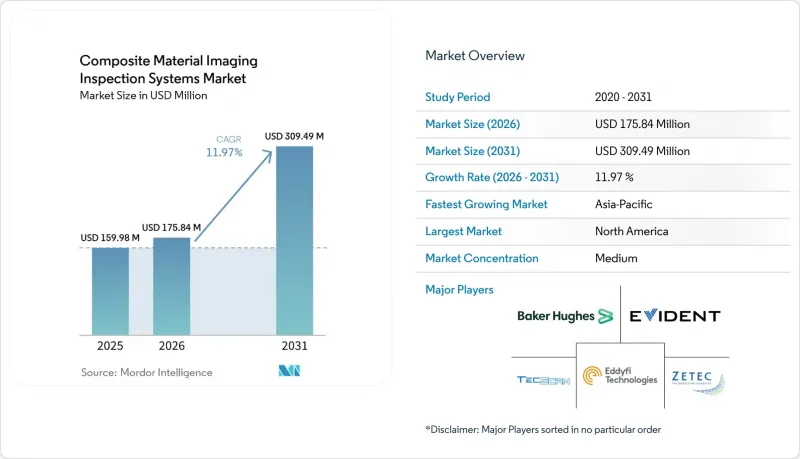
According to Mordor Intelligence, the composite material imaging inspection systems market size is expected to grow from USD 159.98 million in 2025 to USD 175.84 million in 2026 and is forecast to reach USD 309.49 million by 2031 at 11.97% CAGR over 2026-2031.
Global Composite Material Imaging Inspection Systems Market Trends and Insights
Increasing Composite Content in Safety-Critical Structures
Composite materials are becoming a design baseline in certified aircraft structures rather than a limited performance feature. More composite content increases the area that requires volumetric inspection during each production cycle. A 2026 ECNDT paper noted that silicon carbide ceramic matrix composites in aerospace engine hot sections require traceable defect decisions because visual review does not provide consistent documentation. New ply orientations, sandwich cores, and hybrid metal-composite joints also increase inspection complexity. The composite material imaging inspection systems market, therefore, favors integrated ultrasonic and thermographic platforms that can assess finer subsurface features across variable laminate geometries. This demand remains relevant even when an individual aircraft program experiences a temporary production slowdown.
Expansion of Aerospace Production and MRO Activity
Aircraft delivery programs remained active in 2024 and 2025, supporting inspection cycles at original equipment manufacturer facilities and maintenance, repair, and overhaul sites. Heavy maintenance requires comprehensive nondestructive testing of composite primary and secondary structures at prescribed inspection intervals. Manufacturers are also using more complex ply arrangements and sandwich-core designs to meet performance requirements. These designs require deeper penetration and finer resolution than systems qualified for earlier laminate generations. The resulting focus on documented in-process results is increasing demand for systems that produce digital inspection records rather than operator-interpreted C-scan printouts. The composite material imaging inspection systems market benefits because the inspection scope per aircraft extends beyond a simple count of delivered aircraft.
High Capital Cost of Automated Imaging Cells
Fully automated composite inspection gantries and robotic scanning cells require multimillion-dollar capital commitments. This is particularly restrictive for tier 2 and tier 3 suppliers with lower production volumes. Total cost extends beyond hardware to adaptive scan-path software, calibration artifact libraries, environmental controls, and facility changes. Each distinct part geometry can also require custom fixtures, which raises the effective cost for suppliers with diverse part portfolios. These economics slow the shift from manual inspection to automated platforms in Asia-Pacific and the Middle East. The composite material imaging inspection systems market may offer more accessible opportunities for suppliers that provide modular or lease-based purchasing models.
Other drivers and restraints analyzed in the detailed report include:
- Adoption of Automated Phased-Array and Matrix-Array Ultrasonics
- Regulatory Demand for Traceable Composite Inspection
- Shortage of Qualified Composite NDT Personnel
For complete list of drivers and restraints, kindly check the Table Of Contents.
Segment Analysis
Ultrasonic imaging held 43.62% of the composite material imaging inspection systems market share in 2025 and remained the main method for identifying delamination, porosity, and impact damage in CFRP and GFRP laminates. Phased-array ultrasonic testing with full-matrix capture and total focusing method processing is widely used for composite qualification. A 2026 ECNDT paper demonstrated fully automated single-pass robotic ultrasonic inspection for elongated composite structural members. The approach can reduce scan time for wing skins, stringers, and rotor-blade spars. Thermographic imaging addresses large-panel disbond and core-crush detection where noncontact coverage is useful. Radiographic imaging and computed tomography are used for volumetric void mapping in flight-critical fastener holes, splice regions, and ceramic matrix composite hot-section components.
Optical and laser imaging is projected to expand at a CAGR of 14.83% through 2031. ISO 8203-4:2025 sets out an international method for laser shearography of fiber-reinforced polymer composites. The method offers noncontact, large-area coverage with single-sided access for curved panels such as fuselage bays and nacelle fairings. Research published in 2026 found that filtered phase-map analysis improved detection of CFRP impact damage in laser shearography. Eddy current arrays and multisensor data fusion continue to serve specialized inspections of bonded metal-composite interfaces. This combination of standards, signal analysis, and blade inspection demand supports wider use of optical methods in the composite material imaging inspection systems industry.
Portable and handheld systems held 36.84% of the composite material imaging inspection systems market in 2025. They are important in maintenance settings where fixed gantries cannot access the part. Portable phased-array detectors and handheld shearography cameras also support field work in wind energy, marine, and civil infrastructure settings. Benchtop and laboratory systems serve material research and damage characterization work. Compact squirter-mode ultrasonic platforms support high-precision testing in facilities with limited floor space. Automated and fixed systems support dedicated production cells for parts such as wing skins, fuselage panels, and rotor blades.
In-line inspection systems are projected to expand at a CAGR of 15.62% through 2031. These systems place imaging sensors directly within automated fiber placement and resin transfer molding lines. Manufacturers can then identify layup errors, porosity, and foreign-object inclusions before laminate consolidation is complete. A collaboration involving Adaptix Ltd., Cranfield University, and the Aerospace Technology Institute demonstrated digital tomography with robotics for scalable 3D X-ray inspection at the composite preform stage. Earlier inspection can reduce post-cure rework and repeat inspection requirements. The composite material imaging inspection systems industry is thus evaluating in-line systems on lifecycle costs rather than on the initial capital cost alone.
Complete Report Scope:
- By Inspection Technology
- Ultrasonic Imaging
- Thermographic Imaging
- Optical and Laser Imaging
- Radiographic Imaging
- Other Imaging Technologies
- By System Configuration
- Portable and Handheld Systems
- Benchtop and Laboratory Systems
- Automated and Fixed Inspection Systems
- In-Line Inspection Systems
- By Application
- Manufacturing and Production Quality Inspection
- In-Service Inspection and Maintenance
- Repair and Refurbishment Verification
- Research, Development, and Material Characterization
- Other Applications
- By End-User
- Aerospace, Defense, and Space
- Automotive and Transportation
- Energy and Power
- Industrial Manufacturing
- Marine and Infrastructure
- Research and Testing
- Other End-Users
- By Geography
- North America
- United States
- Canada
- Mexico
- South America
- Brazil
- Argentina
- Rest of South America
- Europe
- Germany
- United Kingdom
- France
- Italy
- Spain
- Rest of Europe
- Asia-Pacific
- China
- Japan
- India
- South Korea
- ASEAN
- Rest of Asia-Pacific
- Middle East
- Saudi Arabia
- United Arab Emirates
- Turkey
- Rest of the Middle East
- Africa
- South Africa
- Nigeria
- Rest of Africa
- North America
Geography Analysis
North America held 35.18% of 2025 regional demand. The region benefits from the concentration of U.S. aerospace prime contractors, Department of Defense sustainment programs, and a substantial commercial maintenance, repair, and overhaul network. Canada contributes through its tier 1 aerospace supply chain, including structural composite programs and engine testing centers. Mexico is developing a composite manufacturing corridor in its northern states, which supports demand for portable and semi-automated systems near production facilities.
Europe was the second-largest regional area within the composite material imaging inspection systems market, anchored by the Airbus industrial system in Germany, France, the United Kingdom, and Spain. Airbus structures work in Hamburg, and Premium Aerotec operations support ultrasonic imaging procurement in Germany. The United Kingdom composite supply chain, including Rolls-Royce fan systems and GKN Aerospace wing structures, supports demand for portable and semi-automated platforms. The Middle East is investing in domestic aerospace maintenance infrastructure in Saudi Arabia and the UAE, creating openings for portable systems serving wide-body fleets.
Asia-Pacific is projected to expand at a CAGR of 14.67% through 2031. China, India, Japan, and South Korea are expanding domestic composite manufacturing and aerospace programs. China's COMAC programs and related component production are increasing demand for traceability-capable infrastructure that meets AS9100 Rev D requirements. India combines military composite programs, a growing commercial maintenance sector, and rising wind-energy activity. Japan's work on Boeing 787 composite fuselage sections and South Korea's defense programs add further demand. Africa remains an early-stage area centered on South African aerospace maintenance, while wind-energy installations could strengthen demand later in the forecast period.
- Baker Hughes Company
- Evident Corporation
- Eddyfi Technologies Inc.
- Zetec, Inc.
- Sonatest Ltd.
- TecScan Systems Inc.
- Dolphitech AS
- Dantec Dynamics A/S
- Tecnatom, S.A.
- Testia SAS
- AT Sensors Oy
- Technology Design Ltd.
- Phoenix Inspection Systems Limited
- The Phased Array Company Limited
- SINTEG Systems AB
- NextNDT, Inc.
- Arora Technologies Pvt. Ltd.
- ScanMaster Systems Ltd.
- OKOndt GROUP
- Karl Deutsch Pruf- und Messgeratebau GmbH + Co. KG
- Foerster Instruments, Inc.
- Sonotron NDT Ltd.
- Modsonic Instruments Manufacturing Pvt. Ltd.
- Helling GmbH
Additional Benefits:
- The market estimate (ME) sheet in Excel format
- 3 months of analyst support
TABLE OF CONTENTS
1 INTRODUCTION
- 1.1 Study Assumptions and Market Definition
- 1.2 Scope of the Study
2 RESEARCH METHODOLOGY
3 EXECUTIVE SUMMARY
4 MARKET LANDSCAPE
- 4.1 Market Overview
- 4.2 Market Drivers
- 4.2.1 Increasing Composite Content in Safety-Critical Structures
- 4.2.2 Expansion of Aerospace Production and MRO Activity
- 4.2.3 Adoption of Automated Phased-Array and Matrix-Array Ultrasonics
- 4.2.4 Regulatory Demand for Traceable Composite Inspection
- 4.2.5 Real-Time Stiffness Mapping and Defect Localization
- 4.2.6 Digital Twin Integration for Composite Quality Records
- 4.3 Market Restraints
- 4.3.1 High Capital Cost of Automated Imaging Cells
- 4.3.2 Complex Calibration for Thick and Curved Composite Structures
- 4.3.3 Shortage of Qualified Composite NDT Personnel
- 4.3.4 Limited Certification Pathways for AI-Assisted Inspection
- 4.4 Industry Value Chain Analysis
- 4.5 Impact of Macroeconomic Factors on the Market
- 4.6 Regulatory Landscape
- 4.7 Technological Outlook
- 4.8 Porter's Five Forces Analysis
- 4.8.1 Bargaining Power of Suppliers
- 4.8.2 Bargaining Power of Buyers
- 4.8.3 Threat of New Entrants
- 4.8.4 Threat of Substitutes
- 4.8.5 Intensity of Competitive Rivalry
5 MARKET SIZE AND GROWTH FORECASTS (VALUE)
- 5.1 By Inspection Technology
- 5.1.1 Ultrasonic Imaging
- 5.1.2 Thermographic Imaging
- 5.1.3 Optical and Laser Imaging
- 5.1.4 Radiographic Imaging
- 5.1.5 Other Imaging Technologies
- 5.2 By System Configuration
- 5.2.1 Portable and Handheld Systems
- 5.2.2 Benchtop and Laboratory Systems
- 5.2.3 Automated and Fixed Inspection Systems
- 5.2.4 In-Line Inspection Systems
- 5.3 By Application
- 5.3.1 Manufacturing and Production Quality Inspection
- 5.3.2 In-Service Inspection and Maintenance
- 5.3.3 Repair and Refurbishment Verification
- 5.3.4 Research, Development, and Material Characterization
- 5.3.5 Other Applications
- 5.4 By End-User
- 5.4.1 Aerospace, Defense, and Space
- 5.4.2 Automotive and Transportation
- 5.4.3 Energy and Power
- 5.4.4 Industrial Manufacturing
- 5.4.5 Marine and Infrastructure
- 5.4.6 Research and Testing
- 5.4.7 Other End-Users
- 5.5 By Geography
- 5.5.1 North America
- 5.5.1.1 United States
- 5.5.1.2 Canada
- 5.5.1.3 Mexico
- 5.5.2 South America
- 5.5.2.1 Brazil
- 5.5.2.2 Argentina
- 5.5.2.3 Rest of South America
- 5.5.3 Europe
- 5.5.3.1 Germany
- 5.5.3.2 United Kingdom
- 5.5.3.3 France
- 5.5.3.4 Italy
- 5.5.3.5 Spain
- 5.5.3.6 Rest of Europe
- 5.5.4 Asia-Pacific
- 5.5.4.1 China
- 5.5.4.2 Japan
- 5.5.4.3 India
- 5.5.4.4 South Korea
- 5.5.4.5 ASEAN
- 5.5.4.6 Rest of Asia-Pacific
- 5.5.5 Middle East
- 5.5.5.1 Saudi Arabia
- 5.5.5.2 United Arab Emirates
- 5.5.5.3 Turkey
- 5.5.5.4 Rest of the Middle East
- 5.5.6 Africa
- 5.5.6.1 South Africa
- 5.5.6.2 Nigeria
- 5.5.6.3 Rest of Africa
- 5.5.1 North America
6 COMPETITIVE LANDSCAPE
- 6.1 Market Concentration
- 6.2 Strategic Moves
- 6.3 Market Share Analysis
- 6.4 Company Profiles (includes Global Level Overview, Market Level Overview, Core Segments, Financials as available, Strategic Information, Market Rank/Share, Products and Services, Recent Developments)
- 6.4.1 Baker Hughes Company
- 6.4.2 Evident Corporation
- 6.4.3 Eddyfi Technologies Inc.
- 6.4.4 Zetec, Inc.
- 6.4.5 Sonatest Ltd.
- 6.4.6 TecScan Systems Inc.
- 6.4.7 Dolphitech AS
- 6.4.8 Dantec Dynamics A/S
- 6.4.9 Tecnatom, S.A.
- 6.4.10 Testia SAS
- 6.4.11 AT Sensors Oy
- 6.4.12 Technology Design Ltd.
- 6.4.13 Phoenix Inspection Systems Limited
- 6.4.14 The Phased Array Company Limited
- 6.4.15 SINTEG Systems AB
- 6.4.16 NextNDT, Inc.
- 6.4.17 Arora Technologies Pvt. Ltd.
- 6.4.18 ScanMaster Systems Ltd.
- 6.4.19 OKOndt GROUP
- 6.4.20 Karl Deutsch Pruf- und Messgeratebau GmbH + Co. KG
- 6.4.21 Foerster Instruments, Inc.
- 6.4.22 Sonotron NDT Ltd.
- 6.4.23 Modsonic Instruments Manufacturing Pvt. Ltd.
- 6.4.24 Helling GmbH
7 MARKET OPPORTUNITIES AND FUTURE OUTLOOK
- 7.1 White-Space and Unmet-Need Assessment

