PUBLISHER: Mordor Intelligence | PRODUCT CODE: 2157002

PUBLISHER: Mordor Intelligence | PRODUCT CODE: 2157002
Terahertz Industrial Inspection Systems - Market Share Analysis, Industry Trends & Statistics, Growth Forecasts (2026 - 2031)
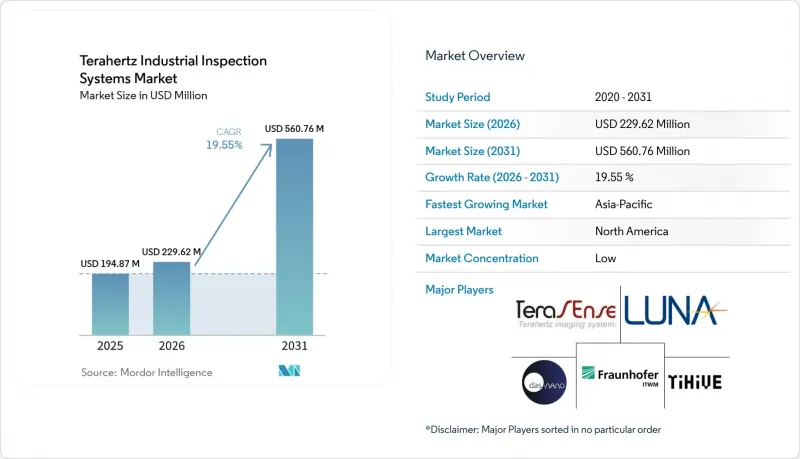
According to Mordor Intelligence, the terahertz industrial inspection systems market size was valued at USD 194.87 million in 2025 and estimated to expand from USD 229.62 million in 2026 to reach USD 560.76 million by 2031, at a CAGR of 19.55% during the forecast period (2026-2031).
Global Terahertz Industrial Inspection Systems Market Trends and Insights
Rising Demand for Non-Destructive Testing in High-Value Manufacturing
Non-destructive testing requirements in aerospace, semiconductor, and composite manufacturing are creating a clear entry point for the Terahertz Industrial Inspection Systems Market. THz inspection can replace ultrasonic C-scan methods for some fiberglass composite applications because it does not require a coupling medium. That distinction is useful in dry-assembly settings where fluid handling adds time and complexity to the process. Fraunhofer ITWM demonstrated scanners that identified defective joints, foreign bodies, air bubbles, and paint-layer variations in aircraft fiberglass panels without fluid contact. Its inline pipe system also performed 50 scans per second for wall-thickness measurement and defect mapping during continuous plastic-pipe production. These use cases strengthen the case for systems capable of inspecting composites and packaging structures while maintaining production speed.
Inline Quality Control for Coatings, Foils, and Multilayer Structures
The Terahertz Industrial Inspection Systems Market benefits from the need for coating and thickness measurement on continuous production lines. Fraunhofer ITWM reported up to 5,000 measurements per second for coating characterization and 1,600 measurements per second for multilayer structures. The reported systems cover thicknesses from 10 µm to the millimeter scale and can support applications that previously relied on contact or X-ray methods. Automotive users can use continuous paint-thickness readings to adjust spray settings during production rather than relying on manual spot checks. das-Nano installed a contactless, nondestructive paint-thickness system for plastic trim parts at BMW Group Plant Leipzig in 2026, reporting +-1 µm accuracy, 5% less material waste, and a 15% reduction in total cost. TOPTICA stated that its 8-channel T-SWEEPER configuration can provide up to 500 thickness values per second per channel, supporting broad-area inspection without a proportional increase in system footprint.
High System and Integration Cost for Early Adopters
High system and integration costs continue to limit adoption in the Terahertz Industrial Inspection Systems Market. A production-ready installation combines a THz source, detector array, motion control, processing equipment, and plant integration. First installations can also require custom fixtures, optical-path design, and links to manufacturing execution systems. These costs can match or exceed the price of the inspection instrument itself. das-Nano reported a 1.5-year return on investment, 5% lower material waste, and 3% fewer reworks for automotive deployments. Such results are most relevant to mature, high-volume lines, whereas plants with lower throughput or varied products may face longer, less certain payback periods.
Other drivers and restraints analyzed in the detailed report include:
- Semiconductor and Advanced Electronics Yield-Improvement Requirements
- AI-Enabled Defect Detection and Traceable Quality Data
- Limited Penetration Through Conductive and Highly Absorptive Materials
For complete list of drivers and restraints, kindly check the Table Of Contents.
Segment Analysis
Active terahertz imaging systems accounted for 91.21% of 2025 revenue and are expected to grow at a 21.26% CAGR through 2031. Their lead reflects the stronger resolution and signal-to-noise performance required for subsurface industrial inspection. Active systems use controlled illumination and programmable acquisition settings, which help operators adapt inspections to different materials and products. Pulsed time-domain, FMCW, and continuous-wave configurations are all included within this architecture. TOPTICA reported that its 8-channel FMCW platform can deliver up to 500 thickness values per second per channel.
Passive systems remain relevant for security and personnel screening where ambient thermal contrast can be sufficient. Their lack of an active source can reduce hardware cost and simplify the system. However, passive sensing has lower spatial resolution and slower acquisition for many production-floor tasks. It also provides less flexibility to adjust signal conditions for different materials. Passive systems are likely to remain a narrower option than active configurations for industrial process control during the forecast period.
Pulsed THz held 42.67% share of the Terahertz Industrial Inspection Systems Market in 2025, supported by broadband coverage and depth-resolved time-domain data. This technology remains useful for material characterization, multilayer delamination mapping, and pharmaceutical tablet coating assessment. Menlo Systems reported that its TeraSmart platform achieved more than 125 traces per second with a 50-picosecond time window. The platform also delivered more than 6 THz bandwidth and more than 100 dB dynamic range for demanding near-line applications. Broadband THz remains relevant where spectral fingerprints are needed for chemical and pharmaceutical identification.
Continuous-wave THz is projected to expand at a 21.89% CAGR through 2031, making it the fastest-growing technology type. Its simpler architecture does not require a femtosecond laser, which can lower cost and improve suitability for field deployment. Continuous-wave and FMCW systems fit high-speed inline tasks where a coating or thickness reading is the required output. Pulsed systems remain more suitable for detailed qualification and complex materials where spectral depth is important. This complementary pattern favors suppliers that support more than 1 technology family within the Terahertz Industrial Inspection Systems Industry.
Complete Report Scope:
- By System Architecture
- Active Terahertz Imaging Systems
- Passive Terahertz Imaging Systems
- By Technology
- Pulsed THz
- Continuous-Wave THz
- Broadband THz
- Narrowband and Tunable THz
- By Inspection Function
- Defect Detection
- Thickness and Layer Measurement
- Material Characterization
- Coating and Adhesive Inspection
- Moisture and Contamination Detection
- Structural and Dimensional Inspection
- Other Inspection Functions
- By End-User Industry
- Semiconductor and Electronics Manufacturing
- Automotive Manufacturing
- Aerospace and Defense Manufacturing
- Battery and Energy Storage Manufacturing
- Chemical and Pharmaceutical Manufacturing
- Food and Agriculture Processing
- Building Products and Infrastructure
- Other End-User Industries
- By Deployment
- Laboratory and R&D
- Offline Quality Control
- At-Line Inspection
- In-Line Production Inspection
- By Geography
- North America
- United States
- Canada
- Mexico
- South America
- Brazil
- Argentina
- Rest of South America
- Europe
- Germany
- United Kingdom
- France
- Italy
- Spain
- Rest of Europe
- Asia-Pacific
- China
- Japan
- India
- South Korea
- Rest of Asia-Pacific
- Middle East and Africa
- Middle East
- Saudi Arabia
- Turkey
- United Arab Emirates
- Rest of the Middle East
- Africa
- South Africa
- Kenya
- Rest of Africa
- Middle East
- North America
Geography Analysis
North America held 34.21% of the global Terahertz Industrial Inspection Systems Market share in 2025. The regional base includes United States semiconductor fabrication, aerospace prime contractors, and defense programs that evaluate new metrology tools. In February 2026, TeraView announced new orders and repeat support contracts from a major semiconductor foundry and a leading smartphone provider. Canada supports demand through aerospace composite maintenance and its supplier links with Bombardier and Airbus, while Mexico is emerging as electronics nearshoring encourages multinational manufacturers to apply United States and European inspection standards.
Asia-Pacific is projected to expand at a 20.98% CAGR through 2031, the fastest regional rate. China is building battery manufacturing capacity and investing in domestic semiconductor capability, which supports demand for process metrology. South Korea has a concentrated HBM and advanced packaging base, making it a significant market for THz inspection. TeraView received Korean patent protection for its automated EOTPR 4500 probing system in January 2026, and a major South Korean HBM provider expanded EOTPR capacity at its Singapore site in March 2026. Japan and ASEAN drive demand for automotive electronics and precision manufacturing, while India can gain prominence as electronics exports require dedicated quality infrastructure.
Europe has a strong position in automotive, aerospace, and chemical manufacturing, where process quality is a major purchasing consideration. Germany leads regional use through original equipment manufacturers and suppliers that are integrating paint-thickness measurement into quality systems, as das-Nano's BMW Group Plant Leipzig installation shows. The United Kingdom includes a THz research and commercial cluster centered on TeraView, which completed paid trials and an initial TeraCota sale to European aerospace and defense partners in March 2026. South America is at an earlier stage, with Brazil and Argentina providing demand through automotive and chemical subsidiaries. The Middle East and Africa offer near-term potential in defense composites and oil-and-gas pipeline inspection.
- Advantest Corporation
- Asqella Oy
- Brainware Terahertz Information Technology Co., Ltd.
- das-Nano
- Fraunhofer Institute for Industrial Mathematics ITWM
- HUBNER GmbH & Co. KG
- Insight Product Co.
- Lytid SAS
- Luna Innovations Incorporated
- MC2 Technologies
- Menlo Systems GmbH
- Microtech Instruments, Inc.
- Terahertz Technologies, Inc.
- TeraSense Group
- TeraView Limited
- Teratonics SAS
- Teralumen Solutions
- Thorlabs, Inc.
- Thruvision Group plc
- TiHive
- TOPTICA Photonics AG
Additional Benefits:
- The market estimate (ME) sheet in Excel format
- 3 months of analyst support
TABLE OF CONTENTS
1 INTRODUCTION
- 1.1 Study Assumptions and Market Definition
- 1.2 Scope of the Study
2 RESEARCH METHODOLOGY
3 EXECUTIVE SUMMARY
4 MARKET LANDSCAPE
- 4.1 Market Overview
- 4.2 Market Drivers
- 4.2.1 Rising Demand for Non-Destructive Testing in High-Value Manufacturing
- 4.2.2 Inline Quality Control for Coatings, Foils, and Multilayer Structures
- 4.2.3 Semiconductor and Advanced Electronics Yield-Improvement Requirements
- 4.2.4 AI-Enabled Defect Detection and Traceable Quality Data
- 4.2.5 Non-Ionizing Inspection Substitution for Selected X-Ray and Contact Methods
- 4.2.6 Battery Electrode and Next-Generation Material Process Control
- 4.3 Market Restraints
- 4.3.1 High System and Integration Cost for Early Adopters
- 4.3.2 Limited Penetration Through Conductive and Highly Absorptive Materials
- 4.3.3 Calibration, Reference-Standard, and Application-Engineering Complexity
- 4.3.4 Inconsistent Plant-Level ROI Evidence Outside Premium Manufacturing Lines
- 4.4 Industry Supply Chain Analysis
- 4.5 Regulatory Landscape
- 4.6 Technological Outlook
- 4.7 Impact of Macroeconomic Factors on the Market
- 4.8 Porter's Five Forces Analysis
- 4.8.1 Threat of New Entrants
- 4.8.2 Bargaining Power of Suppliers
- 4.8.3 Bargaining Power of Buyers
- 4.8.4 Threat of Substitutes
- 4.8.5 Intensity of Comptetive Rivalary
5 MARKET SIZE AND GROWTH FORECASTS (VALUE)
- 5.1 By System Architecture
- 5.1.1 Active Terahertz Imaging Systems
- 5.1.2 Passive Terahertz Imaging Systems
- 5.2 By Technology
- 5.2.1 Pulsed THz
- 5.2.2 Continuous-Wave THz
- 5.2.3 Broadband THz
- 5.2.4 Narrowband and Tunable THz
- 5.3 By Inspection Function
- 5.3.1 Defect Detection
- 5.3.2 Thickness and Layer Measurement
- 5.3.3 Material Characterization
- 5.3.4 Coating and Adhesive Inspection
- 5.3.5 Moisture and Contamination Detection
- 5.3.6 Structural and Dimensional Inspection
- 5.3.7 Other Inspection Functions
- 5.4 By End-User Industry
- 5.4.1 Semiconductor and Electronics Manufacturing
- 5.4.2 Automotive Manufacturing
- 5.4.3 Aerospace and Defense Manufacturing
- 5.4.4 Battery and Energy Storage Manufacturing
- 5.4.5 Chemical and Pharmaceutical Manufacturing
- 5.4.6 Food and Agriculture Processing
- 5.4.7 Building Products and Infrastructure
- 5.4.8 Other End-User Industries
- 5.5 By Deployment
- 5.5.1 Laboratory and R&D
- 5.5.2 Offline Quality Control
- 5.5.3 At-Line Inspection
- 5.5.4 In-Line Production Inspection
- 5.6 By Geography
- 5.6.1 North America
- 5.6.1.1 United States
- 5.6.1.2 Canada
- 5.6.1.3 Mexico
- 5.6.2 South America
- 5.6.2.1 Brazil
- 5.6.2.2 Argentina
- 5.6.2.3 Rest of South America
- 5.6.3 Europe
- 5.6.3.1 Germany
- 5.6.3.2 United Kingdom
- 5.6.3.3 France
- 5.6.3.4 Italy
- 5.6.3.5 Spain
- 5.6.3.6 Rest of Europe
- 5.6.4 Asia-Pacific
- 5.6.4.1 China
- 5.6.4.2 Japan
- 5.6.4.3 India
- 5.6.4.4 South Korea
- 5.6.4.5 Rest of Asia-Pacific
- 5.6.5 Middle East and Africa
- 5.6.5.1 Middle East
- 5.6.5.1.1 Saudi Arabia
- 5.6.5.1.2 Turkey
- 5.6.5.1.3 United Arab Emirates
- 5.6.5.1.4 Rest of the Middle East
- 5.6.5.2 Africa
- 5.6.5.2.1 South Africa
- 5.6.5.2.2 Kenya
- 5.6.5.2.3 Rest of Africa
- 5.6.5.1 Middle East
- 5.6.1 North America
6 COMPETITIVE LANDSCAPE
- 6.1 Market Concentration
- 6.2 Strategic Moves
- 6.3 Market Share Analysis
- 6.4 Company Profiles (includes Global Level Overview, Market Level Overview, Core Segments, Financials as available, Strategic Information, Market RankandShare, Products and Services, Recent Developments)
- 6.4.1 Advantest Corporation
- 6.4.2 Asqella Oy
- 6.4.3 Brainware Terahertz Information Technology Co., Ltd.
- 6.4.4 das-Nano
- 6.4.5 Fraunhofer Institute for Industrial Mathematics ITWM
- 6.4.6 HUBNER GmbH & Co. KG
- 6.4.7 Insight Product Co.
- 6.4.8 Lytid SAS
- 6.4.9 Luna Innovations Incorporated
- 6.4.10 MC2 Technologies
- 6.4.11 Menlo Systems GmbH
- 6.4.12 Microtech Instruments, Inc.
- 6.4.13 Terahertz Technologies, Inc.
- 6.4.14 TeraSense Group
- 6.4.15 TeraView Limited
- 6.4.16 Teratonics SAS
- 6.4.17 Teralumen Solutions
- 6.4.18 Thorlabs, Inc.
- 6.4.19 Thruvision Group plc
- 6.4.20 TiHive
- 6.4.21 TOPTICA Photonics AG
7 MARKET OPPORTUNITIES AND FUTURE OUTLOOK
- 7.1 White-Space and Unmet-Need Assessment

