PUBLISHER: Mordor Intelligence | PRODUCT CODE: 2116107

PUBLISHER: Mordor Intelligence | PRODUCT CODE: 2116107
Tea - Market Share Analysis, Industry Trends & Statistics, Growth Forecasts (2026 - 2031)
According to Mordor Intelligence, the tea market is expected to grow from USD 159.53 billion in 2026 to USD 214.85 billion by 2031, with a compound annual growth rate (CAGR) of 6.13% during the forecast period.
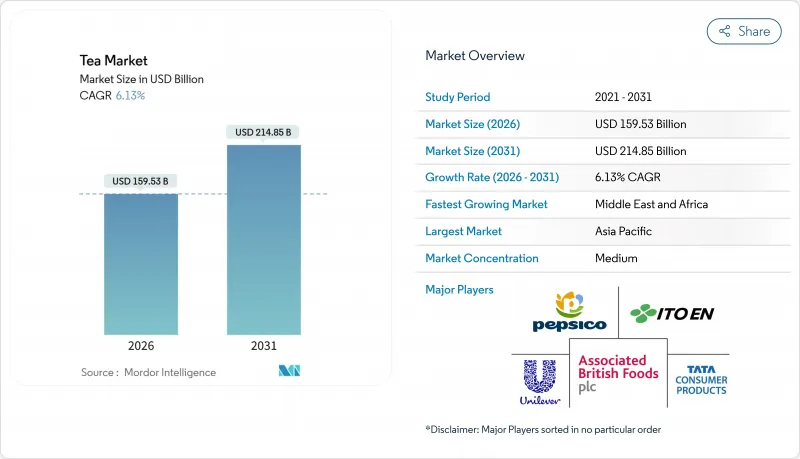
This report is Segmented by Form (Leaf Tea and CTC (Crush/Tear/Curl) Tea), Product Type (Black Tea, Green Tea, and More), Category (Conventional Tea and Organic Tea), Flavouring (Unflavoured and Flavoured), Packaging Type (Box, Bag, and More), Distribution Channel (Off-Trade and On-Trade), and Geography (North America, Europe, Asia-Pacific, and More). The Market Forecasts are Provided in Terms of Value (USD).
Global Tea Market Trends and Insights
Increased health consciousness is boosting the demand for green and herbal teas
Growing health awareness is driving the demand for green and herbal teas, as more consumers opt for beverages that offer additional health benefits beyond basic hydration. According to an article published by the Cleveland Clinic Organization in September 2024, drinking 2 to 4 cups of green tea daily can lower the risk of stroke by up to 24%. Green tea contains compounds such as catechins and L-theanine, which are known to promote heart health, enhance cognitive function, and reduce stress levels. These proven health advantages are encouraging a shift, particularly among younger and health-conscious consumers, from sugary drinks to natural, low-calorie tea options. In response to this trend, brands are expanding their product offerings to include more functional teas for issues such as weight management. For instance, in June 2025, Tetley introduced Tetley Green Tea Slim Care, which is infused with L-Carnitine to cater to the growing interest in teas that support metabolism and weight management.
Gen-Z increasingly prefers wellness teas with low caffeine or decaffeinated options.
Gen Z's focus on wellness is driving a growing demand for low-caffeine and decaffeinated teas. Younger consumers are increasingly seeking beverages that support mental health, promote better sleep quality, and alleviate stress. This trend is supported by findings from Mental Health America's 2024 Mind the Workplace report, which reveals that 71% of Gen Z employees and 59% of Millennials have poor workplace health scores. Three out of four employees in the United States report that work-related stress negatively affects their sleep. As a result, many Gen Z consumers are turning to teas that offer relaxation or calm energy without causing overstimulation. This has led to a rising interest in low-caffeine options, CO2-extracted decaffeinated teas, and herbal blends that maintain flavor while minimizing stimulant content. Brands that clearly label caffeine levels and market tea as a beverage for stress relief or evening relaxation are successfully meeting this demand.
Intense competition from coffee and other beverages
Coffee and functional beverages are increasingly limiting the growth of the tea market by capturing frequent consumption occasions and a significant share of consumer spending. This trend is particularly evident in regions like North America and Europe, where coffee has become a staple in daily routines. For instance, the National Coffee Association's Specialty Coffee Report from June 2025 revealed that 46 percent of American adults consumed specialty coffee in the past day. This highlights coffee's stronghold on morning and on-the-go consumption occasions, areas where tea has traditionally competed. Innovations in coffee products, such as single-serve pods, nitro cans, and high-caffeine cold brews, have raised consumer expectations for convenience, flavor intensity, and functional benefits. At the same time, the rise of functional beverages, such as energy drinks and protein shakes, is further dividing consumer spending in the beverage market.
Other drivers and restraints analyzed in the detailed report include:
- Tea consumption patterns and their cultural importance
- Innovation in flavors, blends, and packaging
- Regulatory challenges and import/export barriers hinder the smooth functioning of supply chains
For complete list of drivers and restraints, kindly check the Table Of Contents.
Segment Analysis
CTC (Crush, Tear, Curl) tea remains a dominant force in the tea market, primarily due to its widespread use in everyday consumption and mass-market channels. In 2025, it held a 61.25% global market share, reflecting its popularity in retail stores, foodservice outlets, and institutional catering. Its quick brewing process, strong flavor, and affordability make it a preferred choice for black tea blends, tea bags, and chai. This format is especially popular in high-demand regions, such as India, Africa, and parts of the Middle East, where it caters to large-scale consumption needs and remains a staple in the tea industry.
In contrast, leaf tea is emerging as the fastest-growing segment, driven by a shift toward premium and specialty products. This segment is projected to grow at a 6.45% CAGR through 2031, as consumers increasingly opt for whole-leaf, artisanal, and specialty teas. The growing interest in green, oolong, white, and high-quality black teas is supported by trends like cafe culture and home brewing. Leaf tea is often associated with better quality, authenticity, and health benefits, making it particularly appealing to urban and higher-income consumers who are willing to pay a premium for a superior tea experience.
Black tea continued to dominate the tea market in 2025, accounting for 41.57% of the total market share. Its popularity is driven by its strong cultural significance in regions such as India, the United Kingdom, and the Middle East, where it is an integral part of daily routines. The versatility of black tea, which pairs well with milk, sugar, and various spices, makes it a favorite for both home consumption and food service. Its availability in various formats, such as tea bags, instant tea, and ready-to-drink options, ensures its appeal across different consumer segments, from budget-friendly to premium categories.
On the other hand, herbal and fruit infusions are emerging as the fastest-growing segment in the tea market, with a projected CAGR of 7.52% through 2031. These teas are gaining traction among health-conscious consumers who prefer caffeine-free and wellness-focused beverages. Popular for their perceived benefits, such as aiding relaxation, digestion, immunity, and sleep, these infusions are particularly appealing to younger demographics. The growing demand for natural, plant-based, and clean-label products is driving their adoption in regions such as North America, Europe, and the Asia Pacific. As a result, herbal and fruit teas are transitioning from niche wellness products to mainstream retail offerings, shaping the future growth of the tea market.
Complete Report Scope:
- By Form
- Leaf Tea
- CTC (Crush/Tear/Curl) Tea
- By Product Type
- Black Tea
- Green Tea
- Oolong Tea
- Herbal and Fruit Tea Infusions
- Other Product Types
- By Category
- Conventional Tea
- Organic Tea
- By Flavouring
- Unflavoured
- Flavoured
- By Packaging Type
- Box
- Bag
- Pouch
- Sachets
- Other Packaging Type
- By Distribution Channel
- Off-Trade
- Supermarkets/Hypermarkets
- Convinience/Grocery Stores
- Online Retail Stores
- Other Distribution Channels
- On-Trade
- Off-Trade
- By Geography
- North America
- United States
- Canada
- Mexico
- Rest of North America
- South America
- Brazil
- Colombia
- Chile
- Peru
- Argentina
- Rest of South America
- Europe
- United Kingdom
- Germany
- France
- Italy
- Spain
- Poland
- Belgium
- Sweden
- Rest of Europe
- Asia-Pacific
- China
- Japan
- India
- Australia
- Indonesia
- South Korea
- Thailand
- Singapore
- Rest of Asia-Pacific
- Middle East and Africa
- South Africa
- Saudi Arabia
- United Arab Emirates
- Nigeria
- Egypt
- Morocco
- Turkey
- Rest of Middle East and Africa
- North America
Geography Analysis
Asia Pacific was the largest regional market for tea, accounting for 36.75% of the global market value by 2025. A robust production base and a long-standing tradition of tea consumption drive this dominance. China and India lead both production and demand, while Japan boosts exports of specialty teas. Southeast Asia is experiencing rapid growth in the ready-to-drink tea segment, with countries like South Korea and Australia contributing through premium imports and a thriving cafe culture. The region's focus on high-quality and certified teas ensures its central role in the tea market.
The Middle East and Africa are the fastest-growing tea markets, with a CAGR of 8.53% through 2031. Urbanization, a young population, and increasing demand for imported packaged beverages are driving this growth. Gulf countries are expanding their retail and foodservice sectors, while East Africa remains a key supplier of black tea globally. In North Africa, traditional green tea and mint blends are popular, but premium and organic teas are gaining attention among urban consumers. However, the region faces challenges such as agricultural risks and climate-related issues that could impact supply.
Europe and North America are mature tea markets but continue to grow through innovation and sustainability efforts. In Europe, stricter regulations are pushing companies to adopt recyclable and compostable packaging, which is changing product designs and shelf displays. In the United States and Canada, there is rising demand for cold-brew, ready-to-drink, and wellness-focused teas, supported by cafes, specialty stores, and online platforms. South America, though smaller in market size, is seeing increased interest in herbal and wellness teas, particularly in countries like Brazil and Chile, where health awareness is growing.
- PepsiCo Inc.
- Tata Consumer Products Ltd.
- Associated British Foods PLC
- ITO EN, Ltd.
- The Hain Celestial Group, Inc.
- Taiwan Tea Corporation
- RC Bigelow, Inc.
- Dilmah Ceylon Tea Company PLC
- DavidsTea Inc.
- Harney & Sons Fine Teas
- Apeejay Surrendra Group
- Rishi Tea & Botanicals
- Lupicia Co., Ltd.
- Kirin Holdings Co., Ltd.
- Ten Ren Tea Co.
- Unilever plc
- JAB Holding Company
- McLeod Russel India Limited
- Teekanne GmbH & Co. KG
- Numi Organic Tea
- The Republic of Tea
- Bettys & Taylors of Harrogate Ltd.
Additional Benefits:
- The market estimate (ME) sheet in Excel format
- 3 months of analyst support
TABLE OF CONTENTS
1 INTRODUCTION
- 1.1 Study Assumptions and Market Definition
- 1.2 Scope of the Study
2 RESEARCH METHODOLOGY
3 EXECUTIVE SUMMARY
4 MARKET LANDSCAPE
- 4.1 Market Overview
- 4.2 Market Drivers
- 4.2.1 Increased health consciousness is boosting the demand for green and herbal teas
- 4.2.2 Consumer preference for sustainable and ethically sourced products is driving market growth
- 4.2.3 Innovation in flavors, blends, and packaging
- 4.2.4 Gen-Z increasingly prefers wellness teas with low caffeine or decaffeinated options.
- 4.2.5 Demand for single-origin tea drives market growth
- 4.2.6 Tea consumption patterns and their cultural importance
- 4.3 Market Restraints
- 4.3.1 Intense competition from coffee and other beverages
- 4.3.2 Climate change and agricultural risks
- 4.3.3 Consumer shift toward instant and functional beverages
- 4.3.4 Regulatory challenges and import/export barriers hinder the smooth functioning of supply chains
- 4.4 Value Chain Analysis
- 4.5 Technological Outlook
- 4.6 Regulatory Outlook
- 4.7 Porter's Five Forces
- 4.7.1 Threat of New Entrants
- 4.7.2 Bargaining Power of Buyers
- 4.7.3 Bargaining Power of Suppliers
- 4.7.4 Threat of Substitute Products
- 4.7.5 Intensity of Competitive Rivalry
5 MARKET SIZE AND GROWTH FORECASTS (VALUE)
- 5.1 By Form
- 5.1.1 Leaf Tea
- 5.1.2 CTC (Crush/Tear/Curl) Tea
- 5.2 By Product Type
- 5.2.1 Black Tea
- 5.2.2 Green Tea
- 5.2.3 Oolong Tea
- 5.2.4 Herbal and Fruit Tea Infusions
- 5.2.5 Other Product Types
- 5.3 By Category
- 5.3.1 Conventional Tea
- 5.3.2 Organic Tea
- 5.4 By Flavouring
- 5.4.1 Unflavoured
- 5.4.2 Flavoured
- 5.5 By Packaging Type
- 5.5.1 Box
- 5.5.2 Bag
- 5.5.3 Pouch
- 5.5.4 Sachets
- 5.5.5 Other Packaging Type
- 5.6 By Distribution Channel
- 5.6.1 Off-Trade
- 5.6.1.1 Supermarkets/Hypermarkets
- 5.6.1.2 Convinience/Grocery Stores
- 5.6.1.3 Online Retail Stores
- 5.6.1.4 Other Distribution Channels
- 5.6.2 On-Trade
- 5.6.1 Off-Trade
- 5.7 By Geography
- 5.7.1 North America
- 5.7.1.1 United States
- 5.7.1.2 Canada
- 5.7.1.3 Mexico
- 5.7.1.4 Rest of North America
- 5.7.2 South America
- 5.7.2.1 Brazil
- 5.7.2.2 Colombia
- 5.7.2.3 Chile
- 5.7.2.4 Peru
- 5.7.2.5 Argentina
- 5.7.2.6 Rest of South America
- 5.7.3 Europe
- 5.7.3.1 United Kingdom
- 5.7.3.2 Germany
- 5.7.3.3 France
- 5.7.3.4 Italy
- 5.7.3.5 Spain
- 5.7.3.6 Poland
- 5.7.3.7 Belgium
- 5.7.3.8 Sweden
- 5.7.3.9 Rest of Europe
- 5.7.4 Asia-Pacific
- 5.7.4.1 China
- 5.7.4.2 Japan
- 5.7.4.3 India
- 5.7.4.4 Australia
- 5.7.4.5 Indonesia
- 5.7.4.6 South Korea
- 5.7.4.7 Thailand
- 5.7.4.8 Singapore
- 5.7.4.9 Rest of Asia-Pacific
- 5.7.5 Middle East and Africa
- 5.7.5.1 South Africa
- 5.7.5.2 Saudi Arabia
- 5.7.5.3 United Arab Emirates
- 5.7.5.4 Nigeria
- 5.7.5.5 Egypt
- 5.7.5.6 Morocco
- 5.7.5.7 Turkey
- 5.7.5.8 Rest of Middle East and Africa
- 5.7.1 North America
6 COMPETITIVE LANDSCAPE
- 6.1 Market Concentration
- 6.2 Strategic Moves
- 6.3 Market Ranking Analysis
- 6.4 Company Profiles (includes Global-level Overview, Market-level Overview, Core Segments, Financials (if available), Strategic Information, Market Rank/Share, Products and Services, Recent Developments)
- 6.4.1 PepsiCo Inc.
- 6.4.2 Tata Consumer Products Ltd.
- 6.4.3 Associated British Foods PLC
- 6.4.4 ITO EN, Ltd.
- 6.4.5 The Hain Celestial Group, Inc.
- 6.4.6 Taiwan Tea Corporation
- 6.4.7 RC Bigelow, Inc.
- 6.4.8 Dilmah Ceylon Tea Company PLC
- 6.4.9 DavidsTea Inc.
- 6.4.10 Harney & Sons Fine Teas
- 6.4.11 Apeejay Surrendra Group
- 6.4.12 Rishi Tea & Botanicals
- 6.4.13 Lupicia Co., Ltd.
- 6.4.14 Kirin Holdings Co., Ltd.
- 6.4.15 Ten Ren Tea Co.
- 6.4.16 Unilever plc
- 6.4.17 JAB Holding Company
- 6.4.18 McLeod Russel India Limited
- 6.4.19 Teekanne GmbH & Co. KG
- 6.4.20 Numi Organic Tea
- 6.4.21 The Republic of Tea
- 6.4.22 Bettys & Taylors of Harrogate Ltd.
7 MARKET OPPORTUNITIES AND FUTURE OUTLOOK

