PUBLISHER: Mordor Intelligence | PRODUCT CODE: 2121713

PUBLISHER: Mordor Intelligence | PRODUCT CODE: 2121713
North America Tea - Market Share Analysis, Industry Trends & Statistics, Growth Forecasts (2026 - 2031)
According to Mordor Intelligence, the North America tea market size was valued at USD 42.01 billion in 2025 and estimated to grow from USD 44.05 billion in 2026 to reach USD 55.82 billion by 2031, at a CAGR of 4.85% during the forecast period (2026-2031).
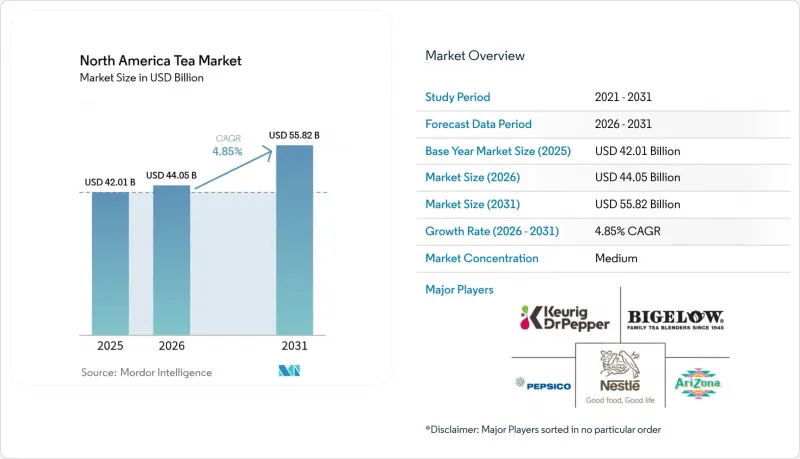
This report is Segmented by Form (Leaf Tea, CTC Granular Tea, Ready-To-Drink Tea), Product Type (Black Tea, Green Tea, Herbal Tea, Others), Flavor Profile (Unflavored, Flavored), Packaging Type (Flexible, Rigid), Distribution Channel (On-Trade, Off-Trade), and Geography (United States, Canada, Mexico, Rest of North America). The Market Forecasts are Provided in Terms of Value (USD).
North America Tea Market Trends and Insights
Expanding Consumer Emphasis on Health and Wellness
Functional tea consumption is increasingly displacing sugar-sweetened beverages as consumers prioritize bioactive compounds over empty calories. This recommendation pertains to teas made from the Camellia sinensis plant, including varieties like green, black, white, and oolong, each containing under 5 calories per 12-ounce serving, establishing tea as a legitimate choice for supporting health. According to Census Bureau statistics, 159 million Americans drink tea every day, and research suggests that consuming just two cups daily can notably lower the likelihood of heart disease and diabetes. Organic tea adoption continues to grow, as consumers associate certification with reduced pesticide residues and enhanced polyphenol content, reinforcing tea's wellness positioning. The launch of herbal and adaptogenic blends featuring ingredients such as ashwagandha and rhodiola rosea targets stress management and immune support, particularly among millennials and Gen Z who increasingly view tea as a functional beverage rather than a traditional hot drink. Innovation in cold-brew, sparkling tea, and tea-infused energy formats is expanding convenience-focused consumption without compromising health credentials. Overall, the combination of regulatory guidance, clinical evidence, and consumer demand for functional wellness strengthens tea's competitive position in the North American beverage market.
Accelerating Adoption of Organic and Natural Product Offerings
Major players in the tea industry are expanding organic and natural teas from niche offerings to mainstream products, driven by consumer preference for clean-label, pesticide-free beverages. USDA-certified organic teas, which adhere to National Organic Program standards prohibiting GMOs, synthetic chemicals, and irradiation, are commanding premium prices at retail while signaling credibility and wellness benefits. Brands are increasingly using natural flavoring systems, such as fruit extracts, essential oils, and botanical infusions, replacing artificial additives in response to clean-label mandates and FDA scrutiny. Certifications such as Rainforest Alliance and Fair Trade are often bundled with organic claims, reinforcing ethical sourcing, traceability, and sustainability to appeal to values-driven consumers. Specialty retail and e-commerce channels play a pivotal role in communicating these attributes, where storytelling and transparency enhance consumer trust and purchase intent. Overall, the convergence of organic, natural, and sustainable certifications is redefining premium tea positioning in North America, aligning wellness, ethical sourcing, and environmental responsibility with market growth.
Volatility in Raw Material Pricing and Supply Chain Disruptions
The North American tea industry continues to face notable challenges from fluctuating commodity prices and a highly sensitive supply chain. Environmental disruptions, including droughts in Kenya, floods in Assam, and frost in China's high-altitude tea regions, are creating instability in global supply and complicating procurement planning. Fertilizer shortages and geopolitical disruptions in key producing countries are further constraining production and elevating input costs for tea estates that rely on synthetic nutrients. Shipping delays and rerouted maritime logistics have added time and cost pressures, affecting landed prices and operational efficiency for importers. Currency volatility also introduces financial risk, as production expenses are incurred in local currencies while imports are invoiced in U.S. dollars, impacting profitability for brands with limited hedging strategies. These supply-side pressures disproportionately affect value-oriented segments, where consumer sensitivity limits price adjustments, while reinforcing the strategic importance of diversified sourcing, sustainable production, and premium positioning in the North American tea market.
Other drivers and restraints analyzed in the detailed report include:
- Escalating Demand for Premium and Specialty Tea Segments
- Continuous Product Innovation and Portfolio Diversification
- Intensifying Competitive Pressure from Alternative Beverage Categories
For complete list of drivers and restraints, kindly check the Table Of Contents.
Segment Analysis
The ready-to-drink (RTD) tea segment accounted for a significant 47.82% market share in 2025, reflecting strong consumer preference for grab-and-go convenience. In contrast, the leaf tea segment is projected to achieve a strong 5.85% CAGR through 2031, fueled by premiumization trends and enthusiasts who prioritize whole-leaf quality, multiple infusions, and intricate flavor profiles unavailable in mass-market tea bags. CTC (crush-tear-curl) granular teas continue to serve the value-oriented and foodservice segments, where rapid brewing and consistent strength are paramount, though growth is limited by the migration toward premium formats. RTD product innovation is accelerating through sparkling variants, reduced-sugar formulations, and functional blends incorporating botanicals, adaptogens, and probiotics to compete with kombucha and other functional beverages in refrigerated channels. Leaf tea's resurgence is particularly evident in specialty retail and e-commerce, where direct-to-consumer subscription services provide curated seasonal offerings, detailed tasting notes, and brewing guidance that foster loyalty and repeat engagement. Collectively, these dual trends highlight a market trajectory where convenience-oriented RTD products coexist with a growing appetite for premium, experiential leaf teas.
Black tea holds a commanding 70.05% share of the market in 2025, reflecting its entrenched position driven by strong consumer preferences. On the other hand, green tea is gaining momentum with a 6.27% CAGR, driven by increasing consumer focus on wellness and the adoption of functional beverages. Herbal teas attract consumers seeking caffeine-free options with functional benefits from ingredients like chamomile, peppermint, rooibos, and hibiscus, though growth faces competition from other wellness beverages offering concentrated botanical extracts. Niche varieties such as oolong, white, yellow, and pu-erh teas are gaining interest among connoisseurs who value intricate processing, terroir, and aging potential, similar to specialty coffee and fine wine enthusiasts. Japanese matcha imports surged as consumers explored ceremonial-grade distinctions, umami flavor profiles, and culinary applications in lattes, smoothies, and baked goods. Chinese oolong and Taiwanese high-mountain teas are expanding in specialty retail, where provenance storytelling and limited-edition releases support premium pricing. This diversification of tea types reflects rising consumer sophistication and willingness to explore beyond traditional black tea, creating opportunities for brands that invest in education, sampling, and immersive experiences.
Complete Report Scope:
- By Form
- Leaf Tea
- CTC (Granular) Tea
- Ready-To-Drink Tea
- By Product Type
- Black Tea
- Green Tea
- Herbal Tea
- Other(Yellow tea, oolong, white teas and others)
- By Flavor Profile
- Unflavored
- Flavored
- By Packaging Type
- Flexible (Tea Bags, Pouches)
- Rigid (Cans, Bottles, Pods)
- By Distribution Channel
- On-Trade
- Off-Trade
- Supermarkets/Hypermarkets
- Specialty Stores
- Convenience/Grocery Stores
- Online Retail Stores
- Other Distribution Channels
- By Country
- United States
- Canada
- Mexico
- Rest of North America
List of Companies Covered in this Report:
- Keurig Dr Pepper Inc.
- Nestle SA
- PepsiCo, Inc.
- Hain Celestial Group Inc.
- Arizona Beverages USA
- Tata Consumer Products
- R.C. Bigelow, Inc.
- William B. Reily & Company (Luzianne)
- Ito En Ltd.
- Bettys & Taylors Group
- DavidsTea Inc.
- Red Diamond, Inc.
- Starbucks Corp. (Teavana)
- Rishi Tea & Botanicals
- Harney & Sons Fine Teas
- The Republic of Tea
- Sound Beverages LLC
- Planting Hope Company Inc. (Argo Tea)
- Stash Tea Co.
- East West Tea Company, LLC
Additional Benefits:
- The market estimate (ME) sheet in Excel format
- 3 months of analyst support
TABLE OF CONTENTS
1 INTRODUCTION
- 1.1 Study Assumptions and Market Definition
- 1.2 Scope of the Study
2 RESEARCH METHODOLOGY
3 EXECUTIVE SUMMARY
4 MARKET DYNAMICS
- 4.1 Market Overview
- 4.2 Market Drivers
- 4.2.1 Expanding Consumer Emphasis on Health and Wellness
- 4.2.2 Accelerating Adoption of Organic and Natural Product Offerings
- 4.2.3 Escalating Demand for Premium and Specialty Tea Segments
- 4.2.4 Continuous Product Innovation and Portfolio Diversification
- 4.2.5 Growing Engagement in Experiential and Lifestyle-Oriented Tea Consumption
- 4.2.6 Strengthening Focus on Supply Chain Transparency and Sustainability Practices
- 4.3 Market Restraints
- 4.3.1 Volatility in Raw Material Pricing and Supply Chain Disruptions
- 4.3.2 Intensifying Competitive Pressure from Alternative Beverage Categories
- 4.3.3 Stringent Regulatory Compliance and Labeling Requirements
- 4.3.4 Environmental and Sustainability Risks in Tea Cultivation
- 4.4 Value/Supply Chain Analysis
- 4.5 Regulatory Landscape
- 4.6 Technological Outlook
- 4.7 Porter's Five Forces Analysis
- 4.7.1 Bargaining Power of Buyers/Consumers
- 4.7.2 Bargaining Power of Suppliers
- 4.7.3 Threat of New Entrants
- 4.7.4 Threat of Substitute Products
- 4.7.5 Intensity of Competitive Rivalry
5 MARKET SIZE AND GROWTH FORECASTS (VALUE AND VOLUME)
- 5.1 By Form
- 5.1.1 Leaf Tea
- 5.1.2 CTC (Granular) Tea
- 5.1.3 Ready-To-Drink Tea
- 5.2 By Product Type
- 5.2.1 Black Tea
- 5.2.2 Green Tea
- 5.2.3 Herbal Tea
- 5.2.4 Other(Yellow tea, oolong, white teas and others)
- 5.3 By Flavor Profile
- 5.3.1 Unflavored
- 5.3.2 Flavored
- 5.4 By Packaging Type
- 5.4.1 Flexible (Tea Bags, Pouches)
- 5.4.2 Rigid (Cans, Bottles, Pods)
- 5.5 By Distribution Channel
- 5.5.1 On-Trade
- 5.5.2 Off-Trade
- 5.5.2.1 Supermarkets/Hypermarkets
- 5.5.2.2 Specialty Stores
- 5.5.2.3 Convenience/Grocery Stores
- 5.5.2.4 Online Retail Stores
- 5.5.2.5 Other Distribution Channels
- 5.6 By Country
- 5.6.1 United States
- 5.6.2 Canada
- 5.6.3 Mexico
- 5.6.4 Rest of North America
6 COMPETITIVE LANDSCAPE
- 6.1 Market Concentration
- 6.2 Strategic Moves
- 6.3 Market Share Analysis
- 6.4 Company Profiles (includes Global level Overview, Market level overview, Core Segments, Financials as available, Strategic Information, Market Rank/Share for key companies, Products & Services, and Recent Developments)
- 6.4.1 Keurig Dr Pepper Inc.
- 6.4.2 Nestle SA
- 6.4.3 PepsiCo, Inc.
- 6.4.4 Hain Celestial Group Inc.
- 6.4.5 Arizona Beverages USA
- 6.4.6 Tata Consumer Products
- 6.4.7 R.C. Bigelow, Inc.
- 6.4.8 William B. Reily & Company (Luzianne)
- 6.4.9 Ito En Ltd.
- 6.4.10 Bettys & Taylors Group
- 6.4.11 DavidsTea Inc.
- 6.4.12 Red Diamond, Inc.
- 6.4.13 Starbucks Corp. (Teavana)
- 6.4.14 Rishi Tea & Botanicals
- 6.4.15 Harney & Sons Fine Teas
- 6.4.16 The Republic of Tea
- 6.4.17 Sound Beverages LLC
- 6.4.18 Planting Hope Company Inc. (Argo Tea)
- 6.4.19 Stash Tea Co.
- 6.4.20 East West Tea Company, LLC
7 MARKET OPPORTUNITIES AND FUTURE OUTLOOK

