PUBLISHER: Mordor Intelligence | PRODUCT CODE: 2116275

PUBLISHER: Mordor Intelligence | PRODUCT CODE: 2116275
Germany E-Brokerage - Market Share Analysis, Industry Trends & Statistics, Growth Forecasts (2026 - 2031)
According to Mordor Intelligence, the Germany e-brokerage market size was valued at USD 1.00 billion in 2025 and estimated to grow from USD 1.06 billion in 2026 to reach USD 1.41 billion by 2031, at a CAGR of 5.95% during the forecast period (2026-2031).
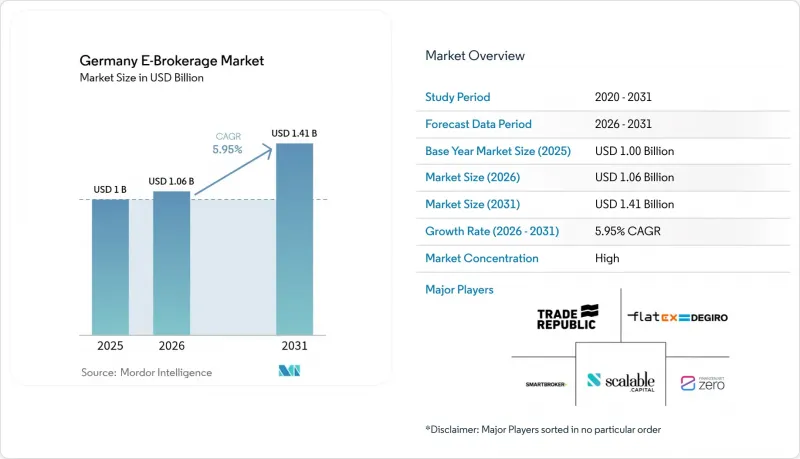
This report is Segmented by Investor Type (Retail, Institutional), Services Offered (Full-Time Brokers, Discount Brokers), Operation (Domestic, Foreign), and Geography (North Germany, South Germany, East Germany, West Germany, Central Germany). The Market Forecasts are Provided in Terms of Value (USD).
Germany E-Brokerage Market Trends and Insights
Surge in Zero-Commission Models Attracting First-Time Investors
Zero-commission trading eliminated entry barriers and pulled millions of price-sensitive Germans into the capital markets. Brokers that relied on PFOF revenue must now replace lost income ahead of the 2026 ban, prompting moves such as Scalable Capital's proprietary exchange launch that captures spreads directly. The transition introduces pricing uncertainty but also incentivizes innovation in subscription tiers and cash-management products. BaFin studies indicate that PFOF gave favourable execution for small orders, yet larger trades faced quality concerns. Platforms able to pivot quickly are positioned to capture share once commissions resurface, while late movers risk margin compression.
Generational Shift to Mobile-First Investing Apps
Younger users trade more frequently, diversify faster, and show a greater appetite for crypto and derivatives than older cohorts. BaFin has warned that behavioural nudges in app design can distort decision-making, pushing brokers to refine interfaces that prioritize investor protection. Traditional banks are facing ongoing challenges in addressing usability gaps, which continues to bolster the competitive advantage of digital-native players. In Germany, the aging population is expected to serve as a key driver of transformation within the e-brokerage market. Their shifting preferences are projected to influence platform design standards significantly, setting new industry benchmarks. This demographic trend is also likely to impact market strategies, compelling service providers to innovate and adapt to meet the evolving demands of this growing consumer segment.
EU Ban on Payment-for-Order-Flow Shrinking Revenue Pools
From 2026, brokers in the German e-brokerage market will face the elimination of Payment for Order Flow (PFOF) as a revenue source, which has historically supported zero-commission trading models. This regulatory shift is prompting firms to explore alternative strategies to offset the financial impact. For instance, Scalable Capital has launched its own exchange, demonstrating a proactive approach to recapturing lost revenue streams. Such initiatives reflect a broader trend within the industry toward innovation and adaptation in response to regulatory changes. However, market makers have expressed concerns that integrated trading venues may replicate the conflicts of interest previously associated with PFOF, potentially attracting stricter regulatory oversight. This development highlights the growing urgency for brokers to diversify their revenue models to maintain competitiveness and ensure long-term financial stability in an increasingly regulated market environment.
Other drivers and restraints analyzed in the detailed report include:
- BaFin's Proportionality Initiative Cutting Compliance Costs for Small Brokers
- Pension Reform Introducing Equity-Fund Retirement Pillar
- Cyber-Incidents & Platform Outages Triggering Regulatory Scrutiny
For complete list of drivers and restraints, kindly check the Table Of Contents.
Segment Analysis
Retail investors held 73.98% of Germany's e-brokerage market size in 2025 as digital platforms removed cost and knowledge barriers. The segment is projected to rise at 16.05% CAGR through 2031, buoyed by fractional investing and intuitive mobile design that encourages first-time participation. Younger users conduct more trades and adopt a broader array of products, including crypto and derivatives, than institutional clients. Brokers meet their needs with gamified interfaces and real-time educational content, although regulators scrutinize possible behavioural manipulation. The institutional segment remains stable, leveraging e-brokerage for cost-efficient execution and accessing alternative asset classes outside traditional prime brokerage. MiFID II best-execution rules drive venue diversification, ensuring the continued relevance of electronic brokers.
The evolving dynamics of retail growth are driving a strategic shift in product development, with a heightened focus on integrating micro-investment functionalities and recurring ETF plans designed to accommodate smaller, consistent monthly contributions. Concurrently, institutional clients are demonstrating a growing demand for sophisticated capabilities, including advanced order-routing mechanisms, comprehensive analytics, and access to exclusive liquidity pools. These requirements are fostering the creation of premium service tiers tailored to meet the complex needs of institutional participants. Although institutional trading volumes are relatively lower, their flows contribute significantly to enhancing market depth and stabilizing bid-ask spreads, thereby improving overall market efficiency and quality. Additionally, regulatory frameworks aimed at safeguarding retail investors are exerting a considerable influence on platform design, particularly in areas such as disclosure practices and risk management protocols. These regulatory considerations are shaping architectural decisions that address the distinct requirements of both retail and institutional customer segments.
Complete Report Scope:
- By Investor Type
- Retail
- Institutional
- By Services Offered
- Full-Time Brokers
- Discount Brokers
- By Operation
- Domestic
- Foreign
- By Region
- North Germany
- South Germany
- East Germany
- West Germany
- Central Germany
List of Companies Covered in this Report:
- Trade Republic GmbH
- flatexDEGIRO AG
- Scalable Capital Broker GmbH
- finanzen.net ZERO (Gratisbroker AG)
- Smartbroker Plus (wallstreet:online broker GmbH)
- justTRADE (JT Technologies GmbH)
- Comdirect Bank AG
- Consorsbank (BNP Paribas S.A. NL Deutschland)
- ING Deutschland (ING-DiBa AG)
- DKB AG
- S Broker AG & Co. KG
- Tradegate Exchange GmbH
- Baader Bank AG (gettex)
- Deutsche Bank AG (maxblue)
- Targobank AG
- CapTrader GmbH
- XTB Deutschland GmbH
- eToro (Europe) Ltd. Germany Branch
- Plus500 Germany
- justTRADE (JT Technologies GmbH)
- lemon.markets
Additional Benefits:
- The market estimate (ME) sheet in Excel format
- 3 months of analyst support
TABLE OF CONTENTS
1 Introduction
- 1.1 Study Assumptions & Market Definition
- 1.2 Scope of the Study
2 Research Methodology
3 Executive Summary
4 Market Landscape
- 4.1 Market Overview
- 4.2 Market Drivers
- 4.2.1 Surge in zero-commission models attracting first-time investors
- 4.2.2 Generational shift to mobile-first investing apps
- 4.2.3 BaFin's proportionality initiative cutting compliance costs for small brokers
- 4.2.4 2.25 %+ cash-interest offers pulling deposits from legacy banks
- 4.2.5 Integration of fractional-share APIs enabling EUR 1 micro-investments
- 4.2.6 Pension reform introducing equity-fund retirement pillar
- 4.3 Market Restraints
- 4.3.1 EU ban on payment-for-order-flow shrinking revenue pools
- 4.3.2 Cyber-incidents & platform outages triggering regulatory scrutiny
- 4.3.3 Rising retail risk-aversion amid macro-uncertainty
- 4.3.4 Shortage of cloud/IT talent slowing platform scalability
- 4.4 Value / Supply-Chain Analysis
- 4.5 Regulatory Landscape
- 4.6 Technological Outlook
- 4.7 Porter's Five Forces
- 4.7.1 Bargaining Power of Buyers
- 4.7.2 Bargaining Power of Suppliers
- 4.7.3 Threat of New Entrants
- 4.7.4 Threat of Substitutes
- 4.7.5 Competitive Rivalry
5 Market Size & Growth Forecasts
- 5.1 By Investor Type
- 5.1.1 Retail
- 5.1.2 Institutional
- 5.2 By Services Offered
- 5.2.1 Full-Time Brokers
- 5.2.2 Discount Brokers
- 5.3 By Operation
- 5.3.1 Domestic
- 5.3.2 Foreign
- 5.4 By Region
- 5.4.1 North Germany
- 5.4.2 South Germany
- 5.4.3 East Germany
- 5.4.4 West Germany
- 5.4.5 Central Germany
6 Competitive Landscape
- 6.1 Market Concentration
- 6.2 Strategic Moves & Developments
- 6.3 Market Share Analysis
- 6.4 Company Profiles (includes Global level Overview, Market level overview, Core Segments, Financials as available, Strategic Information, Market Rank/Share for key companies, Products & Services, and Recent Developments)
- 6.4.1 Trade Republic GmbH
- 6.4.2 flatexDEGIRO AG
- 6.4.3 Scalable Capital Broker GmbH
- 6.4.4 finanzen.net ZERO (Gratisbroker AG)
- 6.4.5 Smartbroker Plus (wallstreet:online broker GmbH)
- 6.4.6 justTRADE (JT Technologies GmbH)
- 6.4.7 Comdirect Bank AG
- 6.4.8 Consorsbank (BNP Paribas S.A. NL Deutschland)
- 6.4.9 ING Deutschland (ING-DiBa AG)
- 6.4.10 DKB AG
- 6.4.11 S Broker AG & Co. KG
- 6.4.12 Tradegate Exchange GmbH
- 6.4.13 Baader Bank AG (gettex)
- 6.4.14 Deutsche Bank AG (maxblue)
- 6.4.15 Targobank AG
- 6.4.16 CapTrader GmbH
- 6.4.17 XTB Deutschland GmbH
- 6.4.18 eToro (Europe) Ltd. Germany Branch
- 6.4.19 Plus500 Germany
- 6.4.20 justTRADE (JT Technologies GmbH)
- 6.4.21 lemon.markets
7 Market Opportunities & Future Outlook
- 7.1 Embedded brokerage-as-a-service partnerships with digital ecosystems
- 7.2 Return-generating crypto staking & tokenized-asset offerings under MiCAR

