PUBLISHER: Mordor Intelligence | PRODUCT CODE: 2116288

PUBLISHER: Mordor Intelligence | PRODUCT CODE: 2116288
United Kingdom Mattress - Market Share Analysis, Industry Trends & Statistics, Growth Forecasts (2026 - 2031)
According to Mordor Intelligence, the United Kingdom mattress market size was valued at USD 1.41 billion in 2025 and estimated to grow from USD 1.45 billion in 2026 to reach USD 1.66 billion by 2031, at a CAGR of 2.74% during the forecast period (2026-2031).
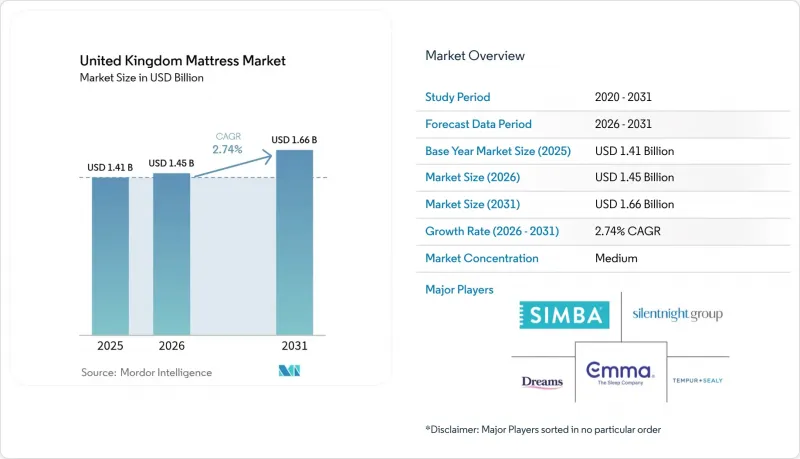
This report is Segmented by Product Type (Innerspring/Coil, Foam, Latex, Hybrid, Other Types), Mattress Size (Single, Double, Queen, King, Custom & Specialty), End User (Residential, Commercial), Distribution Channel (B2C/Retail, B2B/Project), and Geography (England, Scotland, Wales, Northern Ireland). The Market Forecasts are Provided in Terms of Value (USD).
United Kingdom Mattress Market Trends and Insights
Persistently High Replacement Demand Driven by UK Homeowners' Renovation Cycles
British homeowners continue to postpone mattress replacements well beyond the seven-year guideline, leaving pent-up demand that releases when households renovate, relocate, or invest in wellness upgrades. The Travelodge UK Mattress Census notes that 31% of adults sleep on mattresses beyond the recommended lifespan and 10% keep them up to 20 years, even though 43% report discomfort and 20% experience morning aches. Property transactions typically trigger a mattress upgrade within 18 months, ensuring a steady rhythm of replacement sales. Post-pandemic emphasis on the bedroom as a restorative retreat further elevates sleep-quality spending. Consumer-education campaigns by retailers and the National Bed Federation underline the health costs of over-aged sleep surfaces, creating long-run replacement tailwinds.
Proliferation of E-commerce Bed-in-a-Box Brands Reshaping Buying Behavior
Direct-to-consumer innovators such as Emma Sleep, Simba, and Eve Sleep command roughly 5% of the United Kingdom mattress market, having broken the showroom dependency by compressing foam mattresses into easily delivered boxes and backing sales with 90- to 365-day trials. Convenience, price transparency, and friction-free returns resonate with digital natives, and analysts project the online cohort's share could quadruple within three years. Traditional retailers have responded by rolling out their own-brand boxed ranges, upgrading websites, and offering click-and-collect. Yet customer-acquisition costs above 30% of revenue challenge e-commerce profitability, fueling consolidation moves such as Simba's 2025 sale to Sleep Country. CMA scrutiny of online urgency tactics now obliges clearer pricing, nudging bed-in-a-box firms toward sustainable growth models.
Cost Inflation in Polyurethane & Steel Springs Squeezing Mid-Tier Margins
Foam costs face upward pressure amid a planned Carpenter-Recticel merger that would consolidate one of only three UK producers and risk price hikes in comfort foam supply, according to CMA concerns. January 2025 producer-price data showed input prices virtually flat while output prices crept up 0.3%, illustrating manufacturers' limited headroom to absorb raw-material spikes. Mid-tier brands lack the premium pricing power of luxury labels and the scale efficiencies of mass-market players, so margin compression is acute. Steel-coil prices, governed by volatile global scrap and energy costs, further strain innerspring models, which still account for 41.29% of sales. Manufacturers, therefore, accelerate vertical integration or lean toward hybrid and foam lines with lower metal intensity.
Other drivers and restraints analyzed in the detailed report include:
- Hospitality Refurbishment Surge Ahead of Major 2028 UK Tourism Events
- ESG-Linked Procurement by Large Retailers Favoring Low-Carbon Mattresses
- Heightened CMA Scrutiny of Online Discounting Tactics Dampening Flash-Sale Volumes
For complete list of drivers and restraints, kindly check the Table Of Contents.
Segment Analysis
In 2025, innerspring units secured 40.85% share of the United Kingdom mattress market size through consumer familiarity with coil support and perceived longevity. Foam lines, however, hold the growth crown at a 3.02% CAGR, buoyed by memory-foam refinements that address heat retention and durability complaints. Hybrid models blending coils with foam comfort layers gain traction among shoppers seeking balanced support, while latex remains a premium eco-niche. Manufacturers are improving flexible polyurethane foam's resilience and airflow, with EUROPUR research highlighting advancements that extend usable life and enhance ergonomic conformity. Compliance with BS 7177 fire-safety requirements affects all types, but foam producers shoulder added reformulation costs to replace restricted flame-retardants, lifting average selling prices.
Foam's ascendancy intertwines with the bed-in-a-box phenomenon because compressibility favors all-foam cores. As e-commerce adoption widens, foam suppliers secure scale leverage and invest in low-VOC chemistries that appeal to ESG-driven buyers. In contrast, innerspring lines leverage differentiated coil counts and zoning to maintain relevance, especially within traditional showroom environments. Marketing now stresses hybrid comfort benefits such as edge support and temperature neutrality. Altogether, innovation paths diverge: foam specialists chase material science gains, while coil manufacturers focus on optimizing steel-usage efficiency and recyclability.
King-size mattresses dominated with 37.12% market share in 2025, reflecting UK housing trends toward larger bedrooms and consumer willingness to invest in premium sleep experiences. Queen-size variants are experiencing the fastest growth at 3.46% CAGR through 2031, driven by urban apartment living constraints that balance space optimization with comfort preferences. Double-size mattresses maintain steady demand in guest rooms and smaller accommodations, while single-size options serve children's rooms and budget-conscious consumers. Custom and specialty sizes address niche requirements, including extra-long variants for tall individuals and bespoke dimensions for unique bed frames.
Housing stock evolution underpins shifting size preferences. High-density city projects constrain room dimensions, channeling incremental demand toward queen formats. Conversely, suburban expansions with generous layouts preserve king-size preeminence. Manufacturing efficiency favors standard sizing, yet bespoke extra-long orders are rising among taller demographics. Retailers increasingly market split-firmness king models to address partner comfort mismatches, blending luxury cues with personalization.
Complete Report Scope:
- By Product Type
- Innerspring / Coil
- Foam (including memory foam)
- Latex
- Hybrid
- Other Mattress Types
- By Mattress Size
- Single-size Mattress
- Double-size Mattress
- Queen-size Mattress
- King-size Mattress
- Custom & Specialty Sizes
- By End User
- Residential
- Commercial
- By Distribution Channel
- B2C/Retail
- Mass Merchandisers
- Specialty Mattress Stores (including exclusive brand outlets)
- Online
- Other Distribution Channels
- B2B/Project
- B2C/Retail
- By Geography
- England
- Scotland
- Wales
- Northern Ireland
List of Companies Covered in this Report:
- Dreams
- Silentnight Group
- Tempur Sealy UK
- Emma - The Sleep Company
- Simba Sleep
- Harrison Spinks
- Sleepeezee
- Hypnos Beds
- Eve Sleep
- Dormeo
- Vispring
- Brook + Wilde
- OTTY Sleep
- Nectar Sleep (Resident)
- Highgrove Beds
- Sweet Dreams
- Rest Assured
- Millbrook Beds
- Relyon
- Jay-Be
- Warren Evans
Additional Benefits:
- The market estimate (ME) sheet in Excel format
- 3 months of analyst support
TABLE OF CONTENTS
1 Introduction
- 1.1 Study Assumptions & Market Definition
- 1.2 Scope of the Study
2 Research Methodology
3 Executive Summary
4 Market Landscape
- 4.1 Market Overview
- 4.2 Market Drivers
- 4.2.1 Persistently High Replacement Demand Driven By UK Homeowners- Renovation Cycles
- 4.2.2 Proliferation Of E-Commerce Bed-In-A-Box Brands Reshaping Buying Behaviour
- 4.2.3 Hospitality Re-Furbishment Surge Ahead Of Major 2028 UK Tourism Events
- 4.2.4 ESG-Linked Procurement By Large Retailers Favouring Low-Carbon Mattresses
- 4.2.5 Build-To-Rent Furnishing Schemes And Mattress-Subscription Models Unlocking Recurring Demand
- 4.2.6 Ageing-In-Place Drives Uptake Of Pressure-Relief Home-Care Mattresses
- 4.3 Market Restraints
- 4.3.1 Cost-Inflation In Polyurethane & Steel Springs Squeezing Mid-Tier Margins
- 4.3.2 Heightened Cma Scrutiny Of Online Discounting Tactics Dampening Flash-Sale Volumes
- 4.3.3 Second-Hand/Grey-Market Influx From Large-Scale Refurb Projects Cannibalising First-Sales
- 4.3.4 Stricter UK Fire-Retardant Chemical Limits Raising Reformulation Costs For Foam Producers
- 4.4 Industry Value Chain Analysis
- 4.5 Porter's Five Forces
- 4.5.1 Threat of New Entrants
- 4.5.2 Bargaining Power of Suppliers
- 4.5.3 Bargaining Power of Buyers
- 4.5.4 Threat of Substitute Products
- 4.5.5 Intensity of Rivalry
- 4.6 Insights into the Latest Trends and Innovations in the Market
- 4.7 Insights on Recent Developments (New Product Launches, Strategic Initiatives, Investments, Partnerships, JVs, Expansion, M&As, etc.) in the Industry
- 4.8 Insights on Consumer Behavior Analysis and Preferences in the Market (key motivational factors, preferred sales channel, demographics, key influencers and decision-makers)
5 Market Size & Growth Forecasts (Value in USD)
- 5.1 By Product Type
- 5.1.1 Innerspring / Coil
- 5.1.2 Foam (including memory foam)
- 5.1.3 Latex
- 5.1.4 Hybrid
- 5.1.5 Other Mattress Types
- 5.2 By Mattress Size
- 5.2.1 Single-size Mattress
- 5.2.2 Double-size Mattress
- 5.2.3 Queen-size Mattress
- 5.2.4 King-size Mattress
- 5.2.5 Custom & Specialty Sizes
- 5.3 By End User
- 5.3.1 Residential
- 5.3.2 Commercial
- 5.4 By Distribution Channel
- 5.4.1 B2C/Retail
- 5.4.1.1 Mass Merchandisers
- 5.4.1.2 Specialty Mattress Stores (including exclusive brand outlets)
- 5.4.1.3 Online
- 5.4.1.4 Other Distribution Channels
- 5.4.2 B2B/Project
- 5.4.1 B2C/Retail
- 5.5 By Geography
- 5.5.1 England
- 5.5.2 Scotland
- 5.5.3 Wales
- 5.5.4 Northern Ireland
6 Competitive Landscape
- 6.1 Market Concentration
- 6.2 Strategic Moves
- 6.3 Market Share Analysis
- 6.4 Company Profiles (includes Global level Overview, Market level overview, Core Segments, Financials as available, Strategic Information, Market Rank/Share for key companies, Products & Services, and Recent Developments)
- 6.4.1 Dreams
- 6.4.2 Silentnight Group
- 6.4.3 Tempur Sealy UK
- 6.4.4 Emma - The Sleep Company
- 6.4.5 Simba Sleep
- 6.4.6 Harrison Spinks
- 6.4.7 Sleepeezee
- 6.4.8 Hypnos Beds
- 6.4.9 Eve Sleep
- 6.4.10 Dormeo
- 6.4.11 Vispring
- 6.4.12 Brook + Wilde
- 6.4.13 OTTY Sleep
- 6.4.14 Nectar Sleep (Resident)
- 6.4.15 Highgrove Beds
- 6.4.16 Sweet Dreams
- 6.4.17 Rest Assured
- 6.4.18 Millbrook Beds
- 6.4.19 Relyon
- 6.4.20 Jay-Be
- 6.4.21 Warren Evans
7 Market Opportunities & Future Outlook
- 7.1 Circular Economy & Mattress Recycling (Buy-Back) Programs
- 7.2 Smart & Connected Sleep Solutions
- 7.3 Premium Wellness-Oriented Sleep Experiences

