PUBLISHER: Mordor Intelligence | PRODUCT CODE: 2125725

PUBLISHER: Mordor Intelligence | PRODUCT CODE: 2125725
Europe Sustainable Mattress - Market Share Analysis, Industry Trends & Statistics, Growth Forecasts (2026 - 2031)
According to Mordor Intelligence, the Europe sustainable mattress market size is expected to grow from USD 2.77 billion in 2025 to USD 2.97 billion in 2026 and is forecast to reach USD 4.19 billion by 2031 at 7.14% CAGR over 2026-2031.
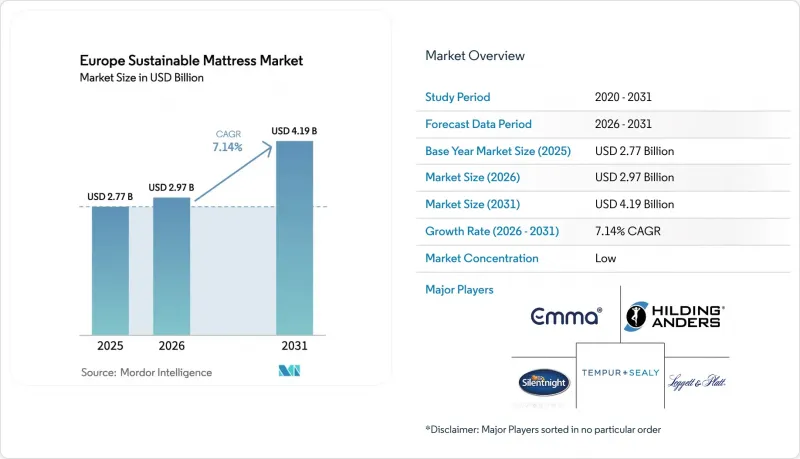
This report is Segmented by Raw Material (Organic Cotton, Wool, Latex, and More), Size (Single, Double, and More), End-User (Residential and Commercial), Distribution Channel (B2C/Retail Consumers, and B2B/Directly From the Manufacturers), and Geography (United Kingdom, Germany and More). The Market Forecasts are Provided in Terms of Value (USD).
Europe Sustainable Mattress Market Trends and Insights
Rising Environmental Awareness Among European Consumers
Europeans consider sustainability important and are buying eco-friendly products, indicating a shift toward low-impact goods. Eighty-six percent of Europeans consider sustainability important, and 29% actively purchase eco-friendly products, indicating a shift toward low-impact goods. Mattress decisions carry added weight because of long replacement cycles and intimate health links, letting brands translate environmental storytelling into palpable value. QR-code product passports and material origin disclosures resonate strongly with digital-native buyers. Austria's public-sector push to cut healthcare carbon footprints reinforces the trend, pulling sustainable choices into residential channels.
Stringent EU Circular-Economy & Ecolabel Policies
The Ecodesign for Sustainable Products Regulation (ESPR) makes mattresses an early priority, obligating digital passports that record composition, recyclability, and end-of-life routes by 2027. Producers such as Aquinos Bedding plan to tag 1 million units via QR and RFID to pre-empt the deadline. EU Ecolabel certification, covering more than 102,000 products, confers brand distinction yet imposes documentation costs that favour scale operators' environment. France, Belgium, and the Netherlands require certified recycling for discarded mattresses, stimulating downstream infrastructure investment. From July 2026, large enterprises may no longer destroy unsold stock, catalyzing circular designs across the value chain.
High Price Premium Vs Conventional Mattresses
Retail tags for sustainable lines sit 40-60% above synthetic foam models, creating affordability tension in price-sensitive regions. The gap stems from costlier inputs, ecolabel audits, and sub-scale runs. Purchase intent surveys show enthusiasm outrunning real conversion when budgets tighten. Financing plans and entry-level models target fence-sitters, yet maintaining margins while lowering ticket prices remains difficult. Economic headwinds, therefore, dampen near-term acceleration in the sustainable mattress market.
Other drivers and restraints analyzed in the detailed report include:
- Premiumisation & Wellness-Oriented Spending On Sleep Products
- Expansion Of D2C E-Commerce Logistics & "Bed-In-A-Box" Models
- Volatile Pricing & Supply of Natural Latex / Organic Fibres
For complete list of drivers and restraints, kindly check the Table Of Contents.
Segment Analysis
Latex commanded 31.65% of the sustainable mattress market share in 2025, reflecting consumer trust in its durability, breathability, and antimicrobial qualities. Upcycled latex is forecast to climb as chemical-recycling processes from Aarhus University enter commercial production, recovering feedstock at industrial yields. The sustainable mattress market size for latex-based units is projected to widen in line with regulatory preferences for biodegradable content. Wool maintains an eco-friendly niche as buyers value moisture control and thermal regulation. Coconut fibre and hemp fill plant-based propositions, whereas Liege University's biobased polyurethane foams introduce isocyanate-free alternatives that cure in under two minutes.
Demand patterns vary across Europe. Nordic consumers, who post longer replacement cycles, gravitate to latex because of durability. Southern markets on tighter budgets prefer blended constructions that temper cost without sacrificing ecolabel eligibility. Suppliers adopt multi-material layering designed for easier disassembly, supporting future recycling mandates while preserving comfort profiles. Leading producers also integrate QR-enabled passports that disclose exact latex origin, verifying sustainable forestry and fair-labour compliance.
Queen units held 39.20% of volume in 2025, benefiting from standardised European bed frames and urban floor-space limits. The sustainable mattress market size for queen offerings remains sizable through 2031, even as king models surge. King formats show 8.55% CAGR because affluent buyers associate a larger surface area with superior sleep wellness. Northern European homes, which feature bigger bedrooms, accelerate the shift. Manufacturers reinforce king uptake with bundling promotions that pair mattresses with adjustable slatted bases made from certified timber, enhancing perceived value.
Single and double mattresses attract students and city dwellers with compact rooms. The segment retains relevance amid mounting urbanization, yet grows modestly compared to premium sizes. Custom dimensions cater to high-end renovation projects and accessible-housing retrofits, providing a small but steady revenue stream. BekaertDeslee's Balance cover technology tailors stretch and breathability ratios to specific thicknesses, illustrating innovation even within traditional size lines.
Complete Report Scope:
- By Raw Material
- Organic Cotton
- Wool
- Latex
- Other Raw Materials (coconut fiber, hemp, etc.)
- By Size
- Single
- Double
- Queen
- King
- Other Sizes
- By End-User
- Residential
- Commercial
- By Distribution Channel
- B2B/Directly from the Manufacturers
- B2C/Retail Consumers
- Specialty Bedding and Mattress Stores
- Multi-brand Stores/Home Centers
- Online
- Other Distribution Channels
- By Geography
- United Kingdom
- Germany
- France
- Spain
- Italy
- BENELUX (Belgium, Netherlands, and Luxembourg)
- NORDICS (Denmark, Finland, Iceland, Norway, and Sweden)
- Rest of Europe
List of Companies Covered in this Report:
- Emma Sleep GmbH
- Tempur Sealy International Inc.
- Leggett & Platt Incorporated
- Relyon Beds Limited
- Kingsdown Inc.
- Silentnight Group
- Hilding Anders International AB
- Simba Sleep Limited
- Hypnos Beds Ltd
- Naturalmat
- Harrison Spinks
- Dormeo
- Vita Group
- Kipli
- Sweetnight
- Dunlopillo GmbH
- Hastens
- Little Green Sheep
- Tuft & Springs
- Naturalist
- Auping
- Vispring
Additional Benefits:
- The market estimate (ME) sheet in Excel format
- 3 months of analyst support
TABLE OF CONTENTS
1 Introduction
- 1.1 Study Assumptions & Market Definition
- 1.2 Scope of the Study
2 Research Methodology
3 Executive Summary
4 Market Landscape
- 4.1 Market Overview
- 4.2 Market Drivers
- 4.2.1 Rising Environmental Awareness Among European Consumers
- 4.2.2 Stringent EU Circular-Economy & Ecolabel Policies
- 4.2.3 Premiumisation & Wellness-Oriented Spending On Sleep Products
- 4.2.4 Expansion Of D2C E-Commerce Logistics & "Bed-In-A-Box" Models
- 4.2.5 Breakthrough Chemical-Recycling Pilots For PU Mattress Foam
- 4.2.6 ESG-Driven Procurement In Healthcare & Hospitality Chains
- 4.3 Market Restraints
- 4.3.1 High Price Premium Vs Conventional Mattresses
- 4.3.2 Volatile Pricing & Supply Of Natural Latex / Organic Fibres
- 4.3.3 Complex Multi-Material Construction Limits Recyclability
- 4.4 Industry Value Chain Analysis
- 4.5 Porter's Five Forces Analysis
- 4.5.1 Threat of New Entrants
- 4.5.2 Bargaining Power of Suppliers
- 4.5.3 Bargaining Power of Buyers
- 4.5.4 Threat of Substitutes
- 4.5.5 Competitive Rivalry
- 4.6 Insights into the Latest Trends and Innovations in the Market
- 4.7 Insights on Recent Developments (New Product Launches, Strategic Initiatives, Investments, Partnerships, JVs, Expansion, M&As, etc.) in the Market
5 Market Size & Growth Forecasts (Value)
- 5.1 By Raw Material
- 5.1.1 Organic Cotton
- 5.1.2 Wool
- 5.1.3 Latex
- 5.1.4 Other Raw Materials (coconut fiber, hemp, etc.)
- 5.2 By Size
- 5.2.1 Single
- 5.2.2 Double
- 5.2.3 Queen
- 5.2.4 King
- 5.2.5 Other Sizes
- 5.3 By End-User
- 5.3.1 Residential
- 5.3.2 Commercial
- 5.4 By Distribution Channel
- 5.4.1 B2B/Directly from the Manufacturers
- 5.4.2 B2C/Retail Consumers
- 5.4.2.1 Specialty Bedding and Mattress Stores
- 5.4.2.2 Multi-brand Stores/Home Centers
- 5.4.2.3 Online
- 5.4.2.4 Other Distribution Channels
- 5.5 By Geography
- 5.5.1 United Kingdom
- 5.5.2 Germany
- 5.5.3 France
- 5.5.4 Spain
- 5.5.5 Italy
- 5.5.6 BENELUX (Belgium, Netherlands, and Luxembourg)
- 5.5.7 NORDICS (Denmark, Finland, Iceland, Norway, and Sweden)
- 5.5.8 Rest of Europe
6 Competitive Landscape
- 6.1 Market Concentration
- 6.2 Strategic Moves
- 6.3 Market Share Analysis
- 6.4 Company Profiles {(includes Global level Overview, Market level overview, Core Segments, Financials as available, Strategic Information, Market Rank/Share for key companies, Products & Services, and Recent Developments)}
- 6.4.1 Emma Sleep GmbH
- 6.4.2 Tempur Sealy International Inc.
- 6.4.3 Leggett & Platt Incorporated
- 6.4.4 Relyon Beds Limited
- 6.4.5 Kingsdown Inc.
- 6.4.6 Silentnight Group
- 6.4.7 Hilding Anders International AB
- 6.4.8 Simba Sleep Limited
- 6.4.9 Hypnos Beds Ltd
- 6.4.10 Naturalmat
- 6.4.11 Harrison Spinks
- 6.4.12 Dormeo
- 6.4.13 Vita Group
- 6.4.14 Kipli
- 6.4.15 Sweetnight
- 6.4.16 Dunlopillo GmbH
- 6.4.17 Hastens
- 6.4.18 Little Green Sheep
- 6.4.19 Tuft & Springs
- 6.4.20 Naturalist
- 6.4.21 Auping
- 6.4.22 Vispring
7 Market Opportunities & Future Outlook
- 7.1 Growth in Circular Economy and Mattress Recycling Initiatives

