PUBLISHER: Global Market Insights Inc. | PRODUCT CODE: 2071276

PUBLISHER: Global Market Insights Inc. | PRODUCT CODE: 2071276
Luxury Mattress Market Opportunity, Growth Drivers, Industry Trend Analysis, and Forecast 2026 - 2035
The Global Luxury Mattress Market was valued at USD 8.2 billion in 2025 and is estimated to grow at a CAGR of 5.6% to reach USD 14.2 billion by 2035.
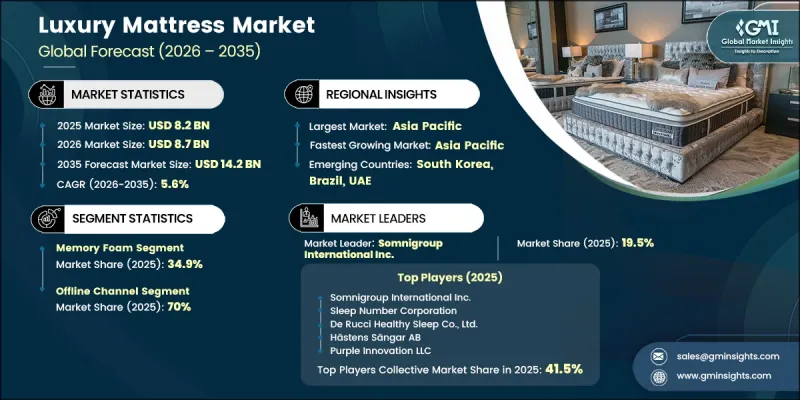
Demand growth is reinforced by the integration of smart sleep technologies, sustainability-focused product positioning, and rising procurement from premium hospitality operators worldwide. Competitive differentiation is increasingly shaped by innovation in biometric-enabled sleep tracking, verified sustainable sourcing, and enhanced digital purchasing experiences rather than material quality alone. The rising global wealth pool is reinforcing long-term demand, as high-income consumers expand wellness spending across fitness, nutrition, and sleep optimization. While North America and Western Europe remain the most established luxury mattress markets, strong momentum is also emerging across urban China, South Korea, and Australia, where premium wellness consumption is becoming more mainstream. This shift reflects the broader globalization of wellness-oriented lifestyles and the increasing acceptance of high-value sleep solutions in APAC urban centers.
| Market Scope | |
|---|---|
| Start Year | 2025 |
| Forecast Year | 2026-2035 |
| Start Value | $8.2 Billion |
| Forecast Value | $14.2 Billion |
| CAGR | 5.6% |
The memory foam products segment held a 34.9% share in 2025. Their dominance is supported by strong adoption across accessible luxury and upper-premium categories, typically priced between USD 1,500 and USD 4,000, where high-volume demand is concentrated. Product offerings in this category are built around advanced viscoelastic foam systems designed to enhance comfort and pressure relief.
The offline distribution channels accounted for a 70% share in 2025. Physical retail continues to play a critical role in purchase conversion due to the importance of in-person product testing and tactile evaluation. Luxury department stores, branded retail outlets, specialty sleep stores, and hospitality-focused showrooms remain central to sales execution, particularly in ultra-premium segments where transaction values frequently exceed USD 10,000.
North America Luxury Mattress Market held a 30.5% share in 2025 and is expected to grow at a CAGR of 3.5% through 2035. The region's growth reflects a mature demand environment with widespread awareness of premium sleep products among affluent households. The United States serves as the core national market, supported by established heritage manufacturers, multi-brand retail platforms, and digitally native premium sleep brands operating across all high-end price tiers.
Major players operating in the global luxury mattress industry include Serta Simmons Bedding LLC, Hastens Sangar AB, Purple Innovation LLC, Emma Sleep GmbH, Kingsdown Inc., Sleep Number Corporation, Somnigroup International Inc., Casper Sleep Inc., Avocado Green Brands Inc., Hypnos Ltd., King Koil Licensing Co. Inc., Duroflex Pvt. Ltd., Hilding Anders International AB, Flex Equipos de Descanso SA, Harrison Spinks Ltd., Treca Paris, De Rucci Healthy Sleep Co., Ltd., Alessanderx SpA, Eight Sleep Inc., Puffy LLC, Saatva Inc. Companies in the luxury mattress market are strengthening their positions through continuous product innovation focused on smart sleep systems, temperature regulation, and biometric tracking capabilities. They are expanding direct-to-consumer and hybrid retail models to balance experiential in-store engagement with digital convenience. Sustainability-driven strategies, including certified organic materials and transparent supply chains, are increasingly used to differentiate premium offerings. Brands are also investing in hospitality partnerships to enhance visibility and credibility in high-end commercial environments. Personalization features such as adjustable firmness and modular design are gaining importance in premium positioning. In addition, companies are leveraging data-driven marketing and subscription-based sleep services to build long-term customer relationships.
Table of Contents
Chapter 1 Methodology & Scope
- 1.1 Research approach
- 1.2 Quality Commitments
- 1.2.1 GMI AI policy & data integrity commitment
- 1.2.1.1 Source consistency protocol
- 1.2.1 GMI AI policy & data integrity commitment
- 1.3 Research Trail & Confidence Scoring
- 1.3.1 Research Trail Components
- 1.3.2 Scoring Components
- 1.4 Data Collection
- 1.4.1 Partial list of primary sources
- 1.5 Data mining sources
- 1.5.1 Paid sources
- 1.5.1.1 Sources, by region
- 1.5.1 Paid sources
- 1.6 Base estimates and calculations
- 1.6.1 Base year calculation for any one approach
- 1.7 Forecast model
- 1.7.1 Quantified market impact analysis
- 1.7.1.1 Mathematical impact of growth parameters on forecast
- 1.7.1 Quantified market impact analysis
- 1.8 Research transparency addendum
- 1.8.1 Source attribution framework
- 1.8.2 Quality assurance metrics
- 1.8.2.1 Our commitment to trust
Chapter 2 Executive Summary
- 2.1 Industry 360° synopsis, 2022 - 2035
- 2.2 Key market trends
- 2.2.1 Region
- 2.2.2 By Type
- 2.2.3 By Size
- 2.2.4 By End use
- 2.2.5 By Distribution channel
Chapter 3 Industry Insights
- 3.1 Industry ecosystem analysis
- 3.1.1 Supplier landscape
- 3.1.2 Profit margin
- 3.1.3 Value addition at each stage
- 3.1.4 Factor affecting the value chain
- 3.2 Industry impact forces
- 3.2.1 Growth drivers
- 3.2.1.1 Rising global HNI population & luxury consumer spending power
- 3.2.1.2 Growing consumer awareness of sleep health & wellness
- 3.2.1.3 Expansion of luxury hospitality sector driving commercial demand
- 3.2.1.4 Technological advancements in smart & adaptive mattress design
- 3.2.2 Industry pitfalls & challenges
- 3.2.2.1 Proliferation of counterfeit & imitation luxury products undermining brand equity
- 3.2.2.2 Sustainability & ESG pressure on natural raw material sourcing
- 3.2.3 Opportunities
- 3.2.3.1 Smart mattress integration with IoT & wearable sleep tech ecosystems
- 3.2.3.2 Luxury market expansion in emerging economies
- 3.2.1 Growth drivers
- 3.3 Growth potential analysis
- 3.4 Regulatory framework
- 3.4.1 Standards & compliance requirements
- 3.4.2 Regional regulatory frameworks
- 3.4.3 Certification standards
- 3.5 Major market trends and disruptions
- 3.6 Technology/innovation landscape
- 3.6.1 Current trends
- 3.6.2 Emerging trends
- 3.7 Pricing Analysis (driven by primary research)
- 3.7.1 Historical price trend analysis (driven by primary research)
- 3.7.2 Pricing strategy by player type (premium / value / cost- plus) (driven by primary research)
- 3.8 Future market trends
- 3.9 Trade data analysis (driven by paid database) (HS Code- 9404)
- 3.9.1 Import/export volume & value trends (driven by primary research)
- 3.9.2 Key trade corridors & tariff impact (driven by primary research)
- 3.10 Impact of AI & Generative AI on the Market
- 3.10.1 AI- driven disruption of existing business models
- 3.10.2 Gen- AI use cases & adoption roadmap by segment
- 3.10.3 Risks, limitations & regulatory considerations
- 3.11 Porter's analysis
- 3.12 PESTEL analysis
- 3.13 Distribution infrastructure & channel penetration landscape (driven by primary research)
- 3.13.1 Channel coverage by region & format (modern vs. Traditional trade) (driven by primary research)
- 3.13.2 Last- mile infrastructure gaps & emerging channel shifts (driven by primary research)
- 3.14 Consumer behavior analysis
- 3.14.1 Purchasing patterns
- 3.14.2 Preference analysis
- 3.14.3 Regional variations in consumer behavior
- 3.14.4 Impact of e- commerce on buying decisions
Chapter 4 Competitive Landscape, 2025
- 4.1 Introduction
- 4.2 Company market share analysis
- 4.2.1 By Region
- 4.2.1.1 North America
- 4.2.1.2 Europe
- 4.2.1.3 Asia Pacific
- 4.2.1.4 Latin America
- 4.2.1.5 Middle East and Africa
- 4.2.1 By Region
- 4.3 Company matrix analysis
- 4.4 Competitive analysis of major market players
- 4.5 Competitive positioning matrix
- 4.6 Key developments
- 4.6.1 Mergers & acquisitions
- 4.6.2 Partnerships & collaborations
- 4.6.3 New product launches
- 4.6.4 Expansion plans
Chapter 5 Market Estimates & Forecast, By Type, 2022 - 2035 (USD Billion, Thousand Units)
- 5.1 Key trends
- 5.2 Memory foam
- 5.2.1 Gel-infused memory foam
- 5.2.2 Copper-infused memory foam
- 5.2.3 Standard luxury memory foam
- 5.3 Latex
- 5.4 Hybrid
- 5.4.1 Foam + pocketed coil
- 5.4.2 Latex + pocketed coil
- 5.4.3 Multi-layer hybrid
- 5.5 Innerspring/coil
- 5.5.1 Pocketed coil (luxury pillow-top)
- 5.5.2 Pocketed coil (euro-top)
- 5.6 Others
- 5.6.1 Smart/adjustable air-chamber
- 5.6.2 Organic fill (wool, cashmere, silk)
- 5.6.3 Water-based
Chapter 6 Market Estimates & Forecast, By Size, 2022 - 2035 (USD Billion, Thousand Units)
- 6.1 Key trends
- 6.2 Twin
- 6.2.1 Standard & Twin XL
- 6.3 Full
- 6.3.1 Standard & Full XL
- 6.4 Queen
- 6.5 King & California King
- 6.6 Other Specialty Sizes
Chapter 7 Market Estimates & Forecast, By End use, 2022 - 2035 (USD Billion, Thousand Units)
- 7.1 Key trends
- 7.2 Residential
- 7.3 Commercial
- 7.3.1 Hotels & Resorts
- 7.3.2 Healthcare & Wellness
- 7.3.3 Others
Chapter 8 Market Estimates & Forecast, By Distribution Channel, 2022 - 2035 (USD Billion, Thousand Units)
- 8.1 Key trends
- 8.2 Offline
- 8.2.1 Luxury Specialty Sleep Stores
- 8.2.2 Department Stores & Premium Home Furnishing Chains
- 8.2.3 Hospitality & B2B Contract Supply
- 8.3 Online
- 8.3.1 Brand Direct / DTC Platforms
- 8.3.2 Third-Party E-commerce
Chapter 9 Market Estimates & Forecast, By Region, 2022 - 2035, (USD Billion, Thousand Units)
- 9.1 Key trends
- 9.2 North America
- 9.2.1 U.S.
- 9.2.2 Canada
- 9.3 Europe
- 9.3.1 Germany
- 9.3.2 U.K.
- 9.3.3 France
- 9.3.4 Italy
- 9.3.5 Spain
- 9.4 Asia Pacific
- 9.4.1 China
- 9.4.2 India
- 9.4.3 Japan
- 9.4.4 South Korea
- 9.4.5 Australia
- 9.5 Latin America
- 9.5.1 Brazil
- 9.5.2 Mexico
- 9.5.3 Argentina
- 9.6 MEA
- 9.6.1 UAE
- 9.6.2 Saudi Arabia
- 9.6.3 South Africa
Chapter 10 Company Profiles
- 10.1 Global Companies
- 10.1.1 Hastens Sangar AB
- 10.1.1.1 Business Overview
- 10.1.1.2 Financial Data
- 10.1.1.3 Product Landscape
- 10.1.1.4 Strategic Outlook
- 10.1.1.5 SWOT Analysis
- 10.1.2 Hilding Anders International AB
- 10.1.3 King Koil Licensing Co. Inc.
- 10.1.4 Purple Innovation LLC
- 10.1.5 Serta Simmons Bedding LLC
- 10.1.6 Sleep Number Corporation
- 10.1.7 Somnigroup International Inc.
- 10.1.1 Hastens Sangar AB
- 10.2 Regional Champions
- 10.2.1 Alessanderx SpA
- 10.2.2 De Rucci Healthy Sleep Co., Ltd.
- 10.2.3 Duroflex Pvt. Ltd.
- 10.2.4 Flex Equipos de Descanso SA
- 10.2.5 Harrison Spinks Ltd.
- 10.2.6 Hypnos Ltd.
- 10.2.7 Kingsdown Inc.
- 10.2.8 Saatva Inc.
- 10.2.9 Treca Paris
- 10.3 Emerging Players
- 10.3.1 Avocado Green Brands Inc.
- 10.3.2 Casper Sleep Inc.
- 10.3.3 Eight Sleep Inc.
- 10.3.4 Emma Sleep GmbH
- 10.3.5 Puffy LLC

