PUBLISHER: Mordor Intelligence | PRODUCT CODE: 2116351

PUBLISHER: Mordor Intelligence | PRODUCT CODE: 2116351
Pharmaceutical 3PL - Market Share Analysis, Industry Trends & Statistics, Growth Forecasts (2026 - 2031)
According to Mordor Intelligence, the pharmaceutical 3PL market size was valued at USD 68.03 billion in 2025 and estimated to grow from USD 73.11 billion in 2026 to reach USD 104.69 billion by 2031, at a CAGR of 7.47% during the forecast period (2026-2031).
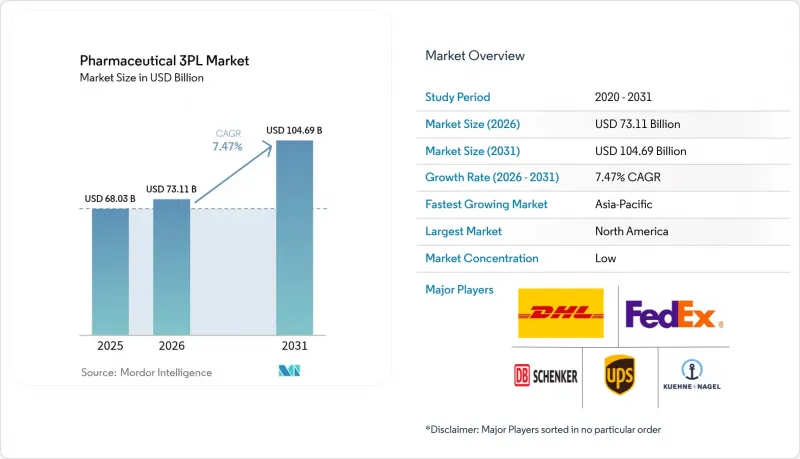
This report is Segmented by Service Type (Domestic Transportation Management and More), by Temperature Type (Cold Chain and Non-Cold Chain), by End User (Pharmaceutical Manufacturers and More), by Product Type (Prescription Drugs, Cell and Gene Therapies and More), and by Region (North America, South America, Europe, Asia-Pacific, Middle East and More). The Market Forecasts are Provided in Terms of Value (USD).
Global Pharmaceutical 3PL Market Trends and Insights
Rise of Specialty Biologics Requiring Strict Cold-Chain Compliance
Half of all vaccine doses are still lost each year because temperature excursions ruin potency, wasting USD 35 billion and exposing compliance gaps in many distribution networks. Biologics now span refrigerated, frozen, and cryogenic regimes, driving carriers to invest in GDP-certified hubs, active containers, and continuous-monitor data loggers. DHL, for example, is enlarging its Specialized Pharma Network and GDP-approved sites to double life-science revenue above EUR 10 billion (USD 11.43 billion) by 2030. These facilities combine redundant refrigeration, qualified packaging, and in-transit telemetry, allowing manufacturers to shorten inventory buffers and accelerate launch cycles.
SME Pharma Outsourcing to 3PLs in Emerging Countries
Mid-tier drug firms in India, Vietnam, and Brazil often lack the capital to install validated freezers, serialization scanners, or GDP-qualified staff. Outsourcing to regional specialists gives them compliant infrastructure on demand, improving release timelines and freeing working capital. In China, alliances between China Resources Pharmaceutical and more than 60 multinational suppliers signal robust demand for integrated storage and distribution services tailored to smaller product volumes. Vendors offering multi-tenant warehouses, batch-level traceability, and customs-brokerage support enjoy a clear advantage when courting these clients.
Cold-Chain Infrastructure Deficit in Developing Regions
Limited GDP-compliant storage and inconsistent power grids constrain vaccine outreach across sub-Saharan Africa and parts of Southeast Asia. Portable solar freezers and community distribution hubs are emerging stopgaps, yet capacity lags behind the booming pipeline of temperature-sensitive medicines. Multinational 3PLs face higher set-up costs and longer payback horizons, dampening expansion pace despite compelling public-health needs.
Other drivers and restraints analyzed in the detailed report include:
- Stringent GDP Regulations Driving Real-Time Monitoring Investments
- E-pharmacy Parcelization Boosting Last-Mile Temperature-Control Needs
- Cross-Border Regulatory Divergence Complicating Trade Flows
For complete list of drivers and restraints, kindly check the Table Of Contents.
Segment Analysis
The service-mix within the pharmaceutical 3PL market remains skewed toward Domestic Transportation Management, which accounted for 45.65% revenue in 2025. Yet the Value-Added Warehousing & Distribution sub-category is set to expand at an 8.31% CAGR, reflecting drug makers' appetite for single-window partners able to store, kit, relabel, and comply with stringent sampling requirements. Providers differentiate by offering modular clean-rooms, serialization lines, and GDP-audited custody processes. The pharmaceutical 3PL market size for warehousing services should therefore outpace line-haul revenues as manufacturers incorporate postponement strategies and later-stage customization closer to end markets. Advanced warehouse-management systems, vertical racking, and energy-efficient refrigeration improve both cost and carbon metrics, reinforcing customer loyalty.
Domestic Transportation Management retains the scale advantage thanks to its embedded role in the daily replenishment of hospitals and pharmacies. However, pricing remains competitive and heavily dependent on fuel surcharges. International Transportation Management grows more slowly as cross-border regulatory divergence and modal congestion lengthen cycle times. Market leaders funnel capital into freight-forwarding control towers and customs-broker platforms, but smaller operators seek niche differentiation by specializing in clinical trials or named-patient imports, cushioning margin compression within the broader pharmaceutical 3PL market.
Non-cold services dominated 63.25% of 2025 revenue but are projected to lose mix as temperature-controlled lanes post a robust 10.14% CAGR. Ambient lanes nonetheless remain critical for over-the-counter analgesics, generics, and bulk excipients, constraining price hikes due to abundant carrier capacity. Conversely, cryogenic moves for cell & gene therapies command premium yields, often five to seven times higher than refrigerated tariffs. Such disparities compel operators to segment fleets and warehouses by lane-specific margin profiles, sharpening the strategic focus across the pharmaceutical 3PL market.
Infrastructural investment concentrates on hybrid cold rooms that flex between 2 °C and -20 °C, backed by dual-redundant compressors and real-time validation. Where the pharmaceutical 3PL market share for frozen lanes approaches regulatory thresholds, carriers trial passive containers with phase-change materials to shrink dry-ice carbon footprints. Digital twin simulations flag potential bottlenecks, helping planners reroute around weather disruptions while maintaining validated temperature brackets.
Complete Report Scope:
- By Service Type
- Domestic Transportation Management (DTM)
- Roadways
- Railways
- Airways
- Waterways
- International Transportation Management (ITM)
- Roadways
- Railways
- Airways
- Waterways
- Value-Added Warehousing and Distribution (VAWD)
- Domestic Transportation Management (DTM)
- By Temperature Type
- Cold Chain
- Non-cold Chain
- By End User
- Pharmaceutical Manufacturers
- Biotech and Biosimilar Manufacturers
- Clinical Research and Trial Sponsors
- Hospitals and Retail Pharmacies
- Healthcare Distributors and Wholesalers
- E-pharmacies and Direct-to-Patient Services
- By Product Type
- Prescription Drugs
- OTC and Consumer Health Products
- Biopharmaceuticals and Biosimilars (ex-CGT)
- Cell and Gene Therapies
- Vaccines and Blood-derived Products
- Veterinary Pharmaceuticals and Animal Health Products
- Medical Devices, Diagnostics and Combination Products
- Clinical-trial Materials (Investigational Medicinal Products)
- Others
- By Region
- North America
- United States
- Canada
- Mexico
- South America
- Brazil
- Argentina
- Chile
- Rest of South America
- Europe
- Germany
- United Kingdom
- France
- Spain
- Italy
- Netherlands
- Russia
- Rest of Europe
- Asia-Pacific
- China
- India
- Japan
- South Korea
- Singapore
- Vietnam
- Indonesia
- Australia
- Rest of Asia-Pacific
- Middle East
- United Arab Emirates
- Saudi Arabia
- Turkey
- Israel
- Rest of Middle East
- Africa
- South Africa
- Egypt
- Nigeria
- Kenya
- Rest of Africa
- North America
Geography Analysis
North America accounted for 33.40% of global revenue in 2025, buoyed by robust biologics pipelines, advanced cold-chain capacity, and integrated regulatory frameworks. UPS alone targets USD 20 billion in healthcare logistics turnover by 2026, a goal underwritten by acquisitions such as Frigo-Trans, which bolsters multi-temperature offerings across continental corridors. The United States' DSCSA rollout and Canada's tightened Health Canada guidelines sustain demand for serialization, track-and-trace, and GDP-qualified personnel. As a result, the region's pharmaceutical 3PL market cultivates premium-priced lanes and remains a bellwether for service innovation.
Asia-Pacific will post the strongest 10.65% CAGR through 2031, propelled by manufacturing scale-ups in China and India and widened insurance coverage in Indonesia, Thailand, and Vietnam. China Resources Pharmaceutical's partnerships with Pfizer and AstraZeneca illustrate the shift toward integrated warehousing and distribution platforms that span B2B and direct-to-patient channels. Japanese incumbents such as ALPS LOGISTICS and MITSUI-SOKO broaden cryogenic networks, while Singapore's GDP-certified free-trade zone warehousing reinforces the city-state's hub status. Infrastructure gaps persist in secondary cities, but national logistics corridors, highway upgrades, and customs digitalization narrow the service-level divide.
Europe maintains a sizeable share underpinned by strict GDP oversight and resilient life-science clusters in Germany, Switzerland, and Ireland. The European Medicines Agency's resumed inspections stress continuous temperature documentation, spurring carriers to retrofit fleets with calibrated IoT sensors. Cross-border complexity after Brexit and the Windsor Framework forces distributors serving Northern Ireland to dual-qualify processes under both EU and UK statutes, elevating compliance overhead. Operational resilience remains high as trans-European rail and road corridors integrate with well-established air-cargo gateways at Frankfurt, Amsterdam-Schiphol, and Liege.
- DHL Supply Chain and Global Forwarding
- Kuehne + Nagel International AG
- UPS Healthcare
- FedEx Logistics
- DB Schenker
- Nippon Express Co., Ltd.
- CEVA Logistics
- Kerry Logistics Network
- Agility Logistics
- XPO Logistics
- Yusen Logistics
- Movianto (Walden Group)
- SF Express (Health)
- DSV Panalpina A/S
- Catalent Clinical Supply Services
- JAS Worldwide Pharma and Healthcare
- Bollore Logistics
- Sinotrans
- Bomi Group
- Biocair
- GEODIS
- World Courier (Cencora)
- Marken
- Fiege Pharma Logistics
- Kintetsu World Express
- Almac Group Clinical Services
Additional Benefits:
- The market estimate (ME) sheet in Excel format
- 3 months of analyst support
TABLE OF CONTENTS
1 Introduction
- 1.1 Study Assumptions
- 1.2 Scope of the Study
2 Research Methodology
3 Executive Summary
4 Market Landscape
- 4.1 Market Overview
- 4.2 Market Drivers
- 4.2.1 Rise of Specialty Biologics Requiring Strict Cold-Chain Compliance
- 4.2.2 SME Pharma Outsourcing to 3PLs in Emerging Countries
- 4.2.3 Stringent GDP Regulations Driving Real-time Monitoring Investments
- 4.2.4 E-pharmacy Parcelization Boosting Last-Mile Temperature-Control Needs
- 4.2.5 Post-COVID Vaccine Pipeline Acceleration Globally
- 4.2.6 End-to-End Visibility via IoT and Blockchain Adoption
- 4.3 Market Restraints
- 4.3.1 Cold-Chain Infrastructure Deficit in developing regions
- 4.3.2 Intense Cost-Pressure from Pharma Tendering Models
- 4.3.3 Cross-border Regulatory Divergence Complicating Trade Flows
- 4.3.4 GDP-Trained Labor Shortage in Warehousing and Trucking industry
- 4.4 Value / Supply-Chain Analysis
- 4.5 Regulatory Outlook (GDP Compliance, DSCSA, EU-FMD, China GSP etc.)
- 4.6 Technological Trends and Digitalization (IoT, RFID, Control-Tower Platforms etc.)
- 4.7 Packaging Innovations (Smart Data-Loggers, Eco-PCM Boxes)
- 4.8 Impact of Geopolitical Events on the Market
- 4.9 Porter's Five Forces
- 4.9.1 Bargaining Power of Suppliers
- 4.9.2 Bargaining Power of Customers
- 4.9.3 Threat of New Entrants
- 4.9.4 Threat of Substitutes
- 4.9.5 Intensity of Competitive Rivalry
5 Market Size and Growth Forecasts (Value)
- 5.1 By Service Type
- 5.1.1 Domestic Transportation Management (DTM)
- 5.1.1.1 Roadways
- 5.1.1.2 Railways
- 5.1.1.3 Airways
- 5.1.1.4 Waterways
- 5.1.2 International Transportation Management (ITM)
- 5.1.2.1 Roadways
- 5.1.2.2 Railways
- 5.1.2.3 Airways
- 5.1.2.4 Waterways
- 5.1.3 Value-Added Warehousing and Distribution (VAWD)
- 5.1.1 Domestic Transportation Management (DTM)
- 5.2 By Temperature Type
- 5.2.1 Cold Chain
- 5.2.2 Non-cold Chain
- 5.3 By End User
- 5.3.1 Pharmaceutical Manufacturers
- 5.3.2 Biotech and Biosimilar Manufacturers
- 5.3.3 Clinical Research and Trial Sponsors
- 5.3.4 Hospitals and Retail Pharmacies
- 5.3.5 Healthcare Distributors and Wholesalers
- 5.3.6 E-pharmacies and Direct-to-Patient Services
- 5.4 By Product Type
- 5.4.1 Prescription Drugs
- 5.4.2 OTC and Consumer Health Products
- 5.4.3 Biopharmaceuticals and Biosimilars (ex-CGT)
- 5.4.4 Cell and Gene Therapies
- 5.4.5 Vaccines and Blood-derived Products
- 5.4.6 Veterinary Pharmaceuticals and Animal Health Products
- 5.4.7 Medical Devices, Diagnostics and Combination Products
- 5.4.8 Clinical-trial Materials (Investigational Medicinal Products)
- 5.4.9 Others
- 5.5 By Region
- 5.5.1 North America
- 5.5.1.1 United States
- 5.5.1.2 Canada
- 5.5.1.3 Mexico
- 5.5.2 South America
- 5.5.2.1 Brazil
- 5.5.2.2 Argentina
- 5.5.2.3 Chile
- 5.5.2.4 Rest of South America
- 5.5.3 Europe
- 5.5.3.1 Germany
- 5.5.3.2 United Kingdom
- 5.5.3.3 France
- 5.5.3.4 Spain
- 5.5.3.5 Italy
- 5.5.3.6 Netherlands
- 5.5.3.7 Russia
- 5.5.3.8 Rest of Europe
- 5.5.4 Asia-Pacific
- 5.5.4.1 China
- 5.5.4.2 India
- 5.5.4.3 Japan
- 5.5.4.4 South Korea
- 5.5.4.5 Singapore
- 5.5.4.6 Vietnam
- 5.5.4.7 Indonesia
- 5.5.4.8 Australia
- 5.5.4.9 Rest of Asia-Pacific
- 5.5.5 Middle East
- 5.5.5.1 United Arab Emirates
- 5.5.5.2 Saudi Arabia
- 5.5.5.3 Turkey
- 5.5.5.4 Israel
- 5.5.5.5 Rest of Middle East
- 5.5.6 Africa
- 5.5.6.1 South Africa
- 5.5.6.2 Egypt
- 5.5.6.3 Nigeria
- 5.5.6.4 Kenya
- 5.5.6.5 Rest of Africa
- 5.5.1 North America
6 Competitive Landscape
- 6.1 Market Concentration
- 6.2 Strategic Moves (MandA, JVs, Investments)
- 6.3 Market Share Analysis
- 6.4 Company Profiles (includes Global level Overview, Market level overview, Core Segments, Financials as available, Strategic Information, Market Rank/Share for key companies, Products and Services, and Recent Developments)
- 6.4.1 DHL Supply Chain and Global Forwarding
- 6.4.2 Kuehne + Nagel International AG
- 6.4.3 UPS Healthcare
- 6.4.4 FedEx Logistics
- 6.4.5 DB Schenker
- 6.4.6 Nippon Express Co., Ltd.
- 6.4.7 CEVA Logistics
- 6.4.8 Kerry Logistics Network
- 6.4.9 Agility Logistics
- 6.4.10 XPO Logistics
- 6.4.11 Yusen Logistics
- 6.4.12 Movianto (Walden Group)
- 6.4.13 SF Express (Health)
- 6.4.14 DSV Panalpina A/S
- 6.4.15 Catalent Clinical Supply Services
- 6.4.16 JAS Worldwide Pharma and Healthcare
- 6.4.17 Bollore Logistics
- 6.4.18 Sinotrans
- 6.4.19 Bomi Group
- 6.4.20 Biocair
- 6.4.21 GEODIS
- 6.4.22 World Courier (Cencora)
- 6.4.23 Marken
- 6.4.24 Fiege Pharma Logistics
- 6.4.25 Kintetsu World Express
- 6.4.26 Almac Group Clinical Services
7 Market Opportunities and Future Outlook

