PUBLISHER: Mordor Intelligence | PRODUCT CODE: 2124728

PUBLISHER: Mordor Intelligence | PRODUCT CODE: 2124728
Germany Pharmaceutical 3PL - Market Share Analysis, Industry Trends & Statistics, Growth Forecasts (2026 - 2031)
According to Mordor Intelligence, the Germany pharmaceutical 3PL market size was valued at USD 4.88 billion in 2025 and estimated to grow from USD 5.11 billion in 2026 to reach USD 6.41 billion by 2031, at a CAGR of 4.66% during the forecast period (2026-2031).
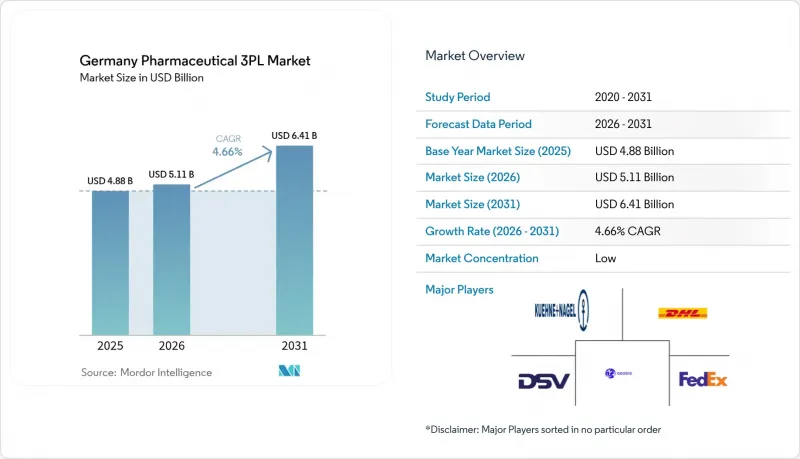
This report is Segmented by Service Type (Domestic Transportation Management, International Transportation Management, Value-Added Warehousing & Distribution), End User (Pharmaceutical Manufacturers, Biotech & Biosimilar Manufacturers, and More), Product Type (Prescription Drugs, OTC & Consumer Health Products, and More). The Market Forecasts are Provided in Terms of Value (USD).
Germany Pharmaceutical 3PL Market Trends and Insights
Strong Domestic Pharmaceutical Demand
Prescription volumes are growing in line with an aging population, and Germany's pharmaceutical industry generated more than EUR 200 billion in revenue in 2024, supporting 350,000 jobs. Capacity constraints inside manufacturers have triggered greater outsourcing of inventory management and distribution to compliant 3PL partners. Berlin's 2023 Pharmaceutical Strategy introduced manufacturing incentives and faster clinical-trial approvals, further increasing logistics complexity that favors specialized providers.
E-commerce Channel Acceleration for Rx & OTC Drugs
Mail-order leaders such as DocMorris scaled aggressively after regulators cleared the apo-rot acquisition, underpinning a last-mile model that demands ambient and cooled fulfillment lines inside GDP-certified facilities. Four-month ERP integrations highlight the IT intensity of this segment, prompting 3PLs to invest in automated picking and serialized, item-level tracking. As consumers embrace home delivery, e-pharmacies need partners that combine wholesale shipping with direct-to-patient drop-offs.
High Operating Costs for GDP/GMP-Compliant Facilities
Annual audit and documentation expenses can top EUR 1 million for large warehouses, and new in-transit verification rules require continuous monitoring in road freight as well. A Cologne distributor lost its license in July 2024 after repeated GDP breaches, underscoring the financial stakes of non-compliance.
Other drivers and restraints analyzed in the detailed report include:
- Rising Biologics & Advanced-Therapy Volumes Requiring GDP-Compliant Cold Chain
- End-to-End Digital Visibility Solutions Lowering Excursion Risk
- Skilled Labor Shortages in Temperature-Controlled Logistics
For complete list of drivers and restraints, kindly check the Table Of Contents.
Segment Analysis
Domestic Transportation Management retained 40.35% of the German pharmaceutical 3PL market share in 2025, confirming the country's status as a distribution bridge into Europe. Value-Added Warehousing & Distribution, the fastest-rising service, is growing at 5.72% CAGR as manufacturers outsource GDP-compliant storage, labeling, and serialization. The German pharmaceutical 3PL market size for warehousing is set to expand further as fully automated silos such as SSI SCHAEFER's build for Losan Pharma go live in 2025. International air corridors stay vital for emergency biologics; Lufthansa Cargo's Cool/td-Active network secures -20 °C to +30 °C moves across 89 stations.
The traditional divide between trucking and storage blurs as 3PLs package transport, inventory visibility, and regulatory filing into single contracts. DHL's planned EUR 2 billion healthcare network and DSV's acquisition of DB Schenker exemplify scale-seeking strategies that lock in captive volumes and higher asset utilization.
Cold-chain operations cover 57.75% of 2025 revenue and expand at a 5.76% CAGR. Growth is fueled by vaccines, biologics, and cell therapies that lose efficacy once temperatures stray beyond narrow windows. The German pharmaceutical 3PL market share for ultra-low-temperature services keeps rising as Secop's next-gen compressors cut energy draw inside -80 °C freezers by double-digit percentages. Ambient logistics face fee pressure because digital direct shipping reduces warehouse dwell time for OTC lines.
Regulatory scrutiny elevates barriers to entry; EU GDP demands validation of every transport lane, forcing smaller providers either to invest or exit. Automation offsets some operating costs: new warehouse management systems linked to predictive HVAC algorithms achieve 30% energy savings, a margin buffer amid volatile power prices.
Complete Report Scope:
- By Service Type
- Domestic Transportation Management (DTM)
- Roadways
- Railways
- Airways
- Waterways
- International Transportation Management (ITM)
- Roadways
- Railways
- Airways
- Waterways
- Value-Added Warehousing & Distribution (VAWD)
- Domestic Transportation Management (DTM)
- By Temperature Type
- Cold Chain
- Non-cold Chain
- By End User
- Pharmaceutical Manufacturers
- Biotech & Biosimilar Manufacturers
- Clinical Research & Trial Sponsors
- Hospitals & Retail Pharmacies
- Healthcare Distributors & Wholesalers
- E-pharmacies & Direct-to-Patient Services
- Others
- By Product Type
- Prescription Drugs
- OTC & Consumer Health Products
- Biopharmaceuticals & Biosimilars (ex-CGT)
- Cell & Gene Therapies
- Vaccines & Blood-derived Products
- Veterinary Pharmaceuticals & Animal Health Products
- Medical Devices, Diagnostics & Combination Products
- Clinical-trial Materials (Investigational Medicinal Products)
- Others
List of Companies Covered in this Report:
- DHL Group
- DSV
- Kuehne + Nagel
- Rhenus Logistics
- Dachser
- CEVA Logistics
- UPS
- FedEx
- Geodis
- Hellmann Worldwide Logistics
- FIEGE Logistik
- Rohlig Logistics
- Eurotranspharma
- NextPharma Logistics
- World Courier
- Frigo-Trans
- MSK Pharma Logistics
- Loxxess Pharma
- Pharmaserv Logistics GmbH
- Pfenning Logistics
Additional Benefits:
- The market estimate (ME) sheet in Excel format
- 3 months of analyst support
TABLE OF CONTENTS
1 Introduction
- 1.1 Study Assumptions & Market Definition
- 1.2 Scope of the Study
2 Research Methodology
3 Executive Summary
4 Market Landscape
- 4.1 Market Overview
- 4.2 Market Drivers
- 4.2.1 Strong domestic pharmaceutical demand
- 4.2.2 E-commerce channel acceleration for Rx & OTC drugs
- 4.2.3 Rising biologics & advanced-therapy volumes that require GDP-compliant cold-chain capacity
- 4.2.4 End-to-end digital visibility solutions lowering excursion risk
- 4.2.5 Sustainability-driven modal shift (air to sea/road) reducing carbon footprint
- 4.2.6 Surge in decentralized/virtual clinical trials driving direct-to-patient logistics needs
- 4.3 Market Restraints
- 4.3.1 High operating costs for GDP/GMP-compliant facilities
- 4.3.2 Skilled labour shortages in temperature-controlled logistics
- 4.3.3 Energy-price volatility inflating warehouse OPEX
- 4.3.4 Scarcity of GDP-approved urban micro-fulfilment space limiting last-mile service expansion
- 4.4 Value / Supply-Chain Analysis
- 4.5 Regulatory Landscape
- 4.6 Technological Outlook
- 4.7 Pharmaceutical E-commerce Outlook
- 4.8 Packaging Spotlight
- 4.9 Impact of Geopolitics & Pandemic
- 4.10 Porter's Five Forces
- 4.10.1 Bargaining Power of Suppliers
- 4.10.2 Bargaining Power of Consumers
- 4.10.3 Threat of New Entrants
- 4.10.4 Threat of Substitutes
- 4.10.5 Intensity of Competitive Rivalry
5 Market Size & Growth Forecasts
- 5.1 By Service Type
- 5.1.1 Domestic Transportation Management (DTM)
- 5.1.1.1 Roadways
- 5.1.1.2 Railways
- 5.1.1.3 Airways
- 5.1.1.4 Waterways
- 5.1.2 International Transportation Management (ITM)
- 5.1.2.1 Roadways
- 5.1.2.2 Railways
- 5.1.2.3 Airways
- 5.1.2.4 Waterways
- 5.1.3 Value-Added Warehousing & Distribution (VAWD)
- 5.1.1 Domestic Transportation Management (DTM)
- 5.2 By Temperature Type
- 5.2.1 Cold Chain
- 5.2.2 Non-cold Chain
- 5.3 By End User
- 5.3.1 Pharmaceutical Manufacturers
- 5.3.2 Biotech & Biosimilar Manufacturers
- 5.3.3 Clinical Research & Trial Sponsors
- 5.3.4 Hospitals & Retail Pharmacies
- 5.3.5 Healthcare Distributors & Wholesalers
- 5.3.6 E-pharmacies & Direct-to-Patient Services
- 5.3.7 Others
- 5.4 By Product Type
- 5.4.1 Prescription Drugs
- 5.4.2 OTC & Consumer Health Products
- 5.4.3 Biopharmaceuticals & Biosimilars (ex-CGT)
- 5.4.4 Cell & Gene Therapies
- 5.4.5 Vaccines & Blood-derived Products
- 5.4.6 Veterinary Pharmaceuticals & Animal Health Products
- 5.4.7 Medical Devices, Diagnostics & Combination Products
- 5.4.8 Clinical-trial Materials (Investigational Medicinal Products)
- 5.4.9 Others
6 Competitive Landscape
- 6.1 Market Concentration
- 6.2 Strategic Moves
- 6.3 Market Share Analysis
- 6.4 Company Profiles (includes Global level Overview, Market level overview, Core Segments, Financials as available, Strategic Information, Market Rank/Share for key companies, Products & Services, and Recent Developments)
- 6.4.1 DHL Group
- 6.4.2 DSV
- 6.4.3 Kuehne + Nagel
- 6.4.4 Rhenus Logistics
- 6.4.5 Dachser
- 6.4.6 CEVA Logistics
- 6.4.7 UPS
- 6.4.8 FedEx
- 6.4.9 Geodis
- 6.4.10 Hellmann Worldwide Logistics
- 6.4.11 FIEGE Logistik
- 6.4.12 Rohlig Logistics
- 6.4.13 Eurotranspharma
- 6.4.14 NextPharma Logistics
- 6.4.15 World Courier
- 6.4.16 Frigo-Trans
- 6.4.17 MSK Pharma Logistics
- 6.4.18 Loxxess Pharma
- 6.4.19 Pharmaserv Logistics GmbH
- 6.4.20 Pfenning Logistics
7 Market Opportunities & Future Outlook
- 7.1 White-space & Unmet-need Assessment

