PUBLISHER: Mordor Intelligence | PRODUCT CODE: 2116395

PUBLISHER: Mordor Intelligence | PRODUCT CODE: 2116395
India Pea Protein - Market Share Analysis, Industry Trends & Statistics, Growth Forecasts (2026 - 2031)
According to Mordor Intelligence, the India pea protein market size was valued at USD 90.80 million in 2025 and estimated to grow from USD 96.87 million in 2026 to reach USD 133.86 million by 2031, at a CAGR of 6.69% during the forecast period (2026-2031).
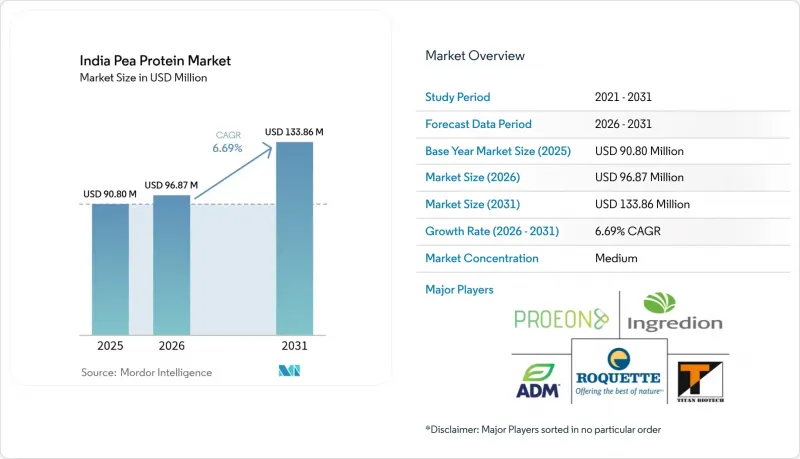
This report is Segmented by Product Type (Concentrates, Isolates, and More), Nature (Organic and Conventional), and Application (Food and Beverage, Animal Feed, and More). The Market Forecasts are Provided in Terms of Value (USD).
India Pea Protein Market Trends and Insights
Rising health and fitness awareness is increasing consumer preference for high-protein, plant-based nutrition options
Health and fitness awareness is growing rapidly in India, driving the demand for plant-based protein sources. The National Institute of Nutrition recommends a daily protein intake of 0.66 g per kilogram of body weight for healthy adults; however, many individuals fall short of this requirement. As a result, consumers are increasingly turning to cleaner and allergen-friendly alternatives to whey protein. Influencers promoting fitness content and forming partnerships with gyms nationwide have made plant-based proteins a regular part of wellness routines. Pea protein, with a digestibility score of 0.82 and a mild flavor, is gaining popularity as it can be easily combined with other plant proteins, such as rice or hemp, to create a complete amino acid profile suitable for various dietary needs. Indian brands, such as Good Fettle, are leveraging claims like "soy-free" and "lactose-free" to attract consumers who are sensitive to these ingredients.
Increasing awareness of protein deficiency in India
Protein deficiency is a significant issue in India, with Frontiers Organization reporting in February 2025 that 70-80% of households fail to meet the recommended daily protein intake, regardless of income levels. This has led to increased national efforts to address the problem, such as fortifying school meals and public-distribution staples with essential nutrients. These initiatives have increased the demand for cost-effective, allergen-free ingredients suitable for large-scale production processes, such as extrusion and mixing. Pea protein, along with other plant-based proteins, has emerged as a preferred choice due to its affordability and compatibility with such programs. For instance, in November 2023, Relsus introduced a premium range of plant-based protein powders in India, reflecting growing confidence in the market and the readiness of suppliers to meet this demand. Additionally, the versatility of pea protein makes it an ideal ingredient for addressing nutritional gaps in both urban and rural areas, further driving its adoption.
Regulatory ambiguity around plant-based meat and dairy analogues
Unclear regulations surrounding plant-based meat and dairy alternatives are becoming a significant challenge for India's pea protein market. There is ongoing confusion about whether terms like "milk," "curd," and "meat" can be used for plant-based products. This uncertainty has compelled companies to redesign their packaging, postpone product launches, or adopt temporary names that often confuse consumers and undermine brand messaging. Regulatory authorities frequently issue directives asking companies to avoid using dairy or meat-related terms, which disrupts product visibility on e-commerce platforms and complicates compliance processes for startups and manufacturers. These challenges make it difficult for businesses to plan effectively and invest confidently in advanced technologies, such as high-moisture extrusion equipment, hybrid formulations, and fortified plant-based foods. As a result, the growth of pea protein-based products across retail, food service, and institutional markets is slowing, limiting the market's ability to expand at its full potential.
Other drivers and restraints analyzed in the detailed report include:
- Growing adoption of vegetarian, vegan and flexitarian diet
- Growth of millet-based foods under India's "Shree Anna" push
- Sensory mismatch in Indian traditional dishes
For complete list of drivers and restraints, kindly check the Table Of Contents.
Segment Analysis
In 2025, pea protein isolates led the Indian market, accounting for 50.78% of the total market share. These isolates are widely preferred due to their ability to dissolve easily, neutral flavor, and smooth texture, making them ideal for use in products like clear beverages, premium sports nutrition powders, and dairy-free creamers. Consumers appreciate their convenience, as they mix well and have minimal grittiness, which enhances the overall product experience. This growing preference highlights the increasing demand for high-quality, clean-label protein options that cater to health-conscious and fitness-focused consumers.
Pea protein concentrates are projected to grow significantly, with an expected CAGR of 8.22% from 2026 to 2031. Their affordability and balanced nutritional profile make them a versatile ingredient for various applications, including fortified snacks, bakery products, and traditional meal preparations. Manufacturers use concentrates in hybrid grain blends and extruded products due to their ability to enhance texture and functionality. As these concentrates become more common in mainstream packaged foods, they are transitioning from niche health-focused products to being a regular part of everyday diets, appealing to a broader consumer base.
Complete Report Scope:
- By Product Type
- Concentrates
- Isolates
- Textured/Hydrolyzed
- By Nature
- Organic
- Conventional
- By Application
- Food and Beverage
- Sports, Dietary, and Medical Nutrition
- Animal Feed
- Others
List of Companies Covered in this Report:
- Archer Daniels Midland Company
- Cargill Inc.
- International Flavors & Fragrances Inc.
- Ingredion India Pvt Ltd
- Roquette India Pvt Ltd
- Titan Biotech Ltd
- Rajvi Enterprise
- Proeon Foods Pvt Ltd
- Puris Proteins LLC
- Jeeva Organic Private Limited
- AGT Foods
- Taj Agro International
- Marico Limited
- Unilever PLC
- Prime Herbonix Health Products Private Limited
- Glanbia PLC
- Kerry Group PLC
- Nutrova
- Vaible Herbal
- Eklavya Biotech Private Limited
Additional Benefits:
- The market estimate (ME) sheet in Excel format
- 3 months of analyst support
TABLE OF CONTENTS
1 INTRODUCTION
- 1.1 Study Assumptions and Market Definition
- 1.2 Scope of the Study
2 RESEARCH METHODOLOGY
3 EXECUTIVE SUMMARY
4 MARKET LANDSCAPE
- 4.1 Market Overview
- 4.2 Market Drivers
- 4.2.1 Rising health and fitness awareness is increasing consumer preference for high-protein, plant-based nutrition options
- 4.2.2 Increasing awareness of protein deficiency in India
- 4.2.3 Growing adoption of vegetarian, vegan and flexitarian diet
- 4.2.4 Popularity of portion-controlled, diet-friendly meal bowls and ready-to-eat items
- 4.2.5 Growth of millet-based foods under India's "Shree Anna" push
- 4.2.6 Growing preference for natural and plant-derived cosmetic ingredients
- 4.3 Market Restraints
- 4.3.1 High cost of product reformulation
- 4.3.2 Higher prices of pea protein compared to local protein sources such as soy, whey and pulses
- 4.3.3 Regulatory ambiguity around plant-based meat and dairy analogues
- 4.3.4 Sensory mismatch in Indian traditional dishes
- 4.4 Regulatory Outlook
- 4.5 Supply Chain Analysis
- 4.6 Porter's Five Forces
- 4.6.1 Threat of New Entrants
- 4.6.2 Bargaining Power of Buyers
- 4.6.3 Bargaining Power of Suppliers
- 4.6.4 Threat of Substitute Products
- 4.6.5 Intensity of Competitive Rivalry
5 MARKET SIZE AND GROWTH FORECASTS (VALUE)
- 5.1 By Product Type
- 5.1.1 Concentrates
- 5.1.2 Isolates
- 5.1.3 Textured/Hydrolyzed
- 5.2 By Nature
- 5.2.1 Organic
- 5.2.2 Conventional
- 5.3 By Application
- 5.3.1 Food and Beverage
- 5.3.2 Sports, Dietary, and Medical Nutrition
- 5.3.3 Animal Feed
- 5.3.4 Others
6 COMPETITIVE LANDSCAPE
- 6.1 Market Concentration
- 6.2 Strategic Moves
- 6.3 Market Positioning Analysis
- 6.4 Company Profiles (includes Global-level Overview, Market-level Overview, Core Segments, Financials (if available), Strategic Information, Market Rank/Share, Products and Services, Recent Developments)
- 6.4.1 Archer Daniels Midland Company
- 6.4.2 Cargill Inc.
- 6.4.3 International Flavors & Fragrances Inc.
- 6.4.4 Ingredion India Pvt Ltd
- 6.4.5 Roquette India Pvt Ltd
- 6.4.6 Titan Biotech Ltd
- 6.4.7 Rajvi Enterprise
- 6.4.8 Proeon Foods Pvt Ltd
- 6.4.9 Puris Proteins LLC
- 6.4.10 Jeeva Organic Private Limited
- 6.4.11 AGT Foods
- 6.4.12 Taj Agro International
- 6.4.13 Marico Limited
- 6.4.14 Unilever PLC
- 6.4.15 Prime Herbonix Health Products Private Limited
- 6.4.16 Glanbia PLC
- 6.4.17 Kerry Group PLC
- 6.4.18 Nutrova
- 6.4.19 Vaible Herbal
- 6.4.20 Eklavya Biotech Private Limited
7 MARKET OPPORTUNITIES AND FUTURE OUTLOOK

