PUBLISHER: Mordor Intelligence | PRODUCT CODE: 2116516

PUBLISHER: Mordor Intelligence | PRODUCT CODE: 2116516
Menstrual Cup - Market Share Analysis, Industry Trends & Statistics, Growth Forecasts (2026 - 2031)
According to Mordor Intelligence, the menstrual cup market size is expected to grow from USD 0.93 billion in 2025 to USD 0.98 billion in 2026 and is forecast to reach USD 1.27 billion by 2031 at 5.38% CAGR over 2026-2031.
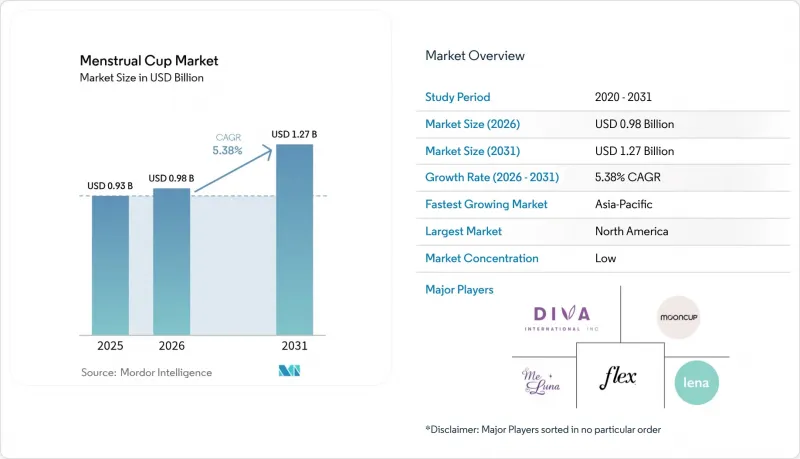
This report is Segmented by Product Type (Disposable and Reusable), Material (Medical-Grade Silicone, Natural Rubber (Latex) and More), Distribution Channel (Pharmacies and Retail Stores, Supermarkets and Hypermarkets and More), and Geography (North America, Europe, Asia-Pacific, Middle East and Africa, and South America). The Market Forecasts are Provided in Terms of Value (USD).
Global Menstrual Cup Market Trends and Insights
Surge in Sustainability-Driven Consumer Behaviour
Multiple life-cycle studies in France, India, and the United States confirm that one cup offsets its embodied emissions within a month of use, amplifying environmental value across a 10-year lifespan. Each unit removes roughly 2,500 tampons from landfill streams. Gen-Z and millennial cohorts actively reward brands with visible climate commitments, reshaping category messaging across the menstrual cups market. Waste-reduction statistics, such as Scotland's annual disposal of 427.5 million single-use period items, sharpen consumer resolve. The alignment of ecological values and personal health preference sustains demand and encourages repeat purchases.
Long-Term Cost Advantage Versus Disposables
One cup can replace close to 3,250 tampons over 10 years, offering compelling household savings that outweigh higher entry price. Cost messaging resonates in price-sensitive economies and is amplified when linked to accessibility initiatives, as shown in Japan, Indonesia, and France where cost information proved a stronger influence than health claims. Subsidy programs cut first-purchase barriers; for instance, Peterborough City Council sells Mooncups at GBP 5 (USD 6.25) compared with the regular GBP 20 (USD 25), driving trial rates. This financial edge becomes more pronounced as inflation lifts the ongoing price of disposables, reinforcing the menstrual cups market growth narrative.
Cultural Stigma & Low Awareness in Emerging Economies
Taboos surrounding menstruation hinder open discussion and product experimentation. A Nepalese study found worries about virginity loss to be a major barrier among schoolgirls NCBI. In South Korea, only 1.6% of women aged 18-45 have adopted cups despite rising health concerns with disposables OPHRP. Effective outreach therefore hinges on culturally sensitive education delivered by trusted community figures. Without this groundwork, the menstrual cups market penetration stalls and counterfeit products proliferate, undermining user confidence.
Other drivers and restraints analyzed in the detailed report include:
- Expanding E-Commerce & DTC Fulfilment Models
- Government "Period-Poverty" Schemes Distributing Free Cups
- Steep Learning Curve for First-Time Users
For complete list of drivers and restraints, kindly check the Table Of Contents.
Segment Analysis
Reusable models owned 52.90% of menstrual cups market share in 2025 while advancing at a 6.41% CAGR. Lower lifetime cost and strong eco-benefits position them as the default choice in most regions. Single-use cups satisfy niche travel and low-water contexts but conflict with the core sustainability narrative powering overall demand. Material research amplifies reusable value: Virginia Tech scientists demonstrated alginate-glycerol gels that solidify menstrual fluid, which could reduce leakage without undermining reusability Gizmodo. Should such features commercialize, reusable leadership will widen as form factors become easier to manage during heavy flow.
Market education highlights cleaning simplicity with compact sterilizers, and community testimonials reassure first-time users. Government agencies increasingly prefer reusable products for public procurement, cementing their primacy in the menstrual cups market. Yet manufacturers still monitor single-use formats for humanitarian aid or disaster scenarios where sterilization remains difficult. Balanced portfolios allow firms to hedge against regional water scarcity, keeping the menstrual cups industry resilient across diverse operating environments.
Complete Report Scope:
- By Product Type
- Reusable Menstrual Cups
- Disposable/Single-use Menstrual Cups
- By Material
- Medical-grade Silicone
- Natural Rubber (Latex)
- Thermoplastic Elastomer (TPE)
- By Distribution Channel
- Pharmacies & Retail Stores
- Supermarkets & Hypermarkets
- Online Stores (Company DTC, Marketplaces)
- Specialty Feminine-Care Stores
- By Geography
- North America
- United States
- Canada
- Mexico
- Europe
- Germany
- United Kingdom
- France
- Italy
- Spain
- Rest of Europe
- Asia-Pacific
- China
- India
- Japan
- South Korea
- Australia
- Rest of Asia-Pacific
- South America
- Brazil
- Argentina
- Rest of South America
- Middle East and Africa
- GCC
- South Africa
- Rest of Middle East and Africa
- North America
Geography Analysis
North America retained 38.40% revenue share in 2025 due to high awareness, favorable regulation, and mature e-commerce logistics. Canada's CAD 29.8 million Menstrual Equity Fund raises adoption further by normalizing cups across public settings Government of Canada. Penetration is already high among younger cohorts, so future growth hinges on technological upgrades and value-added accessories rather than first-time conversions.
Asia-Pacific is the growth engine, demonstrating a 8.85% CAGR to 2031. Rising disposable incomes, improved menstrual-health literacy, and wide-scale public projects such as India's Thinkal distribution of 1 million units underscore latent demand. South Korea's low 1.6% usage rate indicates vast runway once social barriers are addressed. Companies tailor marketing to local norms and partner with NGOs for village-level workshops, steadily enlarging the menstrual cups market. Europe sustains growth via strict waste mandates and publicly funded product schemes. Catalonia's pharmacy rollout to 2.5 million residents exemplifies swift mainstreaming. Wales' target of 90-100% eco-friendly period products reinforces regional leadership. Meanwhile, South America and the Middle East & Africa hold untapped potential, but addressable demand is constrained by cultural stigma and water infrastructure limitations. Producers invest in localized translations, lower-price SKUs, and community demonstrations to lay groundwork for future menstrual cups market expansion.
- Diva International
- Lunette
- Mooncup Ltd.
- Saalt
- Intimina (Essity)
- The Keeper Inc.
- MeLuna GmbH
- Anigan Inc.
- Blossom Cup
- Lena Cup
- Pixie Cup
- Ruby Life Ltd. (Ruby Cup)
- FemmyCycle
- Sirona Hygiene
- AllMatters (OrganiCup)
- LadyCup
- Soft Cup (Instead)
- Merula Cup
- Mermaids Cup
- SheCup
Additional Benefits:
- The market estimate (ME) sheet in Excel format
- 3 months of analyst support
TABLE OF CONTENTS
1 Introduction
- 1.1 Study Assumptions & Market Definition
- 1.2 Scope of the Study
2 Research Methodology
3 Executive Summary
4 Market Landscape
- 4.1 Market Overview
- 4.2 Market Drivers
- 4.2.1 Surge in sustainability-driven consumer behaviour
- 4.2.2 Long-term cost advantage versus disposables
- 4.2.3 Expanding e-commerce & DTC fulfilment models
- 4.2.4 Government "period-poverty" schemes distributing free cups
- 4.2.5 Medical-grade TPE enabling hypoallergenic, ultra-thin cups
- 4.2.6 Social-media influencer advocacy among Gen-Z
- 4.3 Market Restraints
- 4.3.1 Cultural stigma & low awareness in emerging economies
- 4.3.2 Steep learning curve for first-time users
- 4.3.3 Lack of product standards -> counterfeit/low-quality cups
- 4.3.4 Water-scarcity challenges for cleaning & sterilising cups
- 4.4 Value / Supply-Chain Analysis
- 4.5 Regulatory Landscape
- 4.6 Technological Outlook
- 4.7 Porter's Five Forces
- 4.7.1 Bargaining Power of Buyers
- 4.7.2 Bargaining Power of Suppliers
- 4.7.3 Threat of New Entrants
- 4.7.4 Threat of Substitutes
- 4.7.5 Competitive Rivalry
5 Market Size & Growth Forecasts (Value)
- 5.1 By Product Type
- 5.1.1 Reusable Menstrual Cups
- 5.1.2 Disposable/Single-use Menstrual Cups
- 5.2 By Material
- 5.2.1 Medical-grade Silicone
- 5.2.2 Natural Rubber (Latex)
- 5.2.3 Thermoplastic Elastomer (TPE)
- 5.3 By Distribution Channel
- 5.3.1 Pharmacies & Retail Stores
- 5.3.2 Supermarkets & Hypermarkets
- 5.3.3 Online Stores (Company DTC, Marketplaces)
- 5.3.4 Specialty Feminine-Care Stores
- 5.4 By Geography
- 5.4.1 North America
- 5.4.1.1 United States
- 5.4.1.2 Canada
- 5.4.1.3 Mexico
- 5.4.2 Europe
- 5.4.2.1 Germany
- 5.4.2.2 United Kingdom
- 5.4.2.3 France
- 5.4.2.4 Italy
- 5.4.2.5 Spain
- 5.4.2.6 Rest of Europe
- 5.4.3 Asia-Pacific
- 5.4.3.1 China
- 5.4.3.2 India
- 5.4.3.3 Japan
- 5.4.3.4 South Korea
- 5.4.3.5 Australia
- 5.4.3.6 Rest of Asia-Pacific
- 5.4.4 South America
- 5.4.4.1 Brazil
- 5.4.4.2 Argentina
- 5.4.4.3 Rest of South America
- 5.4.5 Middle East and Africa
- 5.4.5.1 GCC
- 5.4.5.2 South Africa
- 5.4.5.3 Rest of Middle East and Africa
- 5.4.1 North America
6 Competitive Landscape
- 6.1 Market Concentration
- 6.2 Market Share Analysis
- 6.3 Company Profiles (includes Global level Overview, Market level overview, Core Segments, Financials as available, Strategic Information, Market Rank/Share for key companies, Products & Services, and Recent Developments)
- 6.3.1 Diva International Inc.
- 6.3.2 Lunette
- 6.3.3 Mooncup Ltd.
- 6.3.4 Saalt
- 6.3.5 Intimina (Essity)
- 6.3.6 The Keeper Inc.
- 6.3.7 MeLuna GmbH
- 6.3.8 Anigan Inc.
- 6.3.9 Blossom Cup
- 6.3.10 Lena Cup
- 6.3.11 Pixie Cup
- 6.3.12 Ruby Life Ltd. (Ruby Cup)
- 6.3.13 FemmyCycle
- 6.3.14 Sirona Hygiene
- 6.3.15 AllMatters (OrganiCup)
- 6.3.16 LadyCup
- 6.3.17 Soft Cup (Instead)
- 6.3.18 Merula Cup
- 6.3.19 Mermaids Cup
- 6.3.20 SheCup
7 Market Opportunities & Future Outlook
- 7.1 White-space & Unmet-Need Assessment

