PUBLISHER: Mordor Intelligence | PRODUCT CODE: 2116518

PUBLISHER: Mordor Intelligence | PRODUCT CODE: 2116518
Europe Virtual Cards - Market Share Analysis, Industry Trends & Statistics, Growth Forecasts (2026 - 2031)
According to Mordor Intelligence, the european virtual cards market reached a value of USD 1.34 trillion in 2026 and is on course to hit USD 3.14 trillion by 2031, reflecting an impressive 18.56% CAGR through the forecast horizon.
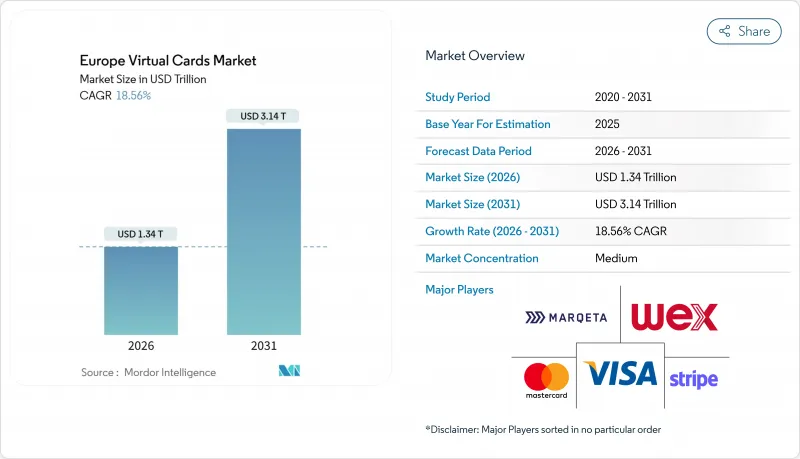
This report is Segmented by Use (Single-Use, Multi-Use), Payment Type (Remote Payments, POS Payments), End User (Consumer, Business), Card Type (Virtual Debit Card, Virtual Credit Card, Virtual Prepaid Card), and Geography (United Kingdom, Germany, France, Spain, Italy, Benelux, Nordics, Rest of Europe). The Market Forecasts are Provided in Terms of Value (USD).
Europe Virtual Cards Market Trends and Insights
Surging B2B Demand for Automated Accounts-Payable Settlement
B2B demand for automated accounts payable settlement is propelling Europe's virtual cards market. Procurement and treasury teams are replacing checks and wire transfers with single-use virtual cards that reconcile directly against purchase orders. Corporate travel and lodging payments are increasingly processed through virtual card platforms, enabling suppliers to receive immediate settlement while companies extend payment terms. Fintech platforms expanding across multiple jurisdictions allow SMEs to embed virtual cards and credit directly into ERP and accounting systems, cutting onboarding from weeks to hours. Under Article 96(6) of the EU's Payment Services Directive (PSD2), payment service providers must report statistical data on fraud to national authorities, which are then shared with the EBA and ECB; this regulatory reporting framework strengthens oversight and incentivizes adoption of safer, tokenized payment methods like virtual cards. Strategic acquisitions of corporate travel specialists signal heightened competition and innovation in B2B virtual card solutions.
E-commerce & Contactless Boom Post-COVID-19
The post-COVID surge in e-commerce and contactless payments is driving Europe's virtual cards market. In Germany, debit card transactions grew from 3.9 billion in 2019 to 10.9 billion in 2024, with mobile-initiated payments rising from 5 % to 16 % over the same period. About 97 % of Germans now own at least one debit card, reflecting widespread adoption of electronic payments. Virtual cards leverage this trend by unifying online and in-store payments through mobile wallets and tokenized credentials, enabling seamless, secure transactions and supporting continued market growth. Remote payments dominate card activity across the euro area, while contactless transactions continue to expand at points of sale, supported by seamless integration with mobile wallets like Apple Pay and Google Pay. Mobile payments increasingly use virtualized card credentials, which unify online and in-store transactions, and regulatory adjustments in the United Kingdom, allowing higher contactless limits, are reducing friction for tap-and-go payments. Virtual cards leverage these trends by enabling secure, seamless transactions across channels, supporting ongoing adoption and growth across Europe.
Low Digital Adoption Among Senior Citizens
Around 9% of euro area residents need assistance to complete digital payments, which places a ceiling on household adoption in segments with lower digital literacy. Older consumers face hurdles with multi-factor authentication, app onboarding, and wallet operation, which are necessary to use tokenized credentials comfortably and safely. Rural areas in parts of Italy, Greece, and Portugal often rely on branch-based interactions and have lower smartphone penetration, which slows the transition to digital-only card formats. The European Digital Identity Wallets mandated under eIDAS 2.0 by November 2026 aim to standardize authentication and may make digital payments more accessible over time. Issuers that simplify user experiences, invest in assisted enrollment, and build supportive interfaces can expand the reachable base in the Europe virtual cards market.
Other drivers and restraints analyzed in the detailed report include:
- PSD2/SCA Compliance Elevates Security Preference for Tokenized Cards
- Digitization of Meal-Voucher Benefits Across Continental Europe
- Interchange & Surcharge Regulation Compress Issuer Margins
For complete list of drivers and restraints, kindly check the Table Of Contents.
Segment Analysis
Single-use virtual cards held 56.45% share of the Europe virtual cards market size in 2025 and are projected to grow at 21.22% through 2031, signaling that precise controls and automated reconciliation outweigh reuse convenience for many enterprises. Procurement teams benefit from exact-amount authorization, narrow validity windows tied to shipment or service delivery, and instant auto-closure of credentials after a single authorization, which limits exposure to misuse. Travel intermediaries create one unique number per booking with merchant code locks and amount ceilings that match reservation totals, which speeds reconciliation and reduces disputes for hotels and airlines. The growth differential relative to multi-use programs shows that enterprises prioritize control, visibility, and audit trails when transaction patterns are irregular or involve multiple counterparties. Embedded issuers such as Stripe Issuing and Marqeta generate ephemeral PANs programmatically, lowering setup costs and timelines for platforms that want to orchestrate granular spend in the Europe virtual cards market.
Multi-use cards, which represent the balance of spend in 2025, fit use cases with predictable frequency, such as software subscriptions, logistics retainers, and employee expense wallets, where issuing a new credential for each transaction would add operational overhead. As enterprises centralize spend management in ERP and travel management systems, multi-use cards remain relevant for recurring spend categories that benefit from stored credentials and simplified renewals. European Payments Initiative's Wero wallet is adding e-commerce acceptance, which will co-exist with cards and could substitute for certain recurring debit flows at lower risk points. Even as account-to-account options scale, the Europe virtual cards market continues to favor single-use controls for ad hoc supplier payments and trip-by-trip travel bookings that require booking-level attributes. This segmentation reflects a broader balance between flexibility and control that characterizes how enterprises manage spend across diverse categories.
Remote payments accounted for 78.32% of activity in 2025, driven by the shift to online channels and the use of tokenized, stored payment credentials that reduce checkout friction. Marketplace operators and subscription platforms rely on these credentials to enable seamless one-click flows, update tokens automatically, and improve transaction approval rates. Point-of-sale credentials embedded in smartphones and wearables are scaling faster at 28.34% as banks increasingly provide NFC access to national wallets. Mobile payments are gaining traction across multiple countries, with virtualized card credentials unifying in-store and online usage. This convergence strengthens consumer convenience and encourages broader adoption of virtual cards across the region.
International debit cards complement domestic schemes, expanding merchant acceptance and daily usage, while regulatory initiatives to open mobile NFC to third-party wallets further reduce friction for tokenized payments. Merchants are increasingly focused on achieving higher approval rates and reducing PCI scope, driving adoption of tokenization at both online and physical points of sale. The integration of wallet ubiquity, instant-payment systems, and token lifecycle management is fostering a multi-rail payment environment. Virtual cards are positioned to grow alongside account-to-account alternatives rather than being displaced by them. Credentials that work seamlessly across channels and devices will continue to be central to consumer and merchant preferences throughout Europe.
Complete Report Scope:
- By Use
- Single-Use
- Multi-Use
- By Payment Type
- Remote Payments
- POS Payments
- By End User
- Consumer
- Business
- By Card Type
- Virtual Debit Card
- Virtual Credit Card
- Virtual Prepaid Card
- By Country
- United Kingdom
- Germany
- France
- Spain
- Italy
- Benelux (Belgium, Netherlands, and Luxembourg)
- Nordics (Sweden, Norway, Denmark, Finland, and Iceland)
- Rest of Europe
List of Companies Covered in this Report:
- Mastercard
- Visa
- Marqeta
- Stripe
- WEX
- AirPlus International
- Edenred Payment Solutions
- American Express
- HSBC
- Barclaycard
- Revolut
- Qonto
- Klarna
- Bunq
- Monese
- Soldo
- Airwallex
- Adyen
- Worldline
- Nexi
Additional Benefits:
- The market estimate (ME) sheet in Excel format
- 3 months of analyst support
TABLE OF CONTENTS
1 Introduction
- 1.1 Study Assumptions & Market Definition
- 1.2 Scope of the Study
2 Research Methodology
3 Executive Summary
4 Market Landscape
- 4.1 Market Overview
- 4.2 Market Drivers
- 4.2.1 Surging B2B demand for automated accounts-payable settlement
- 4.2.2 E-commerce & contactless boom post-COVID-19
- 4.2.3 PSD2/SCA compliance elevates security preference for tokenised cards
- 4.2.4 Embedded-finance APIs slash SME onboarding frictions
- 4.2.5 Digitisation of meal-voucher benefits across continental Europe
- 4.2.6 Travel intermediaries' pivot to single-use VCNs for supplier credit
- 4.3 Market Restraints
- 4.3.1 Low digital adoption among senior citizens
- 4.3.2 Interchange & surcharge regulation compress issuer margins
- 4.3.3 Fragmented BIN-sponsorship rules hinder cross-border issuance
- 4.3.4 Rising cyber-insurance premiums for fintech issuers
- 4.4 Value / Supply-Chain Analysis
- 4.5 Regulatory Landscape
- 4.6 Technological Outlook
- 4.7 Porter's Five Forces
- 4.7.1 Bargaining Power of Suppliers
- 4.7.2 Bargaining Power of Buyers
- 4.7.3 Threat of New Entrants
- 4.7.4 Threat of Substitutes
- 4.7.5 Intensity of Competitive Rivalry
5 Market Size & Growth Forecasts (Value)
- 5.1 By Use
- 5.1.1 Single-Use
- 5.1.2 Multi-Use
- 5.2 By Payment Type
- 5.2.1 Remote Payments
- 5.2.2 POS Payments
- 5.3 By End User
- 5.3.1 Consumer
- 5.3.2 Business
- 5.4 By Card Type
- 5.4.1 Virtual Debit Card
- 5.4.2 Virtual Credit Card
- 5.4.3 Virtual Prepaid Card
- 5.5 By Country
- 5.5.1 United Kingdom
- 5.5.2 Germany
- 5.5.3 France
- 5.5.4 Spain
- 5.5.5 Italy
- 5.5.6 Benelux (Belgium, Netherlands, and Luxembourg)
- 5.5.7 Nordics (Sweden, Norway, Denmark, Finland, and Iceland)
- 5.5.8 Rest of Europe
6 Competitive Landscape
- 6.1 Market Concentration
- 6.2 Strategic Moves
- 6.3 Market Share Analysis
- 6.4 Company Profiles (includes Global Level Overview, Market Level Overview, Core Segments, Financials as available, Strategic Information, Market Rank/Share for Key Companies, Products & Services, and Recent Developments)
- 6.4.1 Mastercard
- 6.4.2 Visa
- 6.4.3 Marqeta
- 6.4.4 Stripe
- 6.4.5 WEX
- 6.4.6 AirPlus International
- 6.4.7 Edenred Payment Solutions
- 6.4.8 American Express
- 6.4.9 HSBC
- 6.4.10 Barclaycard
- 6.4.11 Revolut
- 6.4.12 Qonto
- 6.4.13 Klarna
- 6.4.14 Bunq
- 6.4.15 Monese
- 6.4.16 Soldo
- 6.4.17 Airwallex
- 6.4.18 Adyen
- 6.4.19 Worldline
- 6.4.20 Nexi
7 Market Opportunities & Future Outlook
- 7.1 White-space & Unmet-need Assessment

