PUBLISHER: Mordor Intelligence | PRODUCT CODE: 2116624

PUBLISHER: Mordor Intelligence | PRODUCT CODE: 2116624
UK Virtual Cards - Market Share Analysis, Industry Trends & Statistics, Growth Forecasts (2026 - 2031)
According to Mordor Intelligence, the UK virtual cards market size is expected to grow from USD 240.39 billion in 2025 to USD 282.35 billion in 2026 and is forecast to reach USD 631.28 billion by 2031 at 17.46% CAGR over 2026-2031.
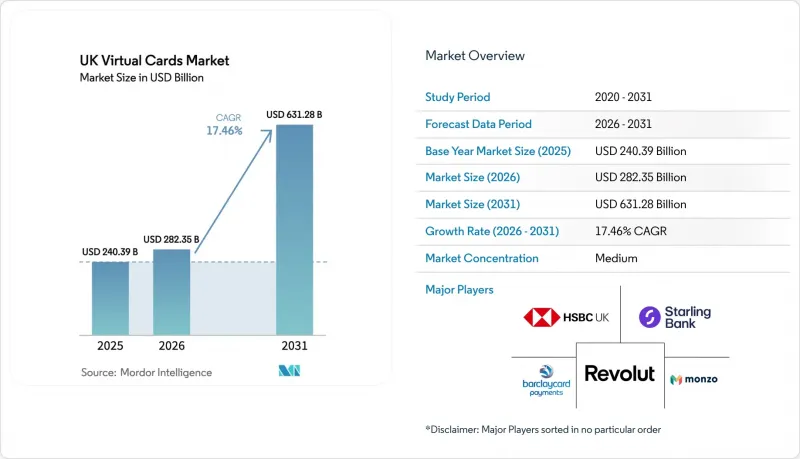
This report is Segmented by Use (Single-Use and Multi-Use), by Payment Type (Remote Payments and POS Payments), by End User (Consumer and Business), and by Card Type (Virtual Debit Card, Virtual Credit Card, and Virtual Prepaid Card). The Market Forecasts are Provided in Terms of Value (USD).
UK Virtual Cards Market Trends and Insights
Rising SME demand for flexible B2B spend controls
Small and mid-sized enterprises are prioritising granular spend limits, merchant-category blocking, and time-bound authorisations to keep tighter reins on cash flow as economic conditions remain volatile. The Crown Commercial Service confirmed GBP 3.52 billion in direct SME public-sector spend during 2024, underscoring the scale of transactions now moving to highly configurable payment rails. Finance teams also favour instant issuance because many employees work remotely and need digital-first tools to settle ad-hoc supplier invoices without waiting for plastic cards. Single-use virtual tokens are attractive because they lapse automatically, preventing forgotten subscriptions from draining budgets. Together, these control features position virtual cards as essential working-capital instruments for the UK's 5.5 million SMEs.
Mainstream push by tier-1 UK banks for tokenized issuance
Lloyds Banking Group's decision to migrate 10 million cards onto Visa's token platform by 2026 signalled a systemic shift away from static PANs. Tokenisation reduces fraud exposure by replacing each card number with dynamic credentials that lose value immediately after use, a security upgrade now marketed aggressively to large corporate clients. Mastercard's pledge to remove manual card entry from online checkouts by 2030 further accelerates issuer adoption, because banks need to meet merchant expectations for effortless payments. Early adopters benefit from easier ERP integration, allowing automated limit resets and richer data capture. As more banks deploy token frameworks, resistance among late movers is likely to erode quickly.
Interchange-fee caps compressing issuer economics
The Payment Systems Regulator estimates UK merchants pay more than GBP 250 million annually in unexplained card-scheme fee increases, signalling likely caps that will erode issuer margins. Mastercard has already raised cross-border acquiring fees, amplifying the concern that revenue per transaction will fall further. Smaller virtual-card providers, lacking volume discounts, may need to pivot towards subscription pricing or premium analytics to stay profitable. Investor appetite could wane if margin pressure intensifies, spurring consolidation among sub-scale issuers. Conversely, large banks see an opportunity to leverage economies of scale and absorb volume from struggling fintechs.
Other drivers and restraints analyzed in the detailed report include:
- Open-banking APIs enabling instant KYC/BIN sponsorship
- Mandatory HMRC Making-Tax-Digital rules are increasing real-time receipt capture
- Persistent merchant mistrust around card-not-present fraud liability
For complete list of drivers and restraints, kindly check the Table Of Contents.
Segment Analysis
Single-use virtual cards captured 58.92% of the UK virtual cards market share in 2025, expanding at a projected 18.98% CAGR to 2031 as finance teams prioritize one-time credentials that shut after settlement, eliminating the risk of stored-card compromise. Subscription SaaS growth amplifies this need because single-use tokens expire before unauthorized rebills can occur.
Multi-use tokens remain relevant for trusted suppliers on recurring contracts, yet adoption lags as companies weigh higher fraud exposure. Mastercard's April 2024 wallet integration that pairs biometric authentication with real-time limit updates further propels single-use popularity. Across travel and ad-hoc spend, employees welcome the convenience of instant numbers delivered to mobile wallets, reinforcing robust demand in the UK virtual cards market.
Remote payments held 70.56% of the UK virtual cards market size in 2025 and will grow at an 18.54% CAGR to 2031, illustrating the preference for online procurement and cross-border supplier settlement after Brexit-driven fee complexities. The Office for National Statistics logged a rebound in foreign card spend during peak travel months, proving that businesses remain comfortable executing remote transactions that virtual cards facilitate.
Physical point-of-sale (POS) utilization lingers behind because many small merchants operate terminals lacking token acceptance. Revolut's 2024 iPad POS application begins to close this gap, yet corporate buyers still lean on contact-free channels where virtual-card rails thrive. For importers paying EU vendors, remote virtual card numbers bypass bank-transfer delays, solidifying remote supremacy in the UK virtual cards market.
Complete Report Scope:
- By Use
- Single-Use
- Multi-Use
- By Payment Type
- Remote Payments
- POS Payments
- By End User
- Consumer
- Business
- By Card Type
- Virtual Debit Card
- Virtual Credit Card
- Virtual Prepaid Card
List of Companies Covered in this Report:
- Revolut
- Monzo
- Starling Bank
- Barclaycard Payments
- HSBC UK
- Lloyds Bank Commercial
- NatWest Group
- Santander UK
- American Express
- Mastercard
- Visa
- PayPal
- Klarna
- Soldo
- Airwallex
- Wise
- Curve
- Tide
- Pleo
- Emburse
Additional Benefits:
- The market estimate (ME) sheet in Excel format
- 3 months of analyst support
TABLE OF CONTENTS
1 Introduction
- 1.1 Study Assumptions & Market Definition
- 1.2 Scope of the Study
2 Research Methodology
3 Executive Summary
4 Market Landscape
- 4.1 Market Overview
- 4.2 Market Drivers
- 4.2.1 Rising SME demand for flexible B2B spend controls
- 4.2.2 Mainstream push by tier-1 UK banks for tokenised issuance
- 4.2.3 Open-banking APIs enabling instant KYC/BIN sponsorship
- 4.2.4 Mandatory HMRC Making-Tax-Digital rules increasing real-time receipt capture
- 4.2.5 ISO 20022 migration unlocking richer data for reconciliation
- 4.2.6 Surge in employee subscription-based SaaS requiring single-use cards
- 4.3 Market Restraints
- 4.3.1 Interchange-fee caps compressing issuer economics
- 4.3.2 Persistent merchant mistrust around "card-not-present" fraud liability
- 4.3.3 Patchy acceptance at legacy government suppliers
- 4.3.4 Growing consumer privacy pushback on token-level data sharing
- 4.4 Value / Supply-Chain Analysis
- 4.5 Regulatory Landscape
- 4.6 Technological Outlook
- 4.7 Porter's Five Forces
- 4.7.1 Bargaining Power of Suppliers
- 4.7.2 Bargaining Power of Buyers
- 4.7.3 Threat of New Entrants
- 4.7.4 Threat of Substitutes
- 4.7.5 Intensity of Competitive Rivalry
5 Market Size & Growth Forecasts (Value)
- 5.1 By Use
- 5.1.1 Single-Use
- 5.1.2 Multi-Use
- 5.2 By Payment Type
- 5.2.1 Remote Payments
- 5.2.2 POS Payments
- 5.3 By End User
- 5.3.1 Consumer
- 5.3.2 Business
- 5.4 By Card Type
- 5.4.1 Virtual Debit Card
- 5.4.2 Virtual Credit Card
- 5.4.3 Virtual Prepaid Card
6 Competitive Landscape
- 6.1 Market Concentration
- 6.2 Strategic Moves
- 6.3 Market Share Analysis
- 6.4 Company Profiles (includes Global Level Overview, Market Level Overview, Core Segments, Financials as available, Strategic Information, Market Rank/Share for Key Companies, Products & Services, and Recent Developments)
- 6.4.1 Revolut
- 6.4.2 Monzo
- 6.4.3 Starling Bank
- 6.4.4 Barclaycard Payments
- 6.4.5 HSBC UK
- 6.4.6 Lloyds Bank Commercial
- 6.4.7 NatWest Group
- 6.4.8 Santander UK
- 6.4.9 American Express
- 6.4.10 Mastercard
- 6.4.11 Visa
- 6.4.12 PayPal
- 6.4.13 Klarna
- 6.4.14 Soldo
- 6.4.15 Airwallex
- 6.4.16 Wise
- 6.4.17 Curve
- 6.4.18 Tide
- 6.4.19 Pleo
- 6.4.20 Emburse
7 Market Opportunities & Future Outlook
- 7.1 White-space & Unmet-need Assessment

