PUBLISHER: Mordor Intelligence | PRODUCT CODE: 2116519

PUBLISHER: Mordor Intelligence | PRODUCT CODE: 2116519
Germany Neobanking - Market Share Analysis, Industry Trends & Statistics, Growth Forecasts (2026 - 2031)
According to Mordor Intelligence, the Germany neobanking market size was valued at USD 0.85 trillion in 2025 and estimated to grow from USD 0.97 trillion in 2026 to reach USD 1.91 trillion by 2031, at a CAGR of 14.41% during the forecast period (2026-2031).
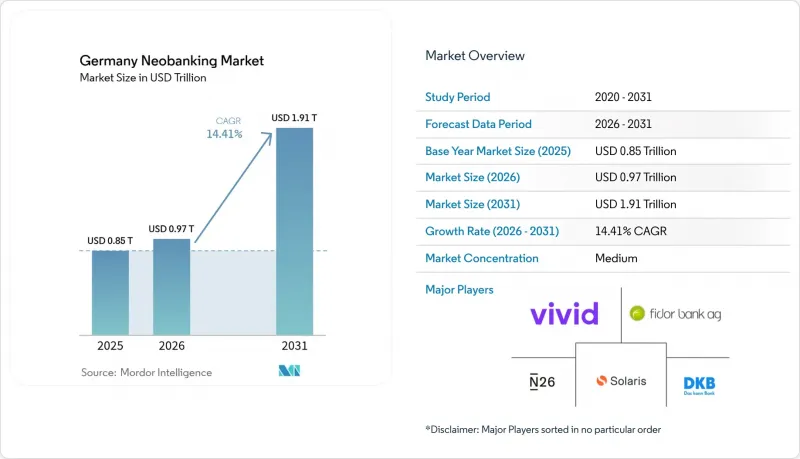
This report is Segmented by Account Type (Business Account and Savings Account), by Service (Mobile Banking, Payments, Money Transfer, Savings Account, Loans, and Others), and by Application (Enterprise, Personal, and Others), by Geography (North Germany, South Germany, East Germany, West Germany, and Central Germany). The Market Forecasts are Provided in Terms of Value (USD).
Germany Neobanking Market Trends and Insights
High Smartphone & Internet Penetration Accelerates Mobile-First Adoption
More than 85% of German residents own a smartphone, creating a vast addressable base for mobile-centric banking services. Pandemic-driven shifts pushed contactless payments into daily routines, compressing nearly a decade of adoption into two years. The rapid expansion of 5G coverage and intuitive app design reduces friction for older users and encourages household-level switching to digital-only providers. As younger consumers influence family financial decisions, viral network effects amplify account openings in the Germany neobanking market. Telecom operators' joint venture to extend rural 5G coverage by 2027 further widens the potential customer pool.
PSD2/Open-Banking Regulation Creates Data-Driven Competitive Moats
PSD2 legally obliges incumbents to share account data with licensed third parties, allowing neobanks to generate unified customer profiles and superior risk analytics. German regulators require strict consent tracking and encryption, so firms that invest early in compliance gain long-term reputational credibility. Access to real-time transactional data enables more accurate underwriting for unsecured SME loans, a segment ignored by legacy lenders due to high manual costs. Open-banking interfaces also permit neobanks to embed white-label accounts inside SaaS platforms, expanding reach beyond their proprietary apps. Over the medium term, regulatory alignment across the European Economic Area simplifies cross-border expansion for German-licensed providers.
Interchange-Fee Caps Force Revenue Model Evolution Beyond Payment Processing
European law limits debit-card interchange to 0.2% and credit-card fees to 0.3%, curbing transaction-based income for mobile-only banks. German providers respond by bundling premium subscriptions that offer travel insurance, higher ATM limits, and carbon-offset debit cards. Fee capping accelerates the pivot into higher-margin segments such as consumer lending, wealth products, and revenue-sharing embedded-finance agreements with SaaS vendors. The Germany neobanking market, therefore, evolves from a free-checking paradigm toward diversified fee baskets. While larger platforms absorb the margin shock by cross-selling, niche challengers must scale rapidly or shift to specialized services to remain viable.
Other drivers and restraints analyzed in the detailed report include:
- Incumbent-Neobank Partnership Momentum Reshapes Traditional Hierarchies
- Export-Oriented SME Cross-Border Payment Demand Drives B2B Innovation
- BaFin AML/KYC Scrutiny Raises Compliance Costs and Operational Complexity
For complete list of drivers and restraints, kindly check the Table Of Contents.
Segment Analysis
Business accounts represented 66.63% of the Germany neobanking market size in 2025, reflecting enterprises' move toward automated reconciliation and API-enabled treasury dashboards. High export intensity and multi-currency payables drive adoption because digital banks settle FX at real-time rates instead of end-of-day averages. CFOs value single-pane cash visibility across domestic and foreign subsidiaries, reinforcing stickiness within the Germany neobanking market. Savings accounts, although currently smaller, are forecast to grow at a robust 33.82% CAGR through 2031 on the back of attractive digital-only interest rates and instant micro-saving features. As deposit protection clarity improves, retail customers funnel excess liquidity from low-yield checking into regulated savings schemes.
Lower overheads allow neobanks to pass on European Central Bank rate increases more quickly than legacy peers, deepening competitiveness. Automated goal-based saving rules appeal to Gen Z households wary of inflation and climate risk. Meanwhile, SMEs benefit from multi-user permissions and two-factor approvals that streamline invoice settlement without compromising security. Competitive bundling of savings vaults inside business accounts further blurs the line between transactional and reserve products. Consequently, corporate and retail balances together strengthen liquidity ratios that support future lending expansion.
Complete Report Scope:
- By Account Type
- Business Account
- Savings Account
- By Services
- Mobile-Banking
- Payments
- Money-Transfers
- Savings Account
- Loans
- Others
- By Application
- Personal
- Enterprise
- Other Application
- By Geography
- North Germany
- South Germany
- East Germany
- West Germany
- Central Germany
List of Companies Covered in this Report:
- N26 GmbH
- Fidor Bank AG
- Vivid Money GmbH
- solaris SE
- Tomorrow GmbH
- Penta Fintech GmbH
- Kontist GmbH
- bunq B.V.
- Revolut Ltd.
- Wise plc
- Monese Ltd.
- Holvi Payment Services Ltd.
- Raisin GmbH
- Deutsche Kreditbank AG
- Comdirect Bank AG
- ING-DiBa AG
- PayCenter GmbH
- Finom Ltd.
- Trade Republic Bank GmbH
Additional Benefits:
- The market estimate (ME) sheet in Excel format
- 3 months of analyst support
TABLE OF CONTENTS
1 Introduction
- 1.1 Study Assumptions & Market Definition
- 1.2 Scope of the Study
2 Research Methodology
3 Executive Summary
4 Market Landscape
- 4.1 Market Overview
- 4.2 Market Drivers
- 4.2.1 High smartphone & internet penetration
- 4.2.2 PSD2/Open-Banking regulation support
- 4.2.3 Incumbent-neobank partnership momentum
- 4.2.4 Export-oriented SME cross-border payment demand
- 4.2.5 Embedded-finance demand from B2B SaaS platforms
- 4.2.6 Gen-Z preference for ESG-aligned banking
- 4.3 Market Restraints
- 4.3.1 Interchange-fee caps squeeze revenues
- 4.3.2 BaFin AML/KYC scrutiny raises compliance costs
- 4.3.3 Consumer trust issues after service outages
- 4.3.4 Profitability drag of low-yield deposit base
- 4.4 Value / Supply-Chain Analysis
- 4.5 Regulatory Landscape
- 4.6 Technological Outlook
- 4.7 Porter's Five Forces
- 4.7.1 Threat of New Entrants
- 4.7.2 Bargaining Power of Buyers
- 4.7.3 Bargaining Power of Suppliers
- 4.7.4 Threat of Substitutes
- 4.7.5 Competitive Rivalry
5 Market Size & Growth Forecasts
- 5.1 By Account Type
- 5.1.1 Business Account
- 5.1.2 Savings Account
- 5.2 By Services
- 5.2.1 Mobile-Banking
- 5.2.2 Payments
- 5.2.3 Money-Transfers
- 5.2.4 Savings Account
- 5.2.5 Loans
- 5.2.6 Others
- 5.3 By Application
- 5.3.1 Personal
- 5.3.2 Enterprise
- 5.3.3 Other Application
- 5.4 By Geography
- 5.4.1 North Germany
- 5.4.2 South Germany
- 5.4.3 East Germany
- 5.4.4 West Germany
- 5.4.5 Central Germany
6 Competitive Landscape
- 6.1 Market Concentration
- 6.2 Strategic Moves
- 6.3 Market Share Analysis
- 6.4 Company Profiles (includes Global level Overview, Market level overview, Core Segments, Financials as available, Strategic Information, Market Rank/Share for key companies, Products & Services, and Recent Developments)
- 6.4.1 N26 GmbH
- 6.4.2 Fidor Bank AG
- 6.4.3 Vivid Money GmbH
- 6.4.4 solaris SE
- 6.4.5 Tomorrow GmbH
- 6.4.6 Penta Fintech GmbH
- 6.4.7 Kontist GmbH
- 6.4.8 bunq B.V.
- 6.4.9 Revolut Ltd.
- 6.4.10 Wise plc
- 6.4.11 Monese Ltd.
- 6.4.12 Holvi Payment Services Ltd.
- 6.4.13 Raisin GmbH
- 6.4.14 Deutsche Kreditbank AG
- 6.4.15 Comdirect Bank AG
- 6.4.16 ING-DiBa AG
- 6.4.17 PayCenter GmbH
- 6.4.18 Finom Ltd.
- 6.4.19 Trade Republic Bank GmbH
7 Market Opportunities & Future Outlook
- 7.1 Expansion into gig-economy lending products
- 7.2 AI-driven personal-finance advisory upsell

