PUBLISHER: Mordor Intelligence | PRODUCT CODE: 2116622

PUBLISHER: Mordor Intelligence | PRODUCT CODE: 2116622
Middle East And Africa Neobanking - Market Share Analysis, Industry Trends & Statistics, Growth Forecasts (2026 - 2031)
According to Mordor Intelligence, Middle East & Africa neobanking market size in 2026 is estimated at USD 431.66 billion, growing from 2025 value of USD 372.35 billion with 2031 projections showing USD 903.9 billion, growing at 15.93% CAGR over 2026-2031.
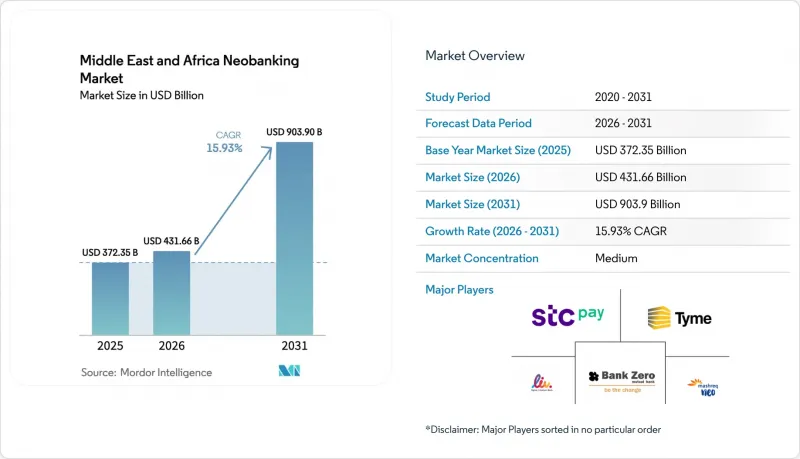
This report is Segmented by Account Type (Business Account, Savings Account), Services (Mobile-Banking, Payments, Money-Transfers, Savings Account, Loans, Others), Application (Personal, Enterprise, Other Application), and Geography (United Arab Emirates, Saudi Arabia, and Other). The Market Forecasts are Provided in Terms of Value (USD), Based On Availability.
Middle East And Africa Neobanking Market Trends and Insights
Smartphone penetration leapfrogs branch networks
Mobile connections far outnumber bank accounts across much of sub-Saharan Africa, enabling digital challengers to bypass costly physical infrastructure. The European Investment Bank reported that mobile-money usage captured 74% of global transaction volumes in 2023, up from 59% in 2021, with Africa accounting for the majority. Orange MEA and Mastercard will furnish 37 million wallet holders with virtual debit cards by 2025, validating scale economics. Device affordability improvements, lower data tariffs, and super-app ecosystems bundled by telcos reinforce usage frequency. As regulators digitize identity verification, onboarding friction continues to decline. Collectively, these trends raise daily active users and transaction velocities, directly lifting fee revenue for neobanks.
Demand from unbanked and under-banked segments
Financial-exclusion levels above 50% persist in multiple African states. Kenya reduced exclusion from 25% in 2013 to 11.6% in 2021 through tiered-KYC mobile wallets, signalling untapped demand curves. Nigeria's central bank licensed 153 digital credit providers by September 2025, collectively disbursing KSh 76.8 billion (USD 594 million) via mobile channels. Tiered deposits, nano-loans, and embedded insurance expand lifetime revenue per customer while broadening inclusion mandates. Development-finance institutions channel concessional capital toward platforms that target women and youth segments, further intensifying momentum. Consequently, addressable volumes for savings and micro-credit products are set to grow faster than GDP.
Stringent capitalization & cybersecurity rules
Regulatory authorities across the region have implemented increasingly demanding capital adequacy and cybersecurity compliance standards that disproportionately impact standalone neobank entrants compared to incumbent-backed digital platforms. Nigeria's banking recapitalization requirements, effective March 2024, mandate minimum paid-up capital ranging from NGN 10 billion to NGN 500 billion depending on license type, while Kenya's Business Laws Amendment Act 2024 raised minimum core capital for banks from KES 1 million to KES 10 million (approximately USD 6,800 to USD 68,000) with compliance required by December 2029. The Cybercrimes Amendment Act 2024 mandates reporting cyber incidents to National CERT within 72 hours, aligning with data protection breach reporting requirements that create substantial compliance overhead for digital-only institutions lacking established risk management frameworks.
Other drivers and restraints analyzed in the detailed report include:
- GCC regulatory sandboxes and open-banking rules
- Sharia-compliant digital finance propositions
- Consumer Trust Deficit in Branch-less Entities
For complete list of drivers and restraints, kindly check the Table Of Contents.
Segment Analysis
Business accounts are growing at a 20.62% CAGR, positioning them as the prime growth lever of the Middle East & Africa neobanking market. Demand stems from micro-, small-, and mid-sized enterprises seeking consolidated cash-management, payroll, and FX modules without legacy-bank paperwork. Nigeria's Payment System Vision 2025 explicitly champions API-driven account aggregation for merchants, encouraging fintech-bank collaborations. Concurrently, Kenyan regulators lifted a decade-long bank-licensing moratorium in July 2025, unlocking charter pathways for vertical-specialist SME banks.
Market maturity in savings accounts persists because low-fee, mobile-first vaults attract first-time depositors. The segment's 55.64% share signals entrenched usage for store-of-value needs, supported by seamless cash-in rails at agent outlets and interoperable QR networks across GCC jurisdictions. Competitive intensity is rising, driving commoditization; hence, providers bundle budgeting analytics and yield-boosting goal posts to retain balances. For business accounts, transaction-linked credit-scoring unlocks working-capital lines, embedding sticky revenue streams and reducing churn probability relative to consumer cohorts.
Complete Report Scope:
- By Account Type
- Business Account
- Savings Account
- By Services
- Mobile-Banking
- Payments
- Money-Transfers
- Savings Account
- Loans
- Others
- By Application
- Personal
- Enterprise
- Other Application
- By Geography
- United Arab Emirates
- Saudi Arabia
- South Africa
- Nigeria
- Rest of Middle East & Africa
List of Companies Covered in this Report:
- STC Pay
- Liv. (Emirates NBD)
- Mashreq Neo
- meem by Gulf International Bank
- Al Maryah Community Bank
- YAP
- Bank Zero
- TymeBank
- Kuda Bank
- Carbon
- FairMoney
- Telda
- Blink Jordan
- Eversend
- Chipper Cash
- Flutterwave
- Fidor Bank (MEA)
- Revolut (MEA)
- Bank Albilad Neo
- ila Bank (Bahrain)
Additional Benefits:
- The market estimate (ME) sheet in Excel format
- 3 months of analyst support
TABLE OF CONTENTS
1 Introduction
- 1.1 Study Assumptions & Market Definition
- 1.2 Scope of the Study
2 Research Methodology
3 Executive Summary
4 Market Landscape
- 4.1 Market Overview
- 4.2 Market Drivers
- 4.2.1 Smartphone penetration leapfrogging traditional banking infra
- 4.2.2 Unbanked and under-banked population demand digital-first accounts
- 4.2.3 Regulatory sandboxes & open banking frameworks in GCC
- 4.2.4 Sharia-compliant Islamic fintech propositions
- 4.2.5 Cross-border remittance corridors require low-cost digital channels
- 4.2.6 Telecom-led super-app ecosystems bundling financial services
- 4.3 Market Restraints
- 4.3.1 Stringent capitalization & cybersecurity licence requirements
- 4.3.2 Consumer trust deficit in branch-less entities
- 4.3.3 Interoperability gaps with legacy payment rails
- 4.3.4 Political instability & FX volatility deterring investors
- 4.4 Value / Supply-Chain Analysis
- 4.5 Regulatory Landscape
- 4.6 Technological Outlook
- 4.7 Porter's Five Forces
- 4.7.1 Threat of New Entrants
- 4.7.2 Bargaining Power of Suppliers
- 4.7.3 Bargaining Power of Buyers
- 4.7.4 Threat of Substitutes
- 4.7.5 Industry Rivalry
5 Market Size & Growth Forecasts
- 5.1 By Account Type
- 5.1.1 Business Account
- 5.1.2 Savings Account
- 5.2 By Services
- 5.2.1 Mobile-Banking
- 5.2.2 Payments
- 5.2.3 Money-Transfers
- 5.2.4 Savings Account
- 5.2.5 Loans
- 5.2.6 Others
- 5.3 By Application
- 5.3.1 Personal
- 5.3.2 Enterprise
- 5.3.3 Other Application
- 5.4 By Geography
- 5.4.1 United Arab Emirates
- 5.4.2 Saudi Arabia
- 5.4.3 South Africa
- 5.4.4 Nigeria
- 5.4.5 Rest of Middle East & Africa
6 Competitive Landscape
- 6.1 Market Concentration
- 6.2 Strategic Moves
- 6.3 Market Share Analysis
- 6.4 Company Profiles (includes Global level Overview, Market level overview, Core Segments, Financials as available, Strategic Information, Market Rank/Share for key companies, Products & Services, and Recent Developments)
- 6.4.1 STC Pay
- 6.4.2 Liv. (Emirates NBD)
- 6.4.3 Mashreq Neo
- 6.4.4 meem by Gulf International Bank
- 6.4.5 Al Maryah Community Bank
- 6.4.6 YAP
- 6.4.7 Bank Zero
- 6.4.8 TymeBank
- 6.4.9 Kuda Bank
- 6.4.10 Carbon
- 6.4.11 FairMoney
- 6.4.12 Telda
- 6.4.13 Blink Jordan
- 6.4.14 Eversend
- 6.4.15 Chipper Cash
- 6.4.16 Flutterwave
- 6.4.17 Fidor Bank (MEA)
- 6.4.18 Revolut (MEA)
- 6.4.19 Bank Albilad Neo
- 6.4.20 ila Bank (Bahrain)
7 Market Opportunities & Future Outlook
- 7.1 Embedded finance with e-commerce & ride-hailing platforms
- 7.2 Digital MSME trade-finance solutions in intra-Africa corridors

