PUBLISHER: Mordor Intelligence | PRODUCT CODE: 2116533

PUBLISHER: Mordor Intelligence | PRODUCT CODE: 2116533
Germany Over-the-Counter Drugs - Market Share Analysis, Industry Trends & Statistics, Growth Forecasts (2026 - 2031)
According to Mordor Intelligence, the Germany OTC drug market size was valued at USD 9.50 billion in 2025 and estimated to grow from USD 9.90 billion in 2026 to reach USD 12.15 billion by 2031, at a CAGR of 4.18% during the forecast period (2026-2031).
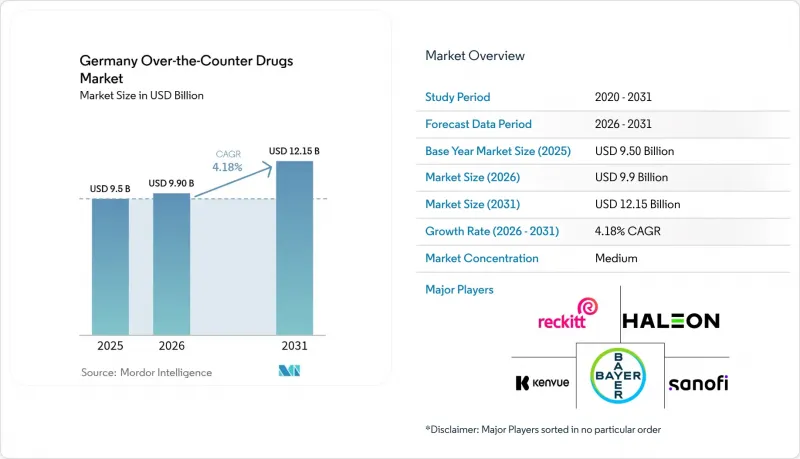
This report is Segmented by Product Type (Cough, Cold and Flu Products, Analgesics, and More), Distribution Channel (Hospital Pharmacies, and More), Dosage Form (Tablets and Caps, and More), Route of Administration(Oral, Topical, and More), Category (Branded OTC and Generic OTC). The Market Sizes and Forecasts are Provided in Terms of Value (USD).
Germany Over-the-Counter Drugs Market Trends and Insights
Ongoing Rx-to-OTC Switch Acceleration
BfArM's streamlined protocols now recognise 15 years of safe EU use for traditional herbal medicines instead of the historic 30, cutting approval times nearly in half. The 2025 Medical Research Act supplements this by allowing confidential price negotiations when manufacturers conduct material R&D in Germany, preserving margins even after a switch. Sanofi's Opella division mirrors industry appetite by gaining FDA clearance for OTC Cialis trials, underscoring global confidence in German regulatory precedents. Wider OTC availability then seeds real-world evidence that supports subsequent switches, reinforcing Germany's reputation as Europe's switch test-bed. The virtuous cycle accelerates revenue diversification and expands therapeutic choice for consumers across the Germany OTC drug market.
Rising Self-Medication & Health-Literacy Levels
Electronic patient records became opt-out in January 2025, giving citizens uniform digital access to diagnoses, labs, and prescription data. Visibility of health data fuels informed OTC decisions and has lifted self-medication prevalence to 40.2% of adults. Academic surveys show 47.2% of women and 33.2% of men use OTCs primarily for prevention rather than acute relief. The behavioral shift translates into EUR 21 billion (USD 24 billion) in annual system savings, highlighting policy interest in OTC expansion. Low preventive-care spending, just 3% of the healthcare budget, creates headroom for growth as insurers and employers sponsor self-care programs to curb future chronic-care costs.
Risk of Misdiagnosis and OTC Abuse
After safety concerns linked to Iberogast's Schollkraut component, Bayer reformulated the product and added mandatory warnings, signaling stricter post-marketing vigilance. Television audits found common breaches of mandatory risk disclosures, prompting new enforcement guidance and higher fines. PPI sales-2.87 billion tablets sold in a 12-month window-exposed off-label use, leading to guidelines capping therapy at 8 weeks for mild reflux. Collectively, tighter pharmacovigilance and advertising rules raise compliance costs and slow first-to-market strategies inside the Germany OTC drug market.
Other drivers and restraints analyzed in the detailed report include:
- Ageing Population Driving Chronic-Care OTC Demand
- Favorable EU Procedures for Well-Established Actives
- Stringent Price/Advertising Controls in Germany
For complete list of drivers and restraints, kindly check the Table Of Contents.
Segment Analysis
Cough, Cold & Flu remedies retained a 22.34% slice of the German OTC drug market size in 2025, yet growth is tapering as milder post-pandemic winters shrink symptom incidence. Weight-loss/Dietary Products headline segment momentum with an 8.78% CAGR through 2031, powered by nutraceutical demand representing 4.1% of global supplement sales. Analgesics sustain relevance via caffeine-enhanced ibuprofen that delivers 50% pain reduction within 2 hours for 90% of study participants. Vitamins, Minerals, and Supplements capitalize on immunity awareness, while dermatology lines benefit from the ageing cohort's skin-health focus. Ophthalmic and sleep-aid niches grow steadily as screen time and stress heighten eye strain and insomnia.
Diverse performance shows how German consumers shift from reactive symptom relief to preventive wellness. Scientific proof points underpin purchasing; herbal adaptogens and sports-nutrition blends succeed only when clinical dossiers substantiate claims. Manufacturers employ staged lifecycles: they start with clinical-grade branded launches and extend into value-priced generics once awareness is built. This approach protects margins while expanding access across income tiers in the German OTC drug market.
Retail Pharmacies safeguarded a 77.40% share in 2025, underpinned by counselling services and insurance reimbursement for select OTCs. Pharmacy numbers, however, dipped below 18,000, the weakest count in 40 years, exposing rural gaps. Online Pharmacies are compounding at 12.40% and are set to narrow the channel disparity as e-prescription ease encourages basket bundling. Hospital Pharmacies remain niche, mainly supplying inpatient needs, while Convenience/Grocery outlets capture impulse buys but face legal limits on SKU breadth.
The Germany OTC drug market therefore orbits an omnichannel core. Click-and-collect keeps local chemists relevant, while pure-play e-pharmacies harness AI chatbots for triage and cross-sell. Regulatory debates around cross-border e-scripts could widen competition if neighboring EU sites secure German fulfilment rights, although technical interoperability hurdles persist.
Complete Report Scope:
- By Product Type
- Cough, Cold & Flu Products
- Analgesics
- Dermatology Products
- Gastrointestinal Products
- Vitamins, Minerals & Supplements (VMS)
- Weight-loss / Dietary Products
- Ophthalmic Products
- Sleeping Aids
- Other Product Types
- By Distribution Channel
- Hospital Pharmacies
- Retail Pharmacies
- Online Pharmacies
- Convenience / Grocery Stores
- By Dosage Form
- Tablets & Caplets
- Liquids & Syrups
- Gummies & Chewables
- Sprays & Drops
- Topicals & Ointments
- By Route of Administration
- Oral
- Topical
- Nasal
- Ophthalmic
- Rectal / Vaginal
- By Category
- Branded OTC
- Private-label / Store Brands
- Generic OTC
List of Companies Covered in this Report:
- Bayer
- Haleon plc
- Kenvue Inc.
- Sanofi
- Reckitt Benckiser Group
- Stada Arzneimittel
- Pfizer
- Novartis
- AstraZeneca
- Takeda Pharmaceuticals
- Bristol-Myers Squibb
- Cardinal Health
- Leo Pharma
- Procter & Gamble
- Aliud Pharma GmbH
- Teva (Ratiopharm)
- Dermapharm Holding SE
- Aristo Pharma GmbH
- Dr. Willmar Schwabe GmbH
- Queisser Pharma GmbH
- Klosterfrau Healthcare Group
Additional Benefits:
- The market estimate (ME) sheet in Excel format
- 3 months of analyst support
TABLE OF CONTENTS
1 Introduction
- 1.1 Study Assumptions & Market Definition
- 1.2 Scope of the Study
2 Research Methodology
3 Executive Summary
4 Market Landscape
- 4.1 Market Overview
- 4.2 Market Drivers
- 4.2.1 Ongoing Rx-To-OTC Switch Acceleration
- 4.2.2 Rising Self-Medication & Health-Literacy Levels
- 4.2.3 Ageing Population Driving Chronic-Care OTC Demand
- 4.2.4 Favorable EU Procedures for Well-Established Actives
- 4.2.5 Expansion Of E-Pharmacies & E-Prescriptions Ecosystem
- 4.2.6 Surge in Demand for Natural/Herbal OTC Alternatives
- 4.3 Market Restraints
- 4.3.1 Risk of Misdiagnosis and OTC Abuse
- 4.3.2 Stringent Price/Advertising Controls in Germany
- 4.3.3 Shrinking Rural Pharmacy Footprint Limits Access
- 4.3.4 Eu Packaging & Serialization Costs Squeeze Margins
- 4.4 Supply-Chain Analysis
- 4.5 Regulatory Landscape
- 4.6 Technological Outlook
- 4.7 Porter's Five Forces
- 4.7.1 Bargaining Power of Suppliers
- 4.7.2 Bargaining Power of Buyers
- 4.7.3 Threat of New Entrants
- 4.7.4 Threat of Substitute Products
- 4.7.5 Intensity of Competitive Rivalry
5 Market Size & Growth Forecasts (Value)
- 5.1 By Product Type
- 5.1.1 Cough, Cold & Flu Products
- 5.1.2 Analgesics
- 5.1.3 Dermatology Products
- 5.1.4 Gastrointestinal Products
- 5.1.5 Vitamins, Minerals & Supplements (VMS)
- 5.1.6 Weight-loss / Dietary Products
- 5.1.7 Ophthalmic Products
- 5.1.8 Sleeping Aids
- 5.1.9 Other Product Types
- 5.2 By Distribution Channel
- 5.2.1 Hospital Pharmacies
- 5.2.2 Retail Pharmacies
- 5.2.3 Online Pharmacies
- 5.2.4 Convenience / Grocery Stores
- 5.3 By Dosage Form
- 5.3.1 Tablets & Caplets
- 5.3.2 Liquids & Syrups
- 5.3.3 Gummies & Chewables
- 5.3.4 Sprays & Drops
- 5.3.5 Topicals & Ointments
- 5.4 By Route of Administration
- 5.4.1 Oral
- 5.4.2 Topical
- 5.4.3 Nasal
- 5.4.4 Ophthalmic
- 5.4.5 Rectal / Vaginal
- 5.5 By Category
- 5.5.1 Branded OTC
- 5.5.2 Private-label / Store Brands
- 5.5.3 Generic OTC
6 Competitive Landscape
- 6.1 Market Concentration
- 6.2 Market Share Analysis
- 6.3 Company Profiles (includes Global level Overview, Market level overview, Core Segments, Financials as available, Strategic Information, Market Rank/Share for key companies, Products, and Recent Developments)
- 6.3.1 Bayer AG
- 6.3.2 Haleon plc
- 6.3.3 Kenvue Inc.
- 6.3.4 Sanofi SA
- 6.3.5 Reckitt Benckiser Group plc
- 6.3.6 STADA Arzneimittel AG
- 6.3.7 Pfizer Inc.
- 6.3.8 Novartis AG
- 6.3.9 AstraZeneca plc
- 6.3.10 Takeda Pharmaceutical Co. Ltd.
- 6.3.11 Bristol-Myers Squibb Co.
- 6.3.12 Cardinal Health Inc.
- 6.3.13 LEO Pharma A/S
- 6.3.14 Procter & Gamble Co.
- 6.3.15 Aliud Pharma GmbH
- 6.3.16 Teva (Ratiopharm)
- 6.3.17 Dermapharm Holding SE
- 6.3.18 Aristo Pharma GmbH
- 6.3.19 Dr. Willmar Schwabe GmbH
- 6.3.20 Queisser Pharma GmbH
- 6.3.21 Klosterfrau Healthcare Group
7 Market Opportunities & Future Outlook
- 7.1 White-space & Unmet-Need Assessment

