PUBLISHER: Mordor Intelligence | PRODUCT CODE: 2119380

PUBLISHER: Mordor Intelligence | PRODUCT CODE: 2119380
Rx-to-OTC Switches - Market Share Analysis, Industry Trends & Statistics, Growth Forecasts (2026 - 2031)
According to Mordor Intelligence, the rx-to-OTC switches market size was valued at USD 45.92 billion in 2025 and is estimated to grow from USD 48.40 billion in 2026 to reach USD 65.39 billion by 2031, at a CAGR of 6.20% during the forecast period (2026-2031).
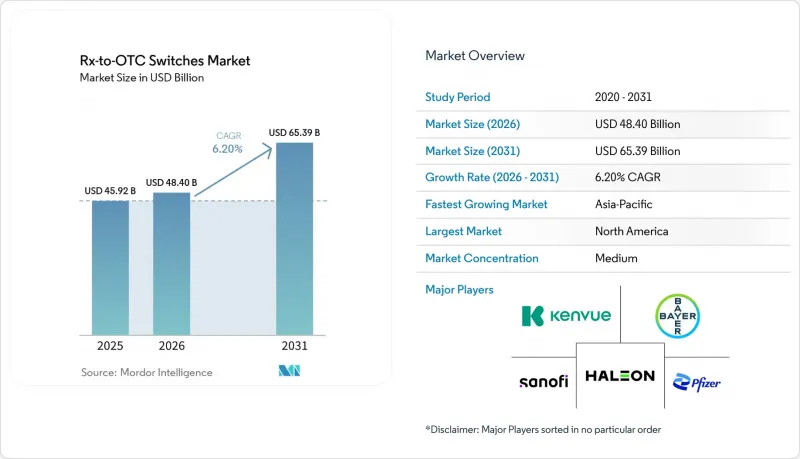
This report is Segmented by Product Type (Allergy and Respiratory Products, Gastrointestinal Drugs, Pain Management Products, and More), Switch Type (Full, Partial, Behind-The-Counter), Dosage Form (Tablets and Capsules, Nasal Sprays, and More), Distribution Channel (Retail Pharmacies, Supermarkets and Hypermarkets and More), and Geography (North America, Europe, and More). Forecasts are Provided in Value (USD).
Global Rx-to-OTC Switches Market Trends and Insights
Consumer Demand for Convenient Self-Care
Consumer preference for self-directed health management now extends beyond minor ailments. People often seek products that can address familiar symptoms without an appointment or a delay at the pharmacy. The Rx-to-OTC Switches Market benefits when consumers recognize a condition and understand the available treatment choices. Choice can also create confusion when similar products present different strengths, warnings, and administration instructions. Clear labeling, shelf navigation, and pharmacist support can help brands convert interest into appropriate selection. Digital channels increasingly influence brand preference before consumers visit a pharmacy or select an item online.
Rising Out-of-Pocket Healthcare Costs
Prescription affordability has become a direct consideration for consumers who must pay part of the cost of care. The Centers for Medicare & Medicaid Services reported that U.S. out-of-pocket spending increased 5.90% to USD 556.60 billion in 2024. This pressure can make nonprescription alternatives more attractive for conditions that consumers can manage safely without supervision. The Rx-to-OTC switches market, therefore, has a broader potential user base in categories with high prescription costs or inconsistent coverage. Sponsors must still show that a switched product can be selected and used correctly outside a traditional prescribing setting. Cost savings alone do not remove the need for appropriate labeling, consumer studies, and ongoing safety oversight.
Consumer Misuse and Self-Selection Risk
Wider nonprescription access can create safety concerns when consumers do not recognize contraindications or warning signs. The World Health Organization has stated that more than half of medicines are prescribed, dispensed, or sold inappropriately worldwide. This concern is relevant to the Rx-to-OTC switches market because a product may be appropriate for many consumers but unsafe for particular groups. The risk is greater where health literacy, access to advice, or pharmacovigilance systems are limited. Sponsors need strong label-comprehension evidence, consumer self-selection studies, and post-market monitoring plans. A failure in one category can also influence regulatory caution toward similar products that are under review.
Other drivers and restraints analyzed in the detailed report include:
- Regulatory Precedents for Safe Switches
- Digital Self-Selection Under Additional Conditions
- High Cost and Long Duration of Switch Programs
For complete list of drivers and restraints, kindly check the Table Of Contents.
Segment Analysis
Allergy and Respiratory Products held 24.56% of product-type revenue in 2025, giving the category the leading share of the Rx-to-OTC switches Market size. The category includes antihistamines, intranasal corticosteroids, and ocular antihistamines that consumers commonly use for familiar symptoms. This history has created established brand awareness and a wide base of generic and store-brand alternatives. The product group also benefits from recurring seasonal demand and clear consumer recognition of allergy symptoms.
Reproductive and Women's Health Products are forecast to grow at a 7.54% CAGR through 2031, the fastest rate within product types. Perrigo's Opill became available in U.S. stores and online in March 2024 as the first daily oral contraceptive sold without a prescription in the United States. The launch confirmed a pathway for hormonal contraception when consumers can use the product safely with accessible information. Dermatology Products and Fungal and Other Infection Products represented smaller categories with defined switch potential.
Full Rx-to-OTC Switch accounted for 52.43% of switch-type revenue in 2025, representing the largest Rx-to-OTC Switches Market share within this classification. This position reflects decades in which a complete reclassification was the primary route to nonprescription access. Established products in allergy, gastrointestinal, and pain categories have created a substantial base of full-switch revenue. Their history can help sponsors understand consumer behavior, label needs, and safety questions for related products.
Behind-the-Counter Switch is forecast to expand at a 6.78% CAGR through 2031. The Additional Condition for Nonprescription Use rule supports this model when a label alone cannot ensure safe self-selection. A pharmacist questionnaire or a digital screening process can provide the extra safeguard needed for access. This route allows products to reach consumers without the normal prescription transaction while keeping controls around selection.
Complete Report Scope:
- By Product Type
- Allergy and Respiratory Products
- Gastrointestinal Drugs
- Pain Management Products
- Reproductive and Women's Health Products
- Dermatology Products
- Fungal and Other Infection Products
- Others (Smoking Cessation and Addiction Products, etc.)
- By Switch Type
- Full Rx-to-OTC Switch
- Partial Rx-to-OTC Switch
- Behind-the-Counter Switch
- By Dosage Form
- Tablets and Capsules
- Nasal Sprays
- Ophthalmic Drops
- Topical Solutions, Creams and Gels
- Transdermal Patches
- By Distribution Channel
- Retail Pharmacies
- Online Pharmacies and E-Commerce
- Supermarkets and Hypermarkets
- Others (Health and Wellness Stores, Institutional/Healthcare Channels)
- By Geography
- North America
- United States
- Canada
- Mexico
- Europe
- Germany
- United Kingdom
- France
- Italy
- Spain
- Rest of Europe
- Asia-Pacific
- China
- India
- Japan
- Australia
- South Korea
- Rest of Asia-Pacific
- Middle East and Africa
- GCC
- South Africa
- Rest of Middle East and Africa
- South America
- Brazil
- Argentina
- Rest of South America
- North America
Geography Analysis
North America held 39.67% of the global Rx-to-OTC switches market revenue in 2025, making it the largest regional contributor. The region has a long record of documented switches and a substantial retail ecosystem for consumer health products. U.S. consumers spent USD 58.20 billion on over-the-counter healthcare products in 2025. Perrigo's Opill retail launch in March 2024 established a new precedent for oral contraceptive access. Europe represented a substantial share of the Rx-to-OTC switches market because national regulators maintain established review processes.
Asia-Pacific is forecast to grow at a 7.45% CAGR through 2031, the highest regional rate in the Rx-to-OTC switches market. China supports the regional base through pharmacy networks, urban expansion, and e-commerce penetration. India has growth potential as organized retail, generic medicine access programs, and smartphone-based pharmacy services change how consumers buy nonprescription products.
- Abbott Laboratories
- Alcon
- AstraZeneca
- Bausch + Lomb Corporation
- Bayer
- Boehringer Ingelheim
- Haleon plc
- Kenvue Inc.
- Merck
- Novartis
- Perrigo Company
- Pfizer
- Prestige Consumer Healthcare
- Procter & Gamble
- Reckitt Benckiser Group
- Sandoz Group AG
- Sanofi
- Takeda Pharmaceuticals
- Teva Pharmaceutical Industries
- Viatris
Additional Benefits:
- The market estimate (ME) sheet in Excel format
- 3 months of analyst support
TABLE OF CONTENTS
1 Introduction
- 1.1 Study Assumptions & Market Definition
- 1.2 Scope of the Study
2 Research Methodology
3 Executive Summary
4 Market Landscape
- 4.1 Market Overview
- 4.2 Market Drivers
- 4.2.1 Consumer Demand for Convenient Self-Care
- 4.2.2 Rising Out-of-Pocket Healthcare Costs
- 4.2.3 Regulatory Precedents for Safe Switches
- 4.2.4 Digital Self-Selection Under Additional Conditions for Nonprescription Use
- 4.2.5 Patent Expiry and Pharmaceutical Lifecycle Optimization
- 4.2.6 Retail and E-Pharmacy Shelf Expansion
- 4.3 Market Restraints
- 4.3.1 Consumer Misuse and Self-Selection Risk
- 4.3.2 High Cost and Long Duration of Switch Programs
- 4.3.3 Brand and Generic Price Erosion After Switch
- 4.3.4 Digital Additional-Condition Infrastructure and Post-Market Governance Burden
- 4.4 Supply-Chain Analysis
- 4.5 Regulatory Landscape
- 4.6 Technological Outlook
- 4.7 Porter's Five Forces Analysis
- 4.7.1 Threat of New Entrants
- 4.7.2 Bargaining Power of Suppliers
- 4.7.3 Bargaining Power of Buyers
- 4.7.4 Threat of Substitutes
- 4.7.5 Industry Rivalry
5 Market Size & Growth Forecasts (Value, USD)
- 5.1 By Product Type
- 5.1.1 Allergy and Respiratory Products
- 5.1.2 Gastrointestinal Drugs
- 5.1.3 Pain Management Products
- 5.1.4 Reproductive and Women's Health Products
- 5.1.5 Dermatology Products
- 5.1.6 Fungal and Other Infection Products
- 5.1.7 Others (Smoking Cessation and Addiction Products, etc.)
- 5.2 By Switch Type
- 5.2.1 Full Rx-to-OTC Switch
- 5.2.2 Partial Rx-to-OTC Switch
- 5.2.3 Behind-the-Counter Switch
- 5.3 By Dosage Form
- 5.3.1 Tablets and Capsules
- 5.3.2 Nasal Sprays
- 5.3.3 Ophthalmic Drops
- 5.3.4 Topical Solutions, Creams and Gels
- 5.3.5 Transdermal Patches
- 5.4 By Distribution Channel
- 5.4.1 Retail Pharmacies
- 5.4.2 Online Pharmacies and E-Commerce
- 5.4.3 Supermarkets and Hypermarkets
- 5.4.4 Others (Health and Wellness Stores, Institutional/Healthcare Channels)
- 5.5 By Geography
- 5.5.1 North America
- 5.5.1.1 United States
- 5.5.1.2 Canada
- 5.5.1.3 Mexico
- 5.5.2 Europe
- 5.5.2.1 Germany
- 5.5.2.2 United Kingdom
- 5.5.2.3 France
- 5.5.2.4 Italy
- 5.5.2.5 Spain
- 5.5.2.6 Rest of Europe
- 5.5.3 Asia-Pacific
- 5.5.3.1 China
- 5.5.3.2 India
- 5.5.3.3 Japan
- 5.5.3.4 Australia
- 5.5.3.5 South Korea
- 5.5.3.6 Rest of Asia-Pacific
- 5.5.4 Middle East and Africa
- 5.5.4.1 GCC
- 5.5.4.2 South Africa
- 5.5.4.3 Rest of Middle East and Africa
- 5.5.5 South America
- 5.5.5.1 Brazil
- 5.5.5.2 Argentina
- 5.5.5.3 Rest of South America
- 5.5.1 North America
6 Competitive Landscape
- 6.1 Market Concentration
- 6.2 Market Share Analysis
- 6.3 Company Profiles {(includes Global level Overview, Market level overview, Core Segments, Financials as available, Strategic Information, Market Rank/Share for key companies, Products & Services, and Recent Developments)}
- 6.3.1 Abbott Laboratories
- 6.3.2 Alcon Inc.
- 6.3.3 AstraZeneca plc
- 6.3.4 Bausch + Lomb Corporation
- 6.3.5 Bayer AG
- 6.3.6 Boehringer Ingelheim International GmbH
- 6.3.7 Haleon plc
- 6.3.8 Kenvue Inc.
- 6.3.9 Merck & Co., Inc.
- 6.3.10 Novartis AG
- 6.3.11 Perrigo Company plc
- 6.3.12 Pfizer Inc.
- 6.3.13 Prestige Consumer Healthcare Inc.
- 6.3.14 Procter & Gamble Company
- 6.3.15 Reckitt Benckiser Group plc
- 6.3.16 Sandoz Group AG
- 6.3.17 Sanofi
- 6.3.18 Takeda Pharmaceutical Company Limited
- 6.3.19 Teva Pharmaceutical Industries Ltd.
- 6.3.20 Viatris Inc.
7 Market Opportunities & Future Outlook
- 7.1 White-space & unmet-need assessment

