PUBLISHER: Mordor Intelligence | PRODUCT CODE: 2116571

PUBLISHER: Mordor Intelligence | PRODUCT CODE: 2116571
ASEAN Online Accommodation - Market Share Analysis, Industry Trends & Statistics, Growth Forecasts (2026 - 2031)
According to Mordor Intelligence, the ASEAN online accommodation market size is expected to grow from USD 27.67 billion in 2025 to USD 30.17 billion in 2026 and is forecast to reach USD 46.48 billion by 2031 at 9.03% CAGR over 2026-2031.
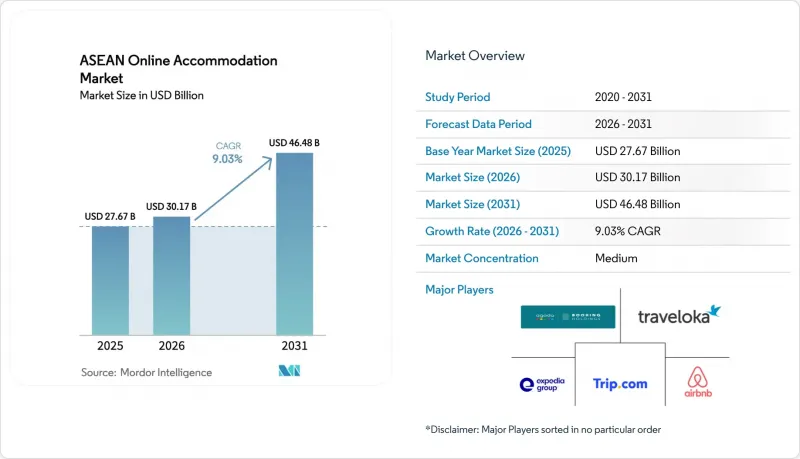
This report is Segmented by Platform Type (Mobile Application and Website), Mode of Booking Type (Third Party Online Portals and Direct/Captive Portals), by Property Type (Hotels & Resorts, Vacation Rentals, Hostels & Budget Accommodations, and Other), and Country (Singapore, Malaysia, Indonesia, Thailand, and Rest of ASEAN). The Market Forecasts are Provided in Terms of Value (USD).
ASEAN Online Accommodation Market Trends and Insights
Growth of Low-Cost Carriers Boosting Intra-ASEAN Leisure Trips
Low-cost carriers, including AirAsia, Scoot, and Cebu Pacific, have strategically increased point-to-point routes, effectively bypassing traditional hub airports. This operational shift has driven significant growth in passenger traffic at secondary airports, highlighting the evolving dynamics of air travel demand. Additionally, the substantial reduction in average leisure fares on key routes, such as Kuala Lumpur to Bangkok and Jakarta to Phuket, has further stimulated travel activity. This fare decline has particularly encouraged weekend travel among middle-income households, reflecting a shift in consumer behavior and preferences within the aviation market. The widened network footprint feeds directly into incremental room nights for emerging beach, cultural, and eco-tourism destinations that previously lacked international lift. Sustained LCC orderbooks for narrow-body aircraft signal capacity growth through the late-2020s, anchoring a durable demand engine for the ASEAN online accommodation market.
Digital Payments Interoperability (QR-Code Cross-Border)
Central-bank-led collaboration has linked domestic e-wallet schemes so that Thai, Malaysian, Indonesian, Vietnamese, and Singaporean tourists can scan familiar QR codes abroad and settle in their home currency. For small and mid-scale lodging operators, the ability to collect digital payments without foreign-merchant accounts removes a key barrier to online distribution. According to industry case studies, implementing streamlined checkout processes significantly enhances booking completion rates, with an observed increase when compared to systems that rely solely on card payment options. This highlights the importance of optimizing payment flows to improve user experience and drive higher conversion rates. Over the next two years, the network is slated to expand to Cambodia, Laos, and the Philippines, making frictionless payments a near-universal feature across the ASEAN online accommodation market.
Fragmented Taxation and Short-Stay Regulations Across ASEAN
Businesses operating in the Southeast Asian hospitality sector face significant challenges due to varying hotel and tourism levies across the region. For instance, Malaysia enforces a straightforward flat RM10 tourism tax, whereas Thailand implements a more intricate framework that includes a multi-layer VAT and TM.30 guest-registration requirements. Providers of alternative accommodations encounter additional complexities, as they must navigate unclear zoning regulations and condominium bylaws. These regulatory ambiguities contribute to the proliferation of a gray market, which undermines the competitiveness of licensed operators. The inconsistent enforcement of these regulations further exacerbates the issue, placing compliant businesses at a disadvantage due to higher operational costs. This disparity not only erodes their price competitiveness but also impedes the overall professionalization and growth of the ASEAN online accommodation market.
Other drivers and restraints analyzed in the detailed report include:
- Post-Pandemic Pent-Up Demand for "Revenge Travel"
- Government Visa-Free Entry Programs
- High Customer-Acquisition Cost on OTAs
For complete list of drivers and restraints, kindly check the Table Of Contents.
Segment Analysis
Mobile Apps accounted for 55.63% of the ASEAN online accommodation market share in 2025, dwarfing desktop channels as travellers pivot to on-the-go planning. Indonesia exemplifies this shift, with more than half of OTA users booking via smartphones as early as 2018. The convenience of fingerprint login saved traveller profiles, and e-wallet checkout underpins a forecast 14.63% CAGR for mobile bookings through 2031. Website interfaces remain relevant for complex multi-city itineraries and corporate travel, yet their growth lags that of app-centric channels.
The ascendancy of apps dovetails with super-app monetization strategies that fuse transport, food delivery, and lodging into a single user journey. Enhanced push-notification targeting and AI-based price alerts further raise app engagement, siphoning share from both traditional desktop portals and call-centre bookings. Regulators, meanwhile, are codifying mobile payment standards that recognize the app as the default commerce environment, cementing its primacy in the ASEAN online accommodation market.
Complete Report Scope:
- By Platform
- Mobile Application
- Website
- By Mode of Booking
- Third-party Online Portals
- Direct/Captive Portals
- By Property Type
- Hotels & Resorts
- Vacation Rentals
- Hostels & Budget Accommodations
- Alternate Lodgings (Glamping, Farm-stays)
- By Geography
- Indonesia
- Thailand
- Malaysia
- Philippines
- Vietnam
- Singapore
- Cambodia
- Laos
- Myanmar
- Brunei
List of Companies Covered in this Report:
- Booking Holdings (Booking.com, Agoda)
- Expedia Group
- Airbnb Inc.
- Traveloka
- Trip.com Group (Trip.com, Skyscanner)
- OYO Rooms
- RedDoorz
- Zen Rooms
- Klook Travel Technology
- Tiket.com
- Pegi-pegi
- Asiatravel.com
- LuxStay
- GoMMT (MakeMyTrip, ibibo)
- Tujia
- Ctrip International
- Hostelworld Group
- Zen Rooms
- Tiket.com
- RedDoorz
Additional Benefits:
- The market estimate (ME) sheet in Excel format
- 3 months of analyst support
TABLE OF CONTENTS
1 Introduction
- 1.1 Study Assumptions & Market Definition
- 1.2 Scope of the Study
2 Research Methodology
3 Executive Summary
4 Market Landscape
- 4.1 Market Overview
- 4.2 Market Drivers
- 4.2.1 Growth of low-cost carriers boosting intra-ASEAN leisure trips
- 4.2.2 Digital payments interoperability (QR-code cross-border)
- 4.2.3 Post-pandemic pent-up demand for "revenge travel"
- 4.2.4 Government visa-free entry programs (e.g., Thailand, Malaysia)
- 4.2.5 Rise of "workcation" remote-work policies
- 4.2.6 Super-app ecosystem cross-selling (Grab, Gojek)
- 4.3 Market Restraints
- 4.3.1 Fragmented taxation / short-stay regulations across ASEAN
- 4.3.2 High customer-acquisition cost on OTAs
- 4.3.3 Limited rural broadband coverage hindering bookings
- 4.3.4 Currency volatility impacting cross-border pricing
- 4.4 Value / Supply-Chain Analysis
- 4.5 Regulatory Landscape
- 4.6 Technological Outlook
- 4.7 Porter's Five Forces
- 4.7.1 Threat of New Entrants
- 4.7.2 Bargaining Power of Buyers
- 4.7.3 Bargaining Power of Suppliers
- 4.7.4 Threat of Substitutes
- 4.7.5 Industry Rivalry
5 Market Size & Growth Forecasts
- 5.1 By Platform
- 5.1.1 Mobile Application
- 5.1.2 Website
- 5.2 By Mode of Booking
- 5.2.1 Third-party Online Portals
- 5.2.2 Direct/Captive Portals
- 5.3 By Property Type
- 5.3.1 Hotels & Resorts
- 5.3.2 Vacation Rentals
- 5.3.3 Hostels & Budget Accommodations
- 5.3.4 Alternate Lodgings (Glamping, Farm-stays)
- 5.4 By Geography
- 5.4.1 Indonesia
- 5.4.2 Thailand
- 5.4.3 Malaysia
- 5.4.4 Philippines
- 5.4.5 Vietnam
- 5.4.6 Singapore
- 5.4.7 Cambodia
- 5.4.8 Laos
- 5.4.9 Myanmar
- 5.4.10 Brunei
6 Competitive Landscape
- 6.1 Market Concentration
- 6.2 Strategic Moves
- 6.3 Market Share Analysis
- 6.4 Company Profiles (includes Global level Overview, Market level overview, Core Segments, Financials as available, Strategic Information, Market Rank/Share for key companies, Products & Services, and Recent Developments)
- 6.4.1 Booking Holdings (Booking.com, Agoda)
- 6.4.2 Expedia Group
- 6.4.3 Airbnb Inc.
- 6.4.4 Traveloka
- 6.4.5 Trip.com Group (Trip.com, Skyscanner)
- 6.4.6 OYO Rooms
- 6.4.7 RedDoorz
- 6.4.8 Zen Rooms
- 6.4.9 Klook Travel Technology
- 6.4.10 Tiket.com
- 6.4.11 Pegi-pegi
- 6.4.12 Asiatravel.com
- 6.4.13 LuxStay
- 6.4.14 GoMMT (MakeMyTrip, ibibo)
- 6.4.15 Tujia
- 6.4.16 Ctrip International
- 6.4.17 Hostelworld Group
- 6.4.18 Zen Rooms
- 6.4.19 Tiket.com
- 6.4.20 RedDoorz
7 Market Opportunities & Future Outlook
- 7.1 Integration with super-apps for seamless trip orchestration
- 7.2 Carbon-neutral & eco-certified lodging demand surge

