PUBLISHER: Mordor Intelligence | PRODUCT CODE: 2116603

PUBLISHER: Mordor Intelligence | PRODUCT CODE: 2116603
India Online Accommodation - Market Share Analysis, Industry Trends & Statistics, Growth Forecasts (2026 - 2031)
According to Mordor Intelligence, the India online accommodation market size was valued at USD 8.95 billion in 2025 and estimated to grow from USD 9.85 billion in 2026 to reach USD 15.94 billion by 2031, at a CAGR of 10.09% during the forecast period (2026-2031).
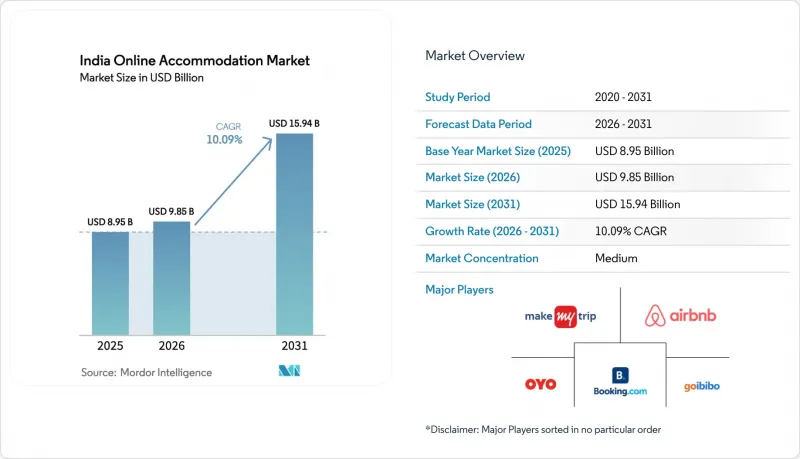
This report is Segmented by Platform (Mobile Application, Website), Mode of Booking (Third-Party Online Portals, Direct/Captive Portals), Property Type (Hotels & Resorts, Vacation Rentals, Hostels & Budget Accommodations, Alternate Lodgings), and Geography (North India, South India, East India, West India, Central India, Northeast India). The Market Forecasts are Provided in Terms of Value (USD).
India Online Accommodation Market Trends and Insights
Smartphone Penetration and Affordable Data Tariffs
Mobile data costs fell below USD 0.20 per GB in 2025, fueling 87.5% usage of apps for search and booking. User engagement rises when connectivity is inexpensive, elevating repeat bookings and shrinking seasonal revenue swings. Tier-2 and Tier-3 cities, once reliant on brick-and-mortar agents, now leap directly to app-based discovery, allowing OTAs to access fresh customer cohorts at lower acquisition costs. Push notifications, location-aware deals, and single-click check-ins deliver convenience that entrenches mobile as the default interface. Platforms benefit from granular behavioral data that drives algorithmic pricing, while travelers receive hyper-personalized suggestions mapping to real-time availability. As 5G rolls out broadly, high-definition images and immersive room tours will further strengthen the mobile value proposition.
UPI-Driven Frictionless Digital Payments
Unified Payments Interface settled 52% more transactions and 40% higher value in H1 2024, trimming historic cart abandonment that exceeded 60% for India online accommodation market bookings . Zero-fee instant transfers raise net margins for small hosts previously paying 2-3% gateway charges. The familiar interface improves trust among first-time digital users, widening the pool of addressable customers well beyond metro geographies. OTAs emphasize India-specific payment rails in their checkout stacks, giving them a competitive moat versus global rivals still optimized for card-based flows. As UPI's credit-on-UPI feature matures, installment-style travel payments could unlock higher-ticket bookings and length-of-stay upgrades. The virtuous loop between seamless payments and rising bookings amplifies scale effects for market leaders.
High OTA Commission Structure Squeezing Margins
Commission rates climbed from 15-18% toward 40-45%, inciting hotel associations to threaten boycotts that forced MakeMyTrip to cap commissions near 22% . Margin compression incentivizes properties to channel-shift toward direct bookings and ONDC-enabled storefronts that forgo intermediary fees. Chains with bargaining clout negotiate tiered rate bands, widening competitive gaps versus independents that lack volumes. OTAs counter by offering bundled ad credits and loyalty integrations that promise revenue lifts, offsetting fee loads. Nevertheless, commission escalation accelerates consolidation as financially stretched small hotels cede market presence to scaled operators. Government scrutiny of pricing parity clauses may further unravel existing commission frameworks.
Other drivers and restraints analyzed in the detailed report include:
- Domestic Leisure and Micro-Vacation Boom
- Millennial Acceptance of Alternative Lodging
- Complex Multi-Layer GST and Compliance Burden
For complete list of drivers and restraints, kindly check the Table Of Contents.
Segment Analysis
Mobile applications controlled 64.84% of India online accommodation market share in 2025 and are anticipated to post a 18.73% compound rate to 2031, whereas desktop websites serve primarily corporate and multi-stop itineraries. The India online accommodation market size for mobile interfaces is set to expand as Hindi and Tamil voice-search penetration multiplies, simplifying query entry for non-English speakers. Push-notification retargeting converts undecided browsers into bookers, while biometric log-ins shrink funnel drop-offs. Location-based dynamic discounting aligns unsold inventory with nearby demand in real time, boosting occupancy without rate erosion. OTA mobile super-apps aggregate transport, experiences, and financial services, embedding accommodation inside broader lifestyle ecosystems that elevate retention. Developers integrate smartphone cameras for visual search, allowing users to scan landmarks and surface proximate lodging options, a feature absent on conventional web platforms. As 5G broadens bandwidth, high-resolution immersive room tours will become table stakes for mobile listings, raising content-creation costs but enhancing trust.
Desktop websites, despite slower growth, remain relevant for large travel management corporations requiring integration with expense systems. They also appeal to longer-lead wedding and MICE bookings that need advanced filters unavailable on mobile. While web traffic as a share of total sessions contracts, its absolute volume edges up due to overall market expansion. OTAs, therefore, pursue responsive design so that hotel partners can manage inventory from any device, minimizing operational friction. Cross-channel user-identifier stitching lets platforms recognize the same traveler moving between mobile and desktop, preserving personalization continuity. The interplay among screen sizes underlines the omnichannel imperative even in a mobile-first nation.
Complete Report Scope:
- By Platform
- Mobile Application
- Website
- By Mode of Booking
- Third-party Online Portals
- Direct/Captive Portals
- By Property Type
- Hotels & Resorts
- Vacation Rentals
- Hostels & Budget Accommodations
- Alternate Lodgings (Glamping, Farm-stays)
- By Geography
- North India
- South India
- East India
- West India
- Central India
- Northeast India
List of Companies Covered in this Report:
- MakeMyTrip
- OYO Rooms
- Goibibo
- Airbnb
- Booking.com
- Agoda
- Expedia
- EaseMyTrip
- Yatra Online
- Ixigo
- FabHotels
- Treebo Hotels
- Cleartrip
- Trip.com Group
- The Hosteller
- Zostel
- Vista Rooms
- SaffronStays
- HappyEasyGo
Additional Benefits:
- The market estimate (ME) sheet in Excel format
- 3 months of analyst support
TABLE OF CONTENTS
1 Introduction
- 1.1 Study Assumptions & Market Definition
- 1.2 Scope of the Study
2 Research Methodology
3 Executive Summary
4 Market Landscape
- 4.1 Market Overview
- 4.2 Market Drivers
- 4.2.1 Smartphone penetration & affordable data tariffs
- 4.2.2 UPI-driven frictionless digital payments
- 4.2.3 Domestic leisure & micro-vacation boom
- 4.2.4 Millennial acceptance of alternative lodging
- 4.2.5 ONDC-enabled zero-commission distribution
- 4.2.6 Vernacular voice-search adoption in Tier-2/3 towns
- 4.3 Market Restraints
- 4.3.1 High OTA commission structure squeezing margins
- 4.3.2 Complex multi-layer GST & compliance burden
- 4.3.3 Escalating cyber-fraud and refund scams
- 4.3.4 Municipal crack-downs on short-term rentals (Goa, Himachal)
- 4.4 Value / Supply-Chain Analysis
- 4.5 Regulatory Landscape
- 4.6 Technological Outlook
- 4.7 Porter's Five Forces
- 4.7.1 Threat of New Entrants
- 4.7.2 Bargaining Power of Suppliers
- 4.7.3 Bargaining Power of Buyers
- 4.7.4 Threat of Substitutes
- 4.7.5 Competitive Rivalry
5 Market Size & Growth Forecasts
- 5.1 By Platform
- 5.1.1 Mobile Application
- 5.1.2 Website
- 5.2 By Mode of Booking
- 5.2.1 Third-party Online Portals
- 5.2.2 Direct/Captive Portals
- 5.3 By Property Type
- 5.3.1 Hotels & Resorts
- 5.3.2 Vacation Rentals
- 5.3.3 Hostels & Budget Accommodations
- 5.3.4 Alternate Lodgings (Glamping, Farm-stays)
- 5.4 By Geography
- 5.4.1 North India
- 5.4.2 South India
- 5.4.3 East India
- 5.4.4 West India
- 5.4.5 Central India
- 5.4.6 Northeast India
6 Competitive Landscape
- 6.1 Market Concentration
- 6.2 Strategic Moves
- 6.3 Market Share Analysis
- 6.4 Company Profiles (includes Global level Overview, Market level overview, Core Segments, Financials as available, Strategic Information, Market Rank/Share for key companies, Products & Services, and Recent Developments)
- 6.4.1 MakeMyTrip
- 6.4.2 OYO Rooms
- 6.4.3 Goibibo
- 6.4.4 Airbnb
- 6.4.5 Booking.com
- 6.4.6 Agoda
- 6.4.7 Expedia
- 6.4.8 EaseMyTrip
- 6.4.9 Yatra Online
- 6.4.10 Ixigo
- 6.4.11 FabHotels
- 6.4.12 Treebo Hotels
- 6.4.13 Cleartrip
- 6.4.14 Trip.com Group
- 6.4.15 The Hosteller
- 6.4.16 Zostel
- 6.4.17 Vista Rooms
- 6.4.18 SaffronStays
- 6.4.19 HappyEasyGo
7 Market Opportunities & Future Outlook
- 7.1 AI-driven hyper-personalised dynamic bundling
- 7.2 Eco-certified stays monetised via carbon-credit tie-ins

