PUBLISHER: Mordor Intelligence | PRODUCT CODE: 2116559

PUBLISHER: Mordor Intelligence | PRODUCT CODE: 2116559
China Online Accommodation - Market Share Analysis, Industry Trends & Statistics, Growth Forecasts (2026 - 2031)
According to Mordor Intelligence, the China online accommodation market size was valued at USD 34.03 billion in 2025 and estimated to grow from USD 37.89 billion in 2026 to reach USD 64.86 billion by 2031, at a CAGR of 11.34% during the forecast period (2026-2031).
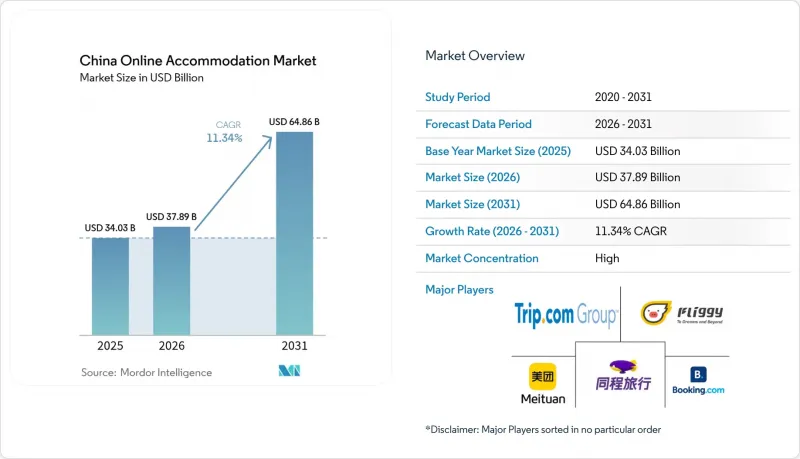
This report is Segmented by Accommodation Type (Hotels, Vacation Rentals / Short-Lets, and More), by Booking Device (Mobile App, Mobile Web, and More), by Platform Type (Online Travel Agencies (OTA), Direct Hotel Apps / Sites, and More), by Customer Type (Leisure / FIT, Business Travel, and More), by Region (East China, North China, and More). The Market Forecasts are Provided in Terms of Value (USD).
China Online Accommodation Market Trends and Insights
Post-pandemic Domestic Tourism Rebound
Holiday periods in 2024 kept that pace, with the Spring Festival alone delivering 474 million trips and upscale-hotel occupancy exceeding 80%. Travellers gravitated toward local experiences, which shifted booking volumes from international to domestic inventory and opened incremental demand in rural destinations. Nearly 800 million visitors explored countryside attractions during Q1 2024, prompting platforms to fast-track listings in peripheral counties. The surge unlocked new lodge construction outside urban cores and broadened the China online accommodation market footprint.
Rise of Experience-Based Travel
Millennials and Gen Z now prioritize immersive stays: 77% of their trips are booked less than a month in advance, favoring spontaneous weekend getaways. "Traveling-at-home" trends-young residents checking into hotels in their hometowns-boosted local bookings during major holidays. Hotels, hostels and vacation rentals are weaving regional decor and artisanal workshops into packages to satisfy authenticity cravings. Douyin's short-video creators amplify this shift by linking viral content to instant booking pages, a loop that accelerates conversion for boutique stays. As cultural immersion becomes mainstream, experience-themed inventory raises ADRs across secondary cities, fortifying long-tail supply on leading platforms.
OTA Commission Pressure on Hotel Margins
Large OTAs command up to 20% commissions, eroding profitability for budget and mid-range operators. Continuous customer-acquisition spending by platforms pushes commissions higher, and independent properties lack scale to negotiate relief. To offset rising costs, hotels roll out direct-booking apps and partnership loyalty schemes, yet open-web marketing expenses temper their effectiveness. The imbalance is expected to nudge asset-light franchises and monarchized models forward, as they offer combined brand awareness and margin resilience.
Other drivers and restraints analyzed in the detailed report include:
- Growth of OTAs and Super Apps
- Government Support and Regulatory Clarity
- Cyber-security and Data-privacy Regulations (PIPL)
For complete list of drivers and restraints, kindly check the Table Of Contents.
Segment Analysis
Hotels captured 68.05% of China's online accommodation market revenue in 2025, a testament to entrenched loyalty programs and robust distribution through major OTAs. Vacation rentals and short-lets, however, are projected to grow at a 14.03% CAGR, driven by travelers appetite for home-style amenities in emerging leisure hubs. Tujia lists more than 2.3 million units, giving it roughly 60% share of the niche and signaling that branded inventory curation is displacing informal hosts. Diversification is growing serviced apartments win favor among relocating professionals, while rural homestays expand as agritourism booms. Capsule hotels keep attracting value-focused Gen Z guests, yet premiumization across the broader China online accommodation market limits their long-run ceiling.
Preference for authenticity feeds a pipeline of hybrid models that fuse hotel services with residential layouts. Operators pilot subscription-based packages granting pool access and co-working space, aligning with digital-nomad habits. Domestic REITs include compliant homestay portfolios, reflecting investor belief in experience-driven demand. The market is therefore expected to witness intensified competition between asset-heavy hotel groups and asset-light rental platforms, each racing to widen supply breadth without compromising service standards.
Mobile apps controlled 81.75% of the China online accommodation market share in 2025 and are on course for a 17.12% CAGR through 2031 as super-apps weave reservation capabilities into daily utilities. With built-in wallets and loyalty points, users can book, pay and review within a single interface, collapsing the path-to-purchase into seconds. The China online accommodation market rewards speed: abandoned-cart rates drop sharply when biometric payment shortcuts auto-populate guest information.
Browser-based mobile sites retain value for extended research, especially among older demographics who prefer larger font scaling, yet they concede traffic as app UX refined. Desktop usage now concentrates on corporate travel desks where multi-traveler workflows matter most. Continuous rollouts of AI chatbots, live-stream showrooms and augmented-reality room previews maintain user attention, ensuring that mobile remains the defining battleground for platform differentiation.
Complete Report Scope:
- By Accommodation Type
- Hotels
- Vacation Rentals / Short-lets
- Hostels and Capsule Hotels
- Serviced Apartments
- By Booking Device
- Mobile App
- Mobile Web
- Desktop / Laptop
- By Platform Type
- Online Travel Agencies (OTA)
- Direct Hotel Apps / Sites
- Super-app Ecosystems (WeChat Mini-Programs)
- By Customer Type
- Leisure / FIT
- Business Travel
- Group and MICE
- Long-stay / Relocation
- By Region
- East China
- North China
- Northeast China
- South-Central China
- Southwest China
- Northwest China
- Hong Kong and Macau SARs
- Taiwan Region
List of Companies Covered in this Report:
- Trip.com Group (Ctrip, Qunar, Skyscanner)
- Meituan
- Tongcheng Travel (LY.com, Elong)
- Fliggy (Alibaba)
- Booking.com
- Airbnb
- Huazhu Group
- H World (Jin Jiang)
- Marriott International
- Accor Greater China
- Wyndham Hotels & Resorts
- Hilton Worldwide
- Atour Hotel Group
- GreenTree Hospitality
- BTG Homeinns
- Xiaozhu
- Tujia
- Yaduo Hotel
- Radisson Hotel Group
- Sonder*
Additional Benefits:
- The market estimate (ME) sheet in Excel format
- 3 months of analyst support
TABLE OF CONTENTS
1 Introduction
- 1.1 Study Assumptions & Market Definition
- 1.2 Scope of the Study
2 Research Methodology
3 Executive Summary
4 Market Landscape
- 4.1 Market Overview
- 4.2 Market Drivers
- 4.2.1 Post-pandemic domestic tourism rebound
- 4.2.2 Rise of Experience-Based Travel
- 4.2.3 Growth of OTAs and Super Apps
- 4.2.4 Government Support and Regulatory Clarity
- 4.2.5 High Internet and Smartphone Penetration
- 4.2.6 Urbanization and Tier Expansion
- 4.3 Market Restraints
- 4.3.1 OTA commission pressure on hotel margins
- 4.3.2 Cyber-security and data-privacy regulations (PIPL)
- 4.3.3 Shrinking supply of urban budget hotels
- 4.3.4 Inter-platform price-parity clamp-downs
- 4.4 Value / Supply-Chain Analysis
- 4.5 Regulatory Landscape
- 4.6 Technological Outlook
- 4.7 Porter's Five Forces
- 4.7.1 Threat of New Entrants
- 4.7.2 Bargaining Power of Suppliers
- 4.7.3 Bargaining Power of Buyers
- 4.7.4 Threat of Substitutes
- 4.7.5 Competitive Rivalry
5 Market Size & Growth Forecasts (Value, RMB bn)
- 5.1 By Accommodation Type
- 5.1.1 Hotels
- 5.1.2 Vacation Rentals / Short-lets
- 5.1.3 Hostels and Capsule Hotels
- 5.1.4 Serviced Apartments
- 5.2 By Booking Device
- 5.2.1 Mobile App
- 5.2.2 Mobile Web
- 5.2.3 Desktop / Laptop
- 5.3 By Platform Type
- 5.3.1 Online Travel Agencies (OTA)
- 5.3.2 Direct Hotel Apps / Sites
- 5.3.3 Super-app Ecosystems (WeChat Mini-Programs)
- 5.4 By Customer Type
- 5.4.1 Leisure / FIT
- 5.4.2 Business Travel
- 5.4.3 Group and MICE
- 5.4.4 Long-stay / Relocation
- 5.5 By Region
- 5.5.1 East China
- 5.5.2 North China
- 5.5.3 Northeast China
- 5.5.4 South-Central China
- 5.5.5 Southwest China
- 5.5.6 Northwest China
- 5.5.7 Hong Kong and Macau SARs
- 5.5.8 Taiwan Region
6 Competitive Landscape
- 6.1 Market Concentration
- 6.2 Strategic Moves
- 6.3 Market Share Analysis
- 6.4 Company Profiles (includes Global level Overview, Market level overview, Core Segments, Financials as available, Strategic Information, Market Rank/Share for key companies, Products & Services, and Recent Developments)
- 6.4.1 Trip.com Group (Ctrip, Qunar, Skyscanner)
- 6.4.2 Meituan
- 6.4.3 Tongcheng Travel (LY.com, Elong)
- 6.4.4 Fliggy (Alibaba)
- 6.4.5 Booking.com
- 6.4.6 Airbnb
- 6.4.7 Huazhu Group
- 6.4.8 H World (Jin Jiang)
- 6.4.9 Marriott International
- 6.4.10 Accor Greater China
- 6.4.11 Wyndham Hotels & Resorts
- 6.4.12 Hilton Worldwide
- 6.4.13 Atour Hotel Group
- 6.4.14 GreenTree Hospitality
- 6.4.15 BTG Homeinns
- 6.4.16 Xiaozhu
- 6.4.17 Tujia
- 6.4.18 Yaduo Hotel
- 6.4.19 Radisson Hotel Group
- 6.4.20 Sonder*
7 Market Opportunities & Future Outlook
- 7.1 White-space & Unmet-need Assessment

