PUBLISHER: Mordor Intelligence | PRODUCT CODE: 2116647

PUBLISHER: Mordor Intelligence | PRODUCT CODE: 2116647
Spain Tropical Fruits - Market Share Analysis, Industry Trends & Statistics, Growth Forecasts (2026 - 2031)
According to Mordor Intelligence, the Spain tropical fruits market size was valued at USD 1.44 billion in 2025 and estimated to grow from USD 1.47 billion in 2026 to reach USD 1.66 billion by 2031, at a CAGR of 2.38% during the forecast period (2026-2031).
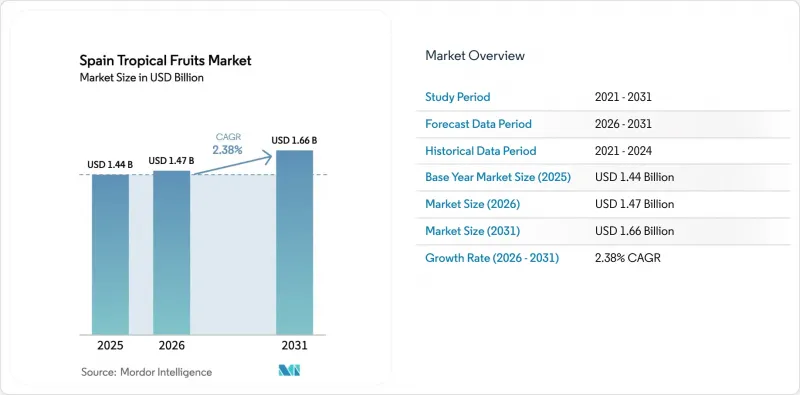
The Spain Tropical Fruits Market Report Includes Production Analysis (Volume), Consumption Analysis (Value and Volume), Export Analysis (Value and Volume), Import Analysis (Value and Volume), and Price Trend Analysis. The Market Forecasts are Provided in Terms of Value (USD) and Volume (Metric Tons).
Spain Tropical Fruits Market Trends and Insights
Rising Health-and-Wellness Purchasing
Sales of antioxidant-rich mango, papaya, and guava rise as older consumers look for heart-supportive and immune-boosting foods. Retail scanners show premium tropical fruit stock-keeping units earning 15-20% higher margins than conventional counterparts, encouraging supermarkets to spotlight origin and nutrition on shelf labels. Producer groups couple controlled irrigation with harvest-maturity indices to safeguard vitamin C and phenolic content, reinforcing the perception of tropical fruits as functional staples rather than indulgent treats. E-commerce platforms amplify the trend by offering mixed "immune packs" containing assorted exotic fruit portions. Altogether, the health narrative steadily widens the customer base for the Spain tropical fruits market.
Growing Immigrant Communities Broadening Taste
American and Asian residents consume nearly double the per-capita exotic fruit volume of native Spaniards, and their culinary preferences now influence mainstream assortments. Urban ethnic restaurants and specialty grocers source hard-to-find varieties, sparking curiosity among local diners who later replicate dishes at home. Second-generation households maintain traditional fruit recipes but benefit from higher disposable incomes, translating to larger basket sizes. The demographic effect concentrates in Madrid, Barcelona, and Valencia, three regions that together absorb more than 60% of imported passion fruit, guava, and lychee shipments. In turn, wholesalers route higher volumes from Andalusia and Murcia farms to meet metropolitan demand seasons, reinforcing the Spain tropical fruits market's urban pull.
Stringent EU MRL and Phytosanitary Checks
New Commission Regulation (EU) 2024/1314 tightens allowable pesticide residues for tropical fruits, obliging growers to refresh integrated pest-management protocols. Compliance adds laboratory fees and may force early harvests that reduce sugar accumulation, trimming profitability. Import bans linked to Phyllosticta citricarpa detections in third-country fruit have prompted auditing of packinghouses and expanded buffer zones. Smaller orchards lack funds for real-time residue testing and certification, deterring entry. Thus, regulatory rigor nudges the Spain tropical fruits market toward consolidation around capital-rich operators.
Other drivers and restraints analyzed in the detailed report include:
- Retail Private-Label Premiumization
- Expansion of Canary Banana PGI Promotional Programs
- High Logistics Cost from Island Production Centers
For complete list of drivers and restraints, kindly check the Table Of Contents.
Complete Report Scope:
- Production Analysis (Volume)
- Consumption Analysis (Value and Volume)
- Export Analysis (Value and Volume)
- Import Analysis (Value and Volume)
- Price Trend Analysis
Additional Benefits:
- The market estimate (ME) sheet in Excel format
- 3 months of analyst support
TABLE OF CONTENTS
1 Introduction
- 1.1 Study Assumptions and Market Definition
- 1.2 Scope of the Study
2 Research Methodology
3 Executive Summary
4 Market Landscape
- 4.1 Market Overview
- 4.2 Market Drivers
- 4.2.1 Rising health-and-wellness purchasing
- 4.2.2 Growing immigrant communities broadening taste
- 4.2.3 Retail private-label premiumization
- 4.2.4 Expansion of Canary banana PGI promotional programs
- 4.2.5 Controlled-atmosphere shipping corridor
- 4.2.6 Indoor cultivation pilots for subtropical crops
- 4.3 Market Restraints
- 4.3.1 Stringent EU MRL and phytosanitary checks
- 4.3.2 High logistics cost from island production centers
- 4.3.3 Water-scarcity risk
- 4.3.4 Limited R&D incentives for niche tropical varieties
- 4.4 Regulatory Landscape
- 4.5 Technological Outlook
- 4.6 Value/Supply-Chain Analysis
- 4.7 PESTEL Analysis
5 Market Size and Growth Forecasts
- 5.1 Production Analysis (Volume)
- 5.2 Consumption Analysis (Value and Volume)
- 5.3 Export Analysis (Value and Volume)
- 5.4 Import Analysis (Value and Volume)
- 5.5 Price Trend Analysis
6 Competitive Landscape
- 6.1 List of Stakeholders
- 6.1.1 Dole plc
- 6.1.2 Fyffes (Sumitomo Corporation)
- 6.1.3 Anecoop
- 6.1.4 Frutas Montosa (JOSE LUIS MONTOSA, S.L.U.)
- 6.1.5 Tropical Millenium S.L.
- 6.1.6 Grupo La Cana (Cana Nature)
- 6.1.7 Reyes Gutierrez
- 6.1.8 Grupo Palmar
- 6.1.9 Frutas Poveda S.A.
- 6.1.10 Natural Tropic
7 Market Opportunities and Future Outlook

