PUBLISHER: Mordor Intelligence | PRODUCT CODE: 2116656

PUBLISHER: Mordor Intelligence | PRODUCT CODE: 2116656
Singapore Used Car - Market Share Analysis, Industry Trends & Statistics, Growth Forecasts (2026 - 2031)
According to Mordor Intelligence, the Singapore used car market size is expected to grow from USD 5.04 billion in 2025 to USD 5.42 billion in 2026 and is forecast to reach USD 7.77 billion by 2031 at a 7.49% CAGR over 2026-2031.
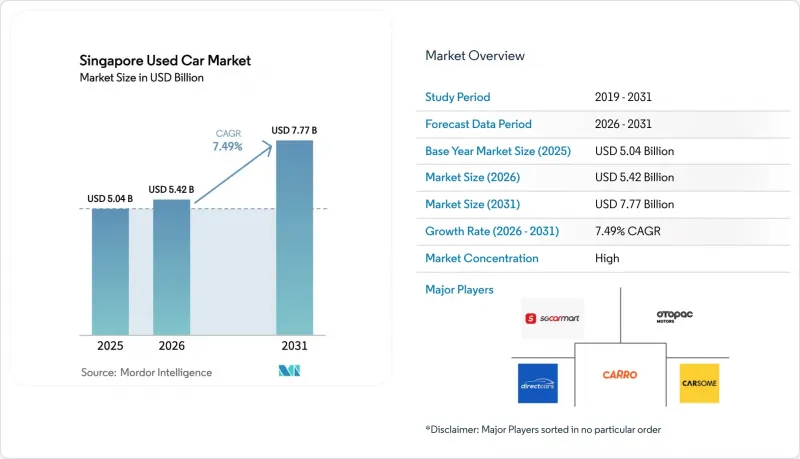
This report is Segmented by Vehicle Type (Hatchback, Sedan, Sports Utility Vehicle (SUVs), and Multi-Purpose Vehicle (MPVs)), Vendor Type (Organised Dealers & Platforms and Unorganised), Booking Type (Online and Offline), and Fuel Type (Gasoline, Diesel, and More). The Market Sizes and Forecasts are Provided in Terms of Value (USD) and Volume (Units) for all the Above Segments.
Singapore Used Car Market Trends and Insights
AI-Based Credit-Scoring Unlocks Sub-Prime Demand
Traditional banks declined roughly 30% of used-car loan applications due to thin files or irregular income. Still, AI-driven underwriting parses alternative data-such as utility payments, rental history, and mobile top-ups-to issue risk scores in minutes. SgCarMart's Smart Loan supports a fully digital process, including application via MyInfo and quick approval. United Overseas Bank mirrored this strategy with digital auto loans, which grew by around 40% year-over-year. Uptake is especially strong in the North-East Region, where younger households earning below SGD 8,000 monthly finance seven-year-old Japanese sedans for SGD 60,000-80,000. Wider risk modeling is broadening the eligible borrower pool and reinforcing liquidity for the Singapore used car market.
Rapid Expansion of Online-to-Offline Marketplaces
SgCarMart's monthly listings cement a liquidity moat that obliges even individual sellers to pay commissions for visibility. Carsome markets a 175-point inspection; Carro's 160-point inspection references proprietary technology, including computer visioning to detect sub-millimeter paint thickness variations, reducing disputes by approximately 35% and converting premium shoppers who fear latent accident damage. Central and East residents, dominated by tech-savvy professionals, make up 60% of digital bookings, while buyers in the West and North cling to offline negotiations. Aggregators that bundle ancillary services-road-tax renewal, insurance comparison, loan brokerage-are driving engagement and extending monetization beyond basic listings.
MRT Network Extensions Curtailing Demand
Thomson-East Coast Line Stage 4 (TEL4) opened in June 2024, adding seven stations from Tanjong Rhu to Bayshore and shortened commutes for riders, coinciding with a significant drop in private-car registrations inside 500-meter catchments. The public-transport modal share reached over 60% of peak trips, and ongoing Cross Island Line construction will further deepen this shift. Households in North-East towns show comparatively lower car ownership than the national mean. Subscription services appeal to this demographic but also cannibalize used-car purchases that typically enter the secondary pool after seven years. As the MRT network densifies, incremental demand for pre-owned vehicles will moderate.
Other drivers and restraints analyzed in the detailed report include:
- Rise of OEM-Backed Certified Pre-Owned Programs
- EV Early-Adopter Incentives Spurring ICE Trade-ins
- Rise of On-Demand Mobility & Car-Subscription Services
For complete list of drivers and restraints, kindly check the Table Of Contents.
Segment Analysis
Sedans captured 52.64% of the market size in 2025, solidifying their position as the largest slice of the Singapore used car market. Compact footprints ease navigation through multi-story carparks and Electronic Road Pricing gantries, aligning with dense urban infrastructure. Toyota Corolla Altis and Honda Civic models account for the majority of sedan listings and have slid off 2023 values as early BEV adopters liquidate ICE inventory under ETS incentives. Hatchbacks serve urban singles seeking fuel economy and lower road-tax bands. SUVs and MPVs are on a 7.81% CAGR trajectory as family-formation demographics prioritize third-row seating and perceived safety.
Computer-vision inspection, pioneered by Carro, has significantly reduced SUV post-sale disputes, alleviating buyer concerns about off-road abuse and water damage. Vehicle Emissions Scheme surcharges penalize large SUVs with USD 20,000 levies, yet the constraint suppresses new-car deliveries, indirectly lifting residual values in the Singapore used car market. Hatchbacks and sedans attract minimal VES penalties but face higher resale velocity pressure because of abundant supply. The Central Region's condominium dwellers display balanced demand, while North and West buyers lean toward sedans as budget priorities and older HDB carparks favor smaller dimensions.
Organized dealers and platforms commanded 63.78% share of the Singapore used car market in 2025, expanding at a 6.51% CAGR. SgCarMart's lattice of 80,000 listings delivers network effects that funnel even private sellers into its pay-to-list model, ensuring supply density and price discovery. Carro integrates inspection, financing, and warranties to slash transaction cycles by up to 25% and monetize ancillary services. Carsome uses 175-point computer-vision protocols to justify price premiums over unverified rivals.
Unorganized sellers retain a 36.22% share by discounting up to 8% but suffer significantly longer days-to-sale. Higher-income Central and East buyers prefer warranties and post-sale support, driving an organized-dealer bias. Motorist.sg's insurance comparison, loan brokerage, and road-tax renewal bundle underscores the movement toward ecosystem experiences. OEM CPO programs occupy a subtle portion of organized-dealer throughput and are scaling at a robust CAGR among expatriates and high-net-worth individuals who equate brand warranties with lower residual-value risk.
Complete Report Scope:
- By Vehicle Type
- Hatchbacks
- Sedans
- Sports Utility Vehicles (SUVs) and Multi-purpose Vehicles (MPVs)
- By Vendor Type
- Organized Dealers and Platforms
- Unorganized (Individual/Small Lots)
- By Booking Type
- Online
- Offline
- By Fuel Type
- Gasoline
- Diesel
- Hybrid Electric Vehicles (HEV)
- Plug-in Hybrid Electric Vehicles (PHEV)
- Battery Electric Vehicles (BEV)
- Other Fuel Types
List of Companies Covered in this Report:
- Carro
- Carsome Sdn. Bhd.
- Sgcarmart
- Otopac Motors Pte. Ltd.
- Motorist Pte. Ltd.
- Vincar Pte. Ltd.
- Platinum Motoring
- Cosmo Automobiles
- Republic Auto
- SG Car Choice
- Borneo Motors (Pre-Owned)
- Wearnes Automotive (Pre-Owned)
- Performance Motors (BMW Approved)
- Cycle & Carriage Certified Pre-Owned
- Eurokars Pre-Owned
- AutoInc
- Komoco Certified Pre-Owned
- Prime Pre-Owned
Additional Benefits:
- The market estimate (ME) sheet in Excel format
- 3 months of analyst support
TABLE OF CONTENTS
1 Introduction
- 1.1 Study Assumptions and Market Definition
- 1.2 Scope of the Study
2 Research Methodology
3 Executive Summary
4 Market Landscape
- 4.1 Market Overview
- 4.2 Market Drivers
- 4.2.1 AI-Based Credit-Scoring Unlocks Sub-Prime Buyer Segment
- 4.2.2 Rapid Expansion of Online-to-Offline (O2O) Marketplaces
- 4.2.3 Rise of OEM-backed Certified Pre-Owned (CPO) Programs
- 4.2.4 EV Early-Adopter Incentives Spurring ICE Trade-ins
- 4.2.5 Escalating Cost of New-Car Ownership (COE, ARF) - Fuels Demand for Used Units
- 4.2.6 High Depreciation Rates Encourage Earlier Disposals
- 4.3 Market Restraints
- 4.3.1 MRT Network Extensions Curtailing Private-Car Demand
- 4.3.2 Rise of On-Demand Mobility and Car-Subscription Services
- 4.3.3 Stringent Import and Emission Regulations
- 4.3.4 Tight Domestic Supply of Popular Models
- 4.4 Value / Supply-Chain Analysis
- 4.5 Regulatory Landscape
- 4.6 Technological Outlook (Digital Retailing, AI Pricing Engines)
- 4.7 Porter's Five Forces
- 4.7.1 Threat of New Entrants
- 4.7.2 Bargaining Power of Buyers/Consumers
- 4.7.3 Bargaining Power of Suppliers
- 4.7.4 Threat of Substitute Products
- 4.7.5 Intensity of Competitive Rivalry
5 Market Size and Growth Forecasts (Value, Volume)
- 5.1 By Vehicle Type
- 5.1.1 Hatchbacks
- 5.1.2 Sedans
- 5.1.3 Sports Utility Vehicles (SUVs) and Multi-purpose Vehicles (MPVs)
- 5.2 By Vendor Type
- 5.2.1 Organized Dealers and Platforms
- 5.2.2 Unorganized (Individual/Small Lots)
- 5.3 By Booking Type
- 5.3.1 Online
- 5.3.2 Offline
- 5.4 By Fuel Type
- 5.4.1 Gasoline
- 5.4.2 Diesel
- 5.4.3 Hybrid Electric Vehicles (HEV)
- 5.4.4 Plug-in Hybrid Electric Vehicles (PHEV)
- 5.4.5 Battery Electric Vehicles (BEV)
- 5.4.6 Other Fuel Types
6 Competitive Landscape
- 6.1 Market Concentration
- 6.2 Strategic Moves
- 6.3 Market Share Analysis
- 6.4 Company Profiles (Includes Global level Overview, Market level overview, Core Segments, Financials as available, Strategic Information, Market Rank/Share for key companies, Products and Services, and Recent Developments)
- 6.4.1 Carro
- 6.4.2 Carsome Sdn. Bhd.
- 6.4.3 Sgcarmart
- 6.4.4 Otopac Motors Pte. Ltd.
- 6.4.5 Motorist Pte. Ltd.
- 6.4.6 Vincar Pte. Ltd.
- 6.4.7 Platinum Motoring
- 6.4.8 Cosmo Automobiles
- 6.4.9 Republic Auto
- 6.4.10 SG Car Choice
- 6.4.11 Borneo Motors (Pre-Owned)
- 6.4.12 Wearnes Automotive (Pre-Owned)
- 6.4.13 Performance Motors (BMW Approved)
- 6.4.14 Cycle & Carriage Certified Pre-Owned
- 6.4.15 Eurokars Pre-Owned
- 6.4.16 AutoInc
- 6.4.17 Komoco Certified Pre-Owned
- 6.4.18 Prime Pre-Owned
7 Market Opportunities and Future Outlook
- 7.1 White-Space and Unmet-Need Assessment

