PUBLISHER: Mordor Intelligence | PRODUCT CODE: 2116657

PUBLISHER: Mordor Intelligence | PRODUCT CODE: 2116657
Spain Used Car - Market Share Analysis, Industry Trends & Statistics, Growth Forecasts (2026 - 2031)
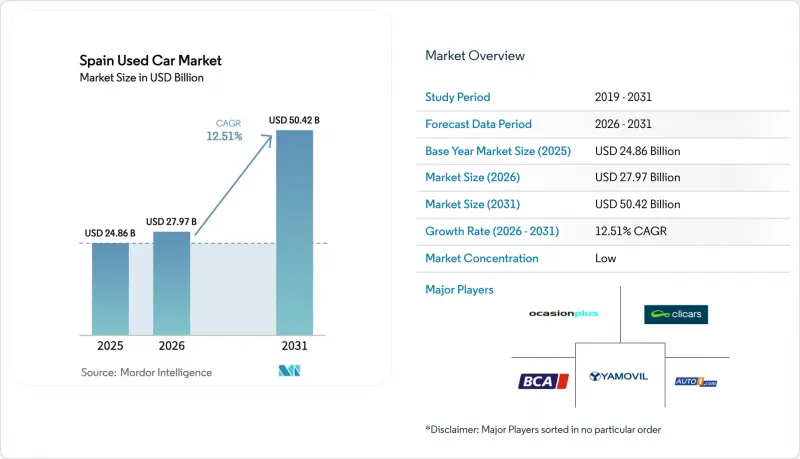
According to Mordor Intelligence, the Spain used car market size was valued at USD 24.86 billion in 2025 and is estimated to grow from USD 27.97 billion in 2026 to reach USD 50.42 billion by 2031, at a CAGR of 12.51% during the forecast period (2026-2031), as tightening Euro 7 rules and macroeconomic caution channel buyers toward affordable second-hand mobility.
[1] Directorate-General for Mobility and Transport, "Euro 7 Vehicle Emissions Proposal," European Commission, ec.europa.eu Demand is reinforced by a national fleet whose average age exceeds 14 years, a factor that broadens the stock of trade-ins, compresses depreciation in older diesel inventory, and raises the appeal of younger, electrified models. This report is Segmented by Vehicle Body Style (Hatchbacks, Sedans, and More), Vendor Type (Organized, and Unorganized), Booking Type (Online and Offline), Fuel Type (Petrol, Diesel, and More), Vehicle Age (0-2 Years, 3-5 Years, and More), Price Band, Customer Type, and Region. The Market Forecasts are Provided in Terms of Value (USD) and Volume (Units).
Spain Used Car Market Trends and Insights
Growing Supply of Off-Lease and Rental Fleet Vehicles Adds Younger Inventory
In Spain's used-car market, an unprecedented influx of near-new stock is being injected as leasing fleets, now exceeding significant volumes, return vehicles after approximately 2 years. Arval's MotorTrade platform, a key player, annually pushes a substantial number of units and has shown remarkable growth in its Re-lease proposition, which recontracts late-model cars. Meanwhile, rental companies are disposing of cars within a shorter time frame, driving growth in the younger vehicle segment. This influx of younger vehicles not only elevates average quality and reduces reconditioning times but also bolsters the rise of certified pre-owned programs, which come bundled with warranties and roadside assistance.
EU Emissions Rules Enlarging Pool of Trade-Ins for Older ICE Vehicles
Euro 7 standards, scheduled to take effect from 2025, raise the cost of ownership for aging diesel and petrol cars, encouraging owners to dispose of non-compliant units before urban low-emission zones tighten enforcement. Spain's fleet age of 14.2 years is driving a surge of diesel trade-ins that are now facing rapid price compression, particularly in the 6-8-year bracket. In a bid to hasten fleet renewal, Royal Decree Law 4/2024 offers accelerated depreciation for low-emission vehicles. This incentive is pushing fleet operators to refresh their assets at a quicker pace. Certain regions are experiencing the largest influx of older internal combustion engine (ICE) vehicles. This trend is altering the dealer landscape, as organized vendors pivot to focus on younger inventory for better margins. The uptick in supply is making consumers more price-sensitive, a trend that favors larger marketplaces adept at algorithmic pricing.
Rapid Depreciation Risk for ICE Assets Amid Electrification
Transactions continue to be led by diesel units, yet these units are witnessing sharper price drops, coinciding with a significant decline in new diesel registrations. Current data indicates that young BEVs are sitting on the market for extended periods, pointing to an oversupply and potential risks to their residual value. In contrast, petrol and hybrid units are spending less time on the market. Dealers, particularly those with substantial diesel inventories, are feeling the pinch. They're slashing margins to offload stock, especially for older cars nearing their annual ITV inspections. With low-emission zone restrictions tightening in Madrid and Barcelona, the stakes are raised, steering buyers more towards hybrid options.
Other drivers and restraints analyzed in the detailed report include:
- End-to-End Digital Retail Platforms With Home Delivery
- Economic Uncertainty Heightens Value-Conscious Consumer Behavior
- Sparse Public Charging Limits Residuals on Used EVs
For complete list of drivers and restraints, kindly check the Table Of Contents.
Segment Analysis
Sport Utility Vehicles (SUVs) and Multi-Purpose Vehicles (MPVs) accounted for 46.03% of sales in 2025 and are growing at a 13.45% CAGR, outpacing hatchbacks and sedans as families seek higher seating positions and flexible cargo space. Fleet disposals supply late-model hybrids such as the Tucson and Sportage, bolstering fuel-efficient choices. The Spanish used-car market for SUVs is projected to expand further as OEMs focus new-car launches on crossover designs, ensuring a robust secondary pipeline. Hatchbacks remain popular in urban areas where parking density favors compact dimensions, yet their share declines in absolute terms.
Demand drivers include tax incentives for low-emission SUVs, improved mild-hybrid efficiency, and stronger residuals linked to consumer preference stability. As public charging improves, electrified SUVs will likely displace older diesel MPVs, raising average transaction values. The Spanish used-car market share for SUVs is therefore poised to expand by the decade's end if current flow dynamics persist.
Unorganized dealers controlled 66.13% of transactions in 2025, yet organized channels are compounding at 14.65% annually by 2031. Margin compression to 3-5% is offset by financing commissions and high sales velocity. Platforms integrate miDGT reports, blockchain verification, and 14-day returns to differentiate on transparency. The Spanish used car market size attributable to organized vendors is set to expand by 2031 as rural penetration improves.
Unorganized outlets retain strength in rural areas where personal relationships and flexible cash terms persist. However, as smartphone adoption saturates and bank partnerships extend credit scoring deeper into the population, digital marketplaces gain further leverage. Their ability to guarantee vehicle quality and deliver cars nationwide within hours reshapes buyer expectations, raising switching costs back to traditional lots.
Online bookings will grow at a 15.46% CAGR as younger buyers prioritize convenience. Virtual 360-degree tours, single-click financing approval, and two-hour delivery reduce buying friction by a step change. Offline channels remain dominant with a 75.25% share in 2025, especially among older consumers who value tactile inspection. Dealers address that gap by offering hybrid models that enable online reservations and in-person pickup within 72 hours.
Growth headwinds include cybersecurity concerns and limited broadband in sparsely populated provinces, but as 5G coverage widens, these barriers recede. The shift to online is also expanding the Spanish used-car industry's data pool, enhancing pricing algorithms that keep listed prices close to market-clearing levels, thereby accelerating stock turnover.
Complete Report Scope:
- By Vehicle Body Style
- Hatchbacks
- Sedans
- Sport Utility Vehicles (SUVs) and Multi-Purpose Vehicles (MPVs)
- By Vendor Type
- Organized
- Unorganized
- By Booking Type
- Online
- Offline
- By Fuel Type
- Petrol
- Diesel
- Electric
- Hybrid
- Others
- By Vehicle Age
- 0-2 Years
- 3-5 Years
- 6-8 Years
- Above 8 Years
- By Price Band
- Below USD 10,000
- USD 10,000-15,000
- USD 15,000-25,000
- Above USD 25,000
- By Customer Type
- Individual
- Corporate/Fleet
- By Spanish Region
- Andalusia
- Catalonia
- Community of Madrid
- Valencian Community
- Rest of Spain
List of Companies Covered in this Report:
- Clicars Spain SL
- BCA Group
- AUTO1.com GmbH
- OcasionPlus
- YAMOVIL SA
- AutoScout24
- Flexicar
- Coches.net (Adevinta)
- Wallapop Motors
- Grupo Quadis
- Ayvens Carmarket
- Hertz Car Sales (the Hertz Corporation)
- Arval AutoSelect
- Caetano Retail Espana
- Autofesa
- Costamapps Autotrader
- CAR OUTLET DEL AUTOMOVIL
- OOYYO Corp
Additional Benefits:
- The market estimate (ME) sheet in Excel format
- 3 months of analyst support
TABLE OF CONTENTS
1 Introduction
- 1.1 Study Assumptions & Market Definition
- 1.2 Scope of the Study
2 Research Methodology
3 Executive Summary
4 Market Landscape
- 4.1 Market Overview
- 4.2 Market Drivers
- 4.2.1 Growing Supply of Off-Lease and Rental Fleet Vehicles Adds Younger Inventory
- 4.2.2 EU Emissions Rules Enlarging Pool of Trade-Ins for Older ICE Vehicles
- 4.2.3 End-to-End Digital Retail Platforms With Home Delivery
- 4.2.4 Economic Uncertainty Heightens Value-Conscious Consumer Behavior
- 4.2.5 Expansion of OEM Certified-Pre-Owned (CPO) Programs
- 4.2.6 Widespread Availability of Vehicle-History and Inspection Reports Boosts Buyer Confidence
- 4.3 Market Restraints
- 4.3.1 Rapid Depreciation Risk for ICE Assets Amid Electrification
- 4.3.2 Sparse Public Charging Limits Residuals on Used EVs
- 4.3.3 Chip-Shortage Easing Narrows New-vs-Used Price Gap
- 4.3.4 Complex VAT and Registration Taxes for Inter-Region Transfers
- 4.4 Value / Supply-Chain Analysis
- 4.5 Regulatory Landscape
- 4.6 Technological Outlook
- 4.7 Porter's Five Forces
- 4.7.1 Threat of New Entrants
- 4.7.2 Bargaining Power of Buyers
- 4.7.3 Bargaining Power of Suppliers
- 4.7.4 Threat of Substitutes
- 4.7.5 Intensity of Competitive Rivalry
- 4.8 Consumer Behaviour & Preference Analysis
5 Market Size & Growth Forecasts (Value (USD) and Volume (Units))
- 5.1 By Vehicle Body Style
- 5.1.1 Hatchbacks
- 5.1.2 Sedans
- 5.1.3 Sport Utility Vehicles (SUVs) and Multi-Purpose Vehicles (MPVs)
- 5.2 By Vendor Type
- 5.2.1 Organized
- 5.2.2 Unorganized
- 5.3 By Booking Type
- 5.3.1 Online
- 5.3.2 Offline
- 5.4 By Fuel Type
- 5.4.1 Petrol
- 5.4.2 Diesel
- 5.4.3 Electric
- 5.4.4 Hybrid
- 5.4.5 Others
- 5.5 By Vehicle Age
- 5.5.1 0-2 Years
- 5.5.2 3-5 Years
- 5.5.3 6-8 Years
- 5.5.4 Above 8 Years
- 5.6 By Price Band
- 5.6.1 Below USD 10,000
- 5.6.2 USD 10,000-15,000
- 5.6.3 USD 15,000-25,000
- 5.6.4 Above USD 25,000
- 5.7 By Customer Type
- 5.7.1 Individual
- 5.7.2 Corporate/Fleet
- 5.8 By Spanish Region
- 5.8.1 Andalusia
- 5.8.2 Catalonia
- 5.8.3 Community of Madrid
- 5.8.4 Valencian Community
- 5.8.5 Rest of Spain
6 Competitive Landscape
- 6.1 Market Concentration
- 6.2 Strategic Moves
- 6.3 Market Share Analysis
- 6.4 Company Profiles (includes Global Level Overview, Market Level Overview, Core Segments, Financials as Available, Strategic Information, Market Rank/Share for Key Companies, Products and Services, SWOT Analysis, and Recent Developments)
- 6.4.1 Clicars Spain SL
- 6.4.2 BCA Group
- 6.4.3 AUTO1.com GmbH
- 6.4.4 OcasionPlus
- 6.4.5 YAMOVIL SA
- 6.4.6 AutoScout24
- 6.4.7 Flexicar
- 6.4.8 Coches.net (Adevinta)
- 6.4.9 Wallapop Motors
- 6.4.10 Grupo Quadis
- 6.4.11 Ayvens Carmarket
- 6.4.12 Hertz Car Sales (the Hertz Corporation)
- 6.4.13 Arval AutoSelect
- 6.4.14 Caetano Retail Espana
- 6.4.15 Autofesa
- 6.4.16 Costamapps Autotrader
- 6.4.17 CAR OUTLET DEL AUTOMOVIL
- 6.4.18 OOYYO Corp
7 Market Opportunities & Future Outlook
- 7.1 White-space & Unmet-Need Assessment

