PUBLISHER: Mordor Intelligence | PRODUCT CODE: 2116677

PUBLISHER: Mordor Intelligence | PRODUCT CODE: 2116677
India Ultrasound Devices - Market Share Analysis, Industry Trends & Statistics, Growth Forecasts (2026 - 2031)
According to Mordor Intelligence, the India ultrasound devices market size was valued at USD 271.31 million in 2025 and estimated to grow from USD 285.98 million in 2026 to reach USD 372.08 million by 2031, at a CAGR of 5.41% during the forecast period (2026-2031).
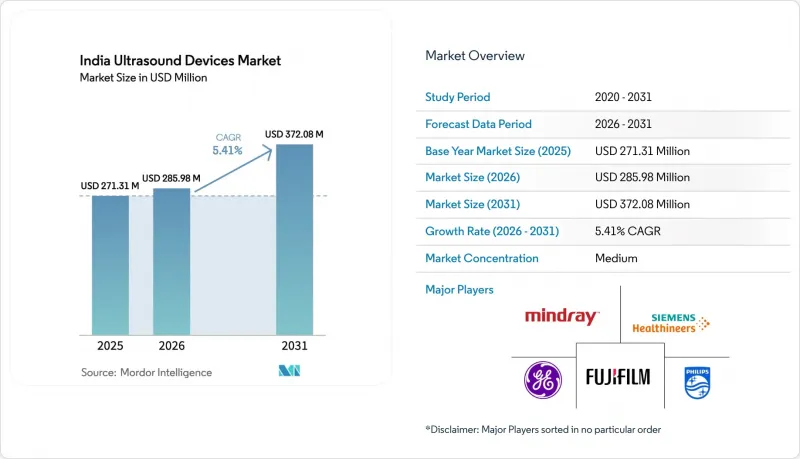
This report is Segmented by Application (Anesthesiology, Cardiology, Gynecology/Obstetrics, and More), Technology (2D Ultrasound Imaging, and More), Portability (Stationary Systems, and More), End User (Hospitals, and More), and Region (North India, South India, West India, East India, Central India, North-East India). The Market Forecasts are Provided in Terms of Value (USD) and Volume (Units).
India Ultrasound Devices Market Trends and Insights
Rising Burden of Chronic Diseases
One in four Indian adults screened at Apollo Hospitals in 2025 was hypertensive, and nearly the same proportion was diabetic, underscoring a silent epidemic that propels ultrasound from episodic diagnostic use to routine community screening. NPCDCS clinics now operate across every state, embedding ultrasound into standardized protocols at primary centers. Preventive-care financing under Ayushman Bharat further embeds structured reimbursement, while AIIMS Delhi's oncology AI, trained on 500,000 images, exemplifies how artificial intelligence augments image interpretation and mitigates workforce gaps. The combined effect is sustained volume growth for portable units that reach urban outreach camps and rural wellness centers.
Growing Awareness of Early Disease Detection
The eSanjeevani tele-consult platform has served 340 million patients since 2021, integrating imaging referrals into virtual primary care and stimulating demand for systems that upload scans directly to cloud archives. Aster CMI Hospital's 95%-accurate carpal-tunnel AI illustrates specialized ultrasound expansion beyond obstetrics. Hyderabad's SMART DROP diabetic-retinopathy protocol proves how structured screening cascades into higher equipment utilization inside diabetes clinics. Ayushman Bharat reimbursement removes price friction, letting facilities deploy midrange scanners without delaying ROI, thereby accelerating the India ultrasound devices market.
Stringent Regulatory Environment
CDSCO halted refurbished high-end imports in April 2024, citing safety, and its protracted MD-15 approvals encouraged several OEMs to divert assembly to Vietnam, delaying product refresh cycles in India. Although the National Single Window System aims to compress review times, compliance costs remain steep for start-ups. The 2024 marketing code further limits aggressive promotion but promises higher buyer trust long term.
Other drivers and restraints analyzed in the detailed report include:
- Expansion of Portable & Point-of-Care Ultrasound
- Government Healthcare Initiatives
- Shortage of Skilled Professionals
For complete list of drivers and restraints, kindly check the Table Of Contents.
Segment Analysis
Radiology anchored a 37.31% India ultrasound devices market share in 2025 as tertiary hospitals conducted comprehensive abdominal, obstetric, and vascular exams in centralized imaging suites. Critical Care posted the highest 3.75% CAGR, propelled by trauma protocols requiring bedside echo within 5 minutes of admission and by the India ultrasound devices market size growth inside emergency departments. Portable probes allied with AI decision support amplify throughput in ICU rounds and cardiac arrest calls. Gynecology/Obstetrics sustains double-digit volume as maternal-mortality reduction remains a policy target, whereas Musculoskeletal imaging gains visibility through sports-injury clinics that value quick tendon assessments.
Cardiology extends share through AI-enabled speckle-tracking that standardizes ejection-fraction calculation, and Urology leverages ultrasound guidance for minimally invasive stone retrieval. Rising diabetic vasculopathy drives vascular-segment growth, aided by handheld Doppler integration. Unified multi-application consoles, such as GE's Versana Premier, allow smaller hospitals to span seven specialties with a single purchase, reducing capex while widening procedure menus.
3D & 4D platforms held 43.95% of the India ultrasound devices market in 2025, favored for obstetric bonding and surgical-planning clarity. The India ultrasound devices market size for these systems benefits from AI plug-ins that shorten fetal-anomaly scans to under 90 seconds. HIFU registers a 3.42% CAGR as non-invasive liver and prostate therapies receive wider reimbursement and specialist training centers multiply. Legacy 2D scanners persist in primary centers where budgets remain tight, while Color Doppler advances in cardiology and peripheral-artery workups. GE HealthCare's USD 51 million Intelligent Ultrasound buyout infused ScanNav Assist into workflow, highlighting competition pivoting to AI-first differentiators.
Portable "other technologies" wrap in smartphone connectivity and edge-AI lesion detection, broadening reach where radiologists are scarce. GE and NVIDIA's self-navigating prototype underpins a future where novice users capture diagnostic-grade imagery, easing the skilled-workforce choke point across the India ultrasound devices market share landscape.
Complete Report Scope:
- By Application
- Anesthesiology
- Cardiology
- Gynecology / Obstetrics
- Musculoskeletal
- Radiology
- Critical Care
- Urology
- Vascular
- Other Applications
- By Technology
- 2D Ultrasound Imaging
- 3D & 4D Ultrasound Imaging
- Doppler Imaging
- High-Intensity Focused Ultrasound
- Other Technologies
- By Portability
- Stationary Systems
- Portable Cart-based Systems
- Hand-held / Pocket Devices
- By End User
- Hospitals
- Diagnostic Imaging Centres
- Ambulatory Surgical Centres
- Other End Users
- By Region
- North India
- South India
- West India
- East India
- Central India
- North-East India
List of Companies Covered in this Report:
- Canon
- SonoScape Medical
- FUJIFILM
- GE Healthcare
- Hologic
- Koninklijke Philips
- Mindray
- Samsung Medison Co. Ltd.
- Esaote S.p.A.
- Siemens Healthineers
- Trivitron Healthcare
- BPL
- Skanray Technologies Ltd.
- Butterfly Network Inc.
- Clarius Mobile Health
- Vinno Technology (India)
- CHISON Medical Imaging
- Hitachi Healthcare
- Alpinion Medical Systems
- Terason Ultrasound
Additional Benefits:
- The market estimate (ME) sheet in Excel format
- 3 months of analyst support
TABLE OF CONTENTS
1 Introduction
- 1.1 Study Assumptions & Market Definition
- 1.2 Scope of the Study
2 Research Methodology
3 Executive Summary
4 Market Landscape
- 4.1 Market Overview
- 4.2 Market Drivers
- 4.2.1 Rising Burden of Chronic Diseases
- 4.2.2 Growing Awareness of Early Disease Detection
- 4.2.3 Expansion of Portable & Point-of-Care Ultrasound
- 4.2.4 Government Healthcare Initiatives
- 4.2.5 Local Manufacturing & Product Innovation
- 4.2.6 Telemedicine & Remote Ultrasound Access
- 4.3 Market Restraints
- 4.3.1 Stringent Regulatory Environment
- 4.3.2 Shortage of Skilled Professionals
- 4.3.3 High Cost of Advanced Systems
- 4.3.4 Infrastructure Gaps in Rural Areas
- 4.4 Regulatory Landscape
- 4.5 Technological Outlook
- 4.6 Porter's Five Forces Analysis
- 4.6.1 Threat of New Entrants
- 4.6.2 Bargaining Power of Buyers
- 4.6.3 Bargaining Power of Suppliers
- 4.6.4 Threat of Substitutes
- 4.6.5 Intensity of Competitive Rivalry
5 Market Size & Growth Forecasts (Value & Volume)
- 5.1 By Application
- 5.1.1 Anesthesiology
- 5.1.2 Cardiology
- 5.1.3 Gynecology / Obstetrics
- 5.1.4 Musculoskeletal
- 5.1.5 Radiology
- 5.1.6 Critical Care
- 5.1.7 Urology
- 5.1.8 Vascular
- 5.1.9 Other Applications
- 5.2 By Technology
- 5.2.1 2D Ultrasound Imaging
- 5.2.2 3D & 4D Ultrasound Imaging
- 5.2.3 Doppler Imaging
- 5.2.4 High-Intensity Focused Ultrasound
- 5.2.5 Other Technologies
- 5.3 By Portability
- 5.3.1 Stationary Systems
- 5.3.2 Portable Cart-based Systems
- 5.3.3 Hand-held / Pocket Devices
- 5.4 By End User
- 5.4.1 Hospitals
- 5.4.2 Diagnostic Imaging Centres
- 5.4.3 Ambulatory Surgical Centres
- 5.4.4 Other End Users
- 5.5 By Region
- 5.5.1 North India
- 5.5.2 South India
- 5.5.3 West India
- 5.5.4 East India
- 5.5.5 Central India
- 5.5.6 North-East India
6 Competitive Landscape
- 6.1 Market Concentration
- 6.2 Market Share Analysis
- 6.3 Company Profiles (includes Global level Overview, Market level overview, Core Segments, Financials as available, Strategic Information, Market Rank/Share for key companies, Products & Services, and Recent Developments)
- 6.3.1 Canon Medical Systems Corporation
- 6.3.2 SonoScape Medical Corp
- 6.3.3 Fujifilm Holdings Corporation
- 6.3.4 GE HealthCare
- 6.3.5 Hologic Inc.
- 6.3.6 Koninklijke Philips N.V.
- 6.3.7 Mindray Medical International Ltd.
- 6.3.8 Samsung Medison Co. Ltd.
- 6.3.9 Esaote S.p.A.
- 6.3.10 Siemens Healthineers AG
- 6.3.11 Trivitron Healthcare
- 6.3.12 BPL Medical Technologies
- 6.3.13 Skanray Technologies Ltd.
- 6.3.14 Butterfly Network Inc.
- 6.3.15 Clarius Mobile Health
- 6.3.16 Vinno Technology (India)
- 6.3.17 CHISON Medical Imaging
- 6.3.18 Hitachi Healthcare
- 6.3.19 Alpinion Medical Systems
- 6.3.20 Terason Ultrasound
7 Market Opportunities & Future Outlook
- 7.1 White-space & Unmet-need Assessment

