PUBLISHER: Mordor Intelligence | PRODUCT CODE: 2125422

PUBLISHER: Mordor Intelligence | PRODUCT CODE: 2125422
Japan Ultrasound Devices - Market Share Analysis, Industry Trends & Statistics, Growth Forecasts (2026 - 2031)
According to Mordor Intelligence, Japan ultrasound devices market size in 2026 is estimated at USD 536.03 million, growing from 2025 value of USD 512.41 million with 2031 projections showing USD 671.67 million, growing at 4.61% CAGR over 2026-2031.
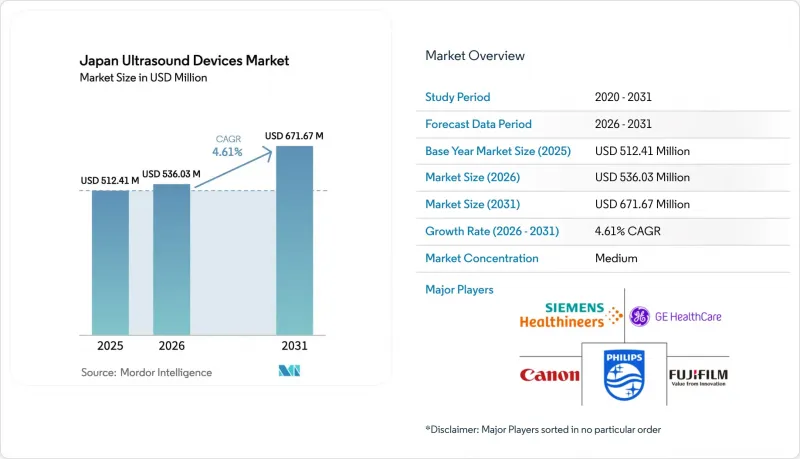
This report is Segmented by Application (Anesthesiology, Cardiology, Gynecology/Obstetrics, Musculoskeletal, Radiology, and More), Technology (2D Ultrasound Imaging, 3D & 4D Ultrasound Imaging, and More), Portability (Stationary Systems, and More), and End User (Hospitals & Academic Medical Centers, and More). The Market Forecasts are Provided in Terms of Value (USD) and Volume (Units).
Japan Ultrasound Devices Market Trends and Insights
Rising Burden of Chronic Diseases & Aging Population
Japan's over-65 demographic now exceeds 30% of the population, creating sustained demand for cardiovascular and musculoskeletal imaging where ultrasound offers non-invasive, radiation-free diagnostics. Elderly patients' preference for outpatient care bolsters portable scanner uptake, especially for home-health and rehabilitation services. GE Healthcare's Voluson Performance 18 was positioned to mitigate obstetrician shortages while supporting perinatal networks. Policy goals that extend healthy life expectancy depend on early detection programs reliant on ultrasound, anchoring long-term growth for the Japan ultrasound market.
Accelerated Adoption of AI-Enabled 3D/4D & Handheld Ultrasound
AI-driven software such as RN-Descartes and METIS Eye demonstrates sensitivity rates that outstrip manual interpretation in breast-cancer detection, directly addressing Japan's sonographer shortfall. Multicenter trials of the KOSMOS handheld platform reported 91.5% clinical applicability, validating bedside use in emergency and rural clinics. The fusion of 3D/4D imaging with real-time AI analytics expands clinical value in cardiology and obstetrics, although PMDA has cleared only two AI SaMD applications to date, creating a window of advantage for early license holders.
Lengthy PMDA Approval Timelines & Post-Market Surveillance Costs
Ultrasound vendors allocate 9-16 months to navigate PMDA pathways, prolonging cash-flow breakeven and advantaging incumbents with legacy approvals. Compliance with Ordinance 169 and ISO 13485 mandates exhaustive validation, while ongoing vigilance reports pile additional costs. Only two of 27 AI SaMD filings have been cleared, illustrating systemic hurdles that temper innovation velocity in the Japan ultrasound market.
Other drivers and restraints analyzed in the detailed report include:
- Government-Funded Point-of-Care Ultrasound Training Initiatives
- Replacement of Aging Analog Systems
- Constrained Hospital CAPEX Under Bundled DRG Payments
For complete list of drivers and restraints, kindly check the Table Of Contents.
Segment Analysis
Radiology generated 29.45% of Japan ultrasound market size in 2025 and remains the backbone of imaging services because every hospital relies on general-purpose consoles for abdominal, vascular, and soft-tissue diagnostics. Growth, however, pivots toward critical-care usage where bedside sonography guides fluid resuscitation, detects pneumothorax, and monitors cardiac function in hemodynamically unstable patients. Certification modules by the Japan Society of Ultrasonics in Medicine reinforce proficiency, ensuring uniform quality nationwide.
Critical-care volumes are predicted to rise at 6.38% CAGR to 2031, propelled by intensivist adoption of portable probes and handhelds that connect wirelessly to hospital PACS. Rapid decision-making reduces ICU length of stay, appealing to administrators operating under DRG cost ceilings. As a result, critical care's share of Japan ultrasound market size is likely to climb beyond its current 11.05% threshold, gradually diluting radiology's dominance while catalyzing software-as-a-service revenues through AI-based hemodynamic analysis modules.
3D/4D imaging occupied 44.12% of Japan ultrasound market share in 2025 thanks to entrenched obstetrics and cardiology workflows. Volumetric datasets improve anomaly detection, a quality metric prized by insurers and clinicians alike. Yet high-intensity focused ultrasound is charting the fastest 5.79% CAGR, propelled by oncology trials evaluating non-invasive ablation for liver, prostate, and pancreatic tumors. Domestic startups translate photonics and robotics know-how into precise beam steering, seeking to commercialize hybrid diagnostic-therapeutic suites.
2D and Doppler modalities continue across routine abdominal scans and vascular studies, especially where hospital budgets remain tight. Even so, vendors embed AI noise suppression and auto-measure algorithms into baseline 2D systems, raising clinical value without inflating price tags. This staircase innovation approach keeps adoption broad while protecting the Japan ultrasound market from abrupt technology obsolescence risk.
Complete Report Scope:
- By Application
- Anesthesiology
- Cardiology
- Gynecology / Obstetrics
- Musculoskeletal
- Radiology
- Critical Care
- Urology
- Vascular
- Other Applications
- By Technology
- 2D Ultrasound Imaging
- 3D & 4D Ultrasound Imaging
- Doppler Imaging
- High-Intensity Focused Ultrasound
- Other Technologies
- By Portability
- Stationary Systems
- Portable Cart-based Systems
- Hand-held / Pocket Devices
- By End User
- Hospitals & Academic Medical Centers
- Diagnostic Imaging Centers
- Ambulatory & Specialty Clinics
- Home-care Settings
List of Companies Covered in this Report:
- Canon
- FUJIFILM
- GE Healthcare
- Hitachi
- Koninklijke Philips
- Siemens Healthineers
- Hologic
- Samsung Medison Co. Ltd.
- Konica Minolta
- Mindray Bio-Medical Electronics Co. Ltd.
- Neusoft Medical Systems Co. Ltd.
- Esaote
- Carestream Health
- Beckton Dickinson
- Fukuda Denshi Co. Ltd.
- Butterfly Network Inc.
- Clarius Mobile Health Corp.
- Chison Medical Technologies Co. Ltd.
- Alpinion Medical Systems Co. Ltd.
Additional Benefits:
- The market estimate (ME) sheet in Excel format
- 3 months of analyst support
TABLE OF CONTENTS
1 Introduction
- 1.1 Study Assumptions & Market Definition
- 1.2 Scope of the Study
2 Research Methodology
3 Executive Summary
4 Market Landscape
- 4.1 Market Overview
- 4.2 Market Drivers
- 4.2.1 Rising Burden of Chronic Diseases & Aging Population
- 4.2.2 Accelerated Adoption of AI-Enabled 3D/4D & Handheld Ultrasound
- 4.2.3 Government-Funded Point-of-Care Ultrasound (POCUS) Training Initiatives
- 4.2.4 Replacement of Aging Analog Systems
- 4.2.5 Breast-Density Screening Programs Boosting Ultrasound Volumes
- 4.2.6 Technological Innovation & Domestic R&D Investment
- 4.3 Market Restraints
- 4.3.1 Lengthy PMDA Approval Timelines & Post-Market Surveillance Costs
- 4.3.2 Constrained Hospital CAPEX Under Bundled DRG Payments
- 4.3.3 Shortage of Certified Sonographers & Uneven Skill Distribution
- 4.3.4 Price Competition from Low-Cost Chinese Imports
- 4.4 Regulatory Landscape
- 4.5 Technological Outlook
- 4.6 Porter's Five Forces Analysis
- 4.6.1 Bargaining Power of Buyers
- 4.6.2 Bargaining Power of Suppliers
- 4.6.3 Threat of New Entrants
- 4.6.4 Threat of Substitute Products
- 4.6.5 Intensity of Competitive Rivalry
5 Market Size & Growth Forecasts (Value & Volume)
- 5.1 By Application
- 5.1.1 Anesthesiology
- 5.1.2 Cardiology
- 5.1.3 Gynecology / Obstetrics
- 5.1.4 Musculoskeletal
- 5.1.5 Radiology
- 5.1.6 Critical Care
- 5.1.7 Urology
- 5.1.8 Vascular
- 5.1.9 Other Applications
- 5.2 By Technology
- 5.2.1 2D Ultrasound Imaging
- 5.2.2 3D & 4D Ultrasound Imaging
- 5.2.3 Doppler Imaging
- 5.2.4 High-Intensity Focused Ultrasound
- 5.2.5 Other Technologies
- 5.3 By Portability
- 5.3.1 Stationary Systems
- 5.3.2 Portable Cart-based Systems
- 5.3.3 Hand-held / Pocket Devices
- 5.4 By End User
- 5.4.1 Hospitals & Academic Medical Centers
- 5.4.2 Diagnostic Imaging Centers
- 5.4.3 Ambulatory & Specialty Clinics
- 5.4.4 Home-care Settings
6 Competitive Landscape
- 6.1 Market Concentration
- 6.2 Market Share Analysis
- 6.3 Company Profiles (includes Global level Overview, Market level overview, Core Segments, Financials as available, Strategic Information, Market Rank/Share for key companies, Products & Services, and Recent Developments)
- 6.3.1 Canon Medical Systems Corporation
- 6.3.2 Fujifilm Holdings Corporation
- 6.3.3 GE HealthCare
- 6.3.4 Hitachi Ltd.
- 6.3.5 Koninklijke Philips N.V.
- 6.3.6 Siemens Healthineers AG
- 6.3.7 Hologic Inc.
- 6.3.8 Samsung Medison Co. Ltd.
- 6.3.9 Konica Minolta Inc.
- 6.3.10 Mindray Bio-Medical Electronics Co. Ltd.
- 6.3.11 Neusoft Medical Systems Co. Ltd.
- 6.3.12 Esaote SpA
- 6.3.13 Carestream Health Inc.
- 6.3.14 Becton, Dickinson and Company
- 6.3.15 Fukuda Denshi Co. Ltd.
- 6.3.16 Butterfly Network Inc.
- 6.3.17 Clarius Mobile Health Corp.
- 6.3.18 Chison Medical Technologies Co. Ltd.
- 6.3.19 Alpinion Medical Systems Co. Ltd.
7 Market Opportunities & Future Outlook
- 7.1 White-space & Unmet-need Assessment

