PUBLISHER: Mordor Intelligence | PRODUCT CODE: 2125424

PUBLISHER: Mordor Intelligence | PRODUCT CODE: 2125424
Germany Ultrasound Devices - Market Share Analysis, Industry Trends & Statistics, Growth Forecasts (2026 - 2031)
According to Mordor Intelligence, the Germany ultrasound devices market size is expected to increase from USD 728.71 million in 2025 to USD 752.76 million in 2026 and reach USD 899.40 million by 2031, growing at a CAGR of 3.62% over 2026-2031.
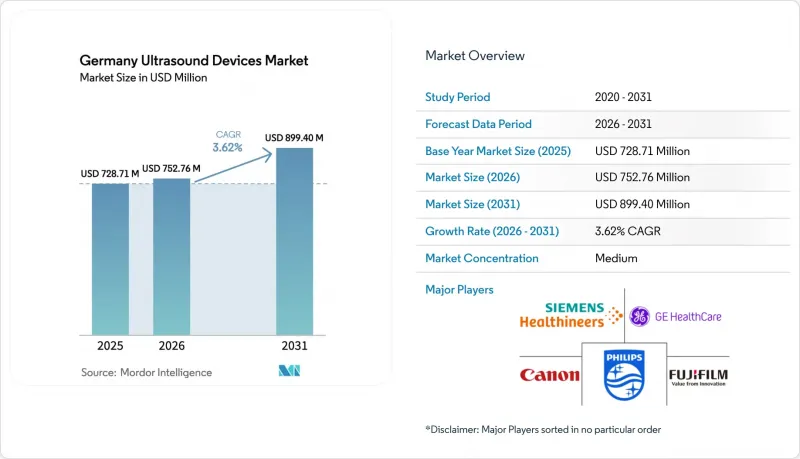
This report is Segmented by Application (Anesthesiology, Cardiology, Gynecology/Obstetrics, Musculoskeletal, and More), Technology (2D, 3D & 4D, Doppler, High-Intensity Focused Ultrasound, Other Technologies), Portability (Stationary, Portable Cart-Based, Hand-held/Pocket), and End User (Hospitals, Diagnostic Centers, and More). Market Forecasts are Provided in Value (USD).
Germany Ultrasound Devices Market Trends and Insights
Rising Prevalence of Chronic Diseases
Germany counted 18.7 million residents aged 65+ in 2025, representing 22.4% of the population, and cardiovascular disease prevalence is projected to increase by 12% by 2030. Echocardiography volumes rose 8 % in 2025, while musculoskeletal referrals jumped 15 % as rheumatologists embraced ultrasound-guided biologic injections. Portable scanners allow home-health nurses to check bladder volume and heart function, reducing nursing-home catheterizations by 18% in Bavaria. Reliable reimbursement for chronic-disease imaging insulates providers from budget freezes, keeping the Germany ultrasound devices market on a steady growth track.
Technological Advancements in Portable & Handheld Ultrasound
Handheld systems under 500 g captured 12 % of German unit shipments in 2025, up from 7 % two years earlier, as Butterfly's iQ3 and Clarius HD3 bundled 5G, wireless charging, and AI auto-measure. Siemens Healthineers' tablet-sized Sequoia Go streams encrypted DICOM over cellular networks, aiding pre-arrival stroke triage in rural districts. With 4-hour battery life, Philips Lumify overcomes previous endurance limits and satisfies emergency physicians' shift needs. Performance parity with mid-tier carts closes the quality gap and lowers capital expense per imaging room by up to 40 %, bolstering the Germany ultrasound devices market.
High Cost of Advanced Ultrasound Systems
Premium carts cost between EUR 80,000 and 150,000, straining hospitals whose equipment budgets fell by 6% in real terms during 2023-2025. Saxony tends to favor sub-EUR 50,000 units, allowing Mindray and Samsung to capture an 18% share with discounted 3D platforms. Leasing eases cash flow 35 % of Siemens placements in 2025 were five-year operating leases-but the upfront sticker shock still elongates replacement cycles, tempering Germany ultrasound devices market growth.
Other drivers and restraints analyzed in the detailed report include:
- Increasing Adoption in Point-Of-Care Settings
- High Cost of Advanced Ultrasound Systems
- Saturated Installed Base in Tertiary Hospitals
For complete list of drivers and restraints, kindly check the Table Of Contents.
Segment Analysis
Critical care imaging is projected to climb at a 5.62 % CAGR, the swiftest trajectory within the Germany ultrasound devices market, because intensive-care teams require real-time hemodynamic data during resuscitation. Radiology retained 39.09% of 2025 revenue, but portable scanners enable emergency physicians to bypass queues, trimming 32% of radiology referrals for suspected pneumonia at Frankfurt University Hospital. Cardiology echo volumes increased by 9% in 2025 due to wider use of strain imaging in oncology follow-up. Musculoskeletal clinics increasingly perform in-office joint assessments, elevating procedure counts and supporting ancillary probe sales. Urologists exploit sub-EUR 3,000 handheld bladder scanners on geriatric wards, aiding infection-prevention goals.
High-intensity focused ultrasound (HIFU) is expanding at 5.13 % because non-invasive ablation of localized prostate cancer and uterine fibroids commands EUR 3,500 reimbursement per case. Although 3D & 4D retained 45.29% of revenue in 2025, its growth moderated as tertiary penetration peaked. Siemens' AI 3D rendering now segments cardiac chambers in 10s, trimming cardiologist read times. Canon's micro-vascular imaging debuted in 2025 and maps capillary perfusion without contrast.
Complete Report Scope:
- By Application
- Anesthesiology
- Cardiology
- Gynecology / Obstetrics
- Musculoskeletal
- Radiology
- Critical Care
- Urology
- Vascular
- Other Applications
- By Technology
- 2D Ultrasound Imaging
- 3D & 4D Ultrasound Imaging
- Doppler Imaging
- High-Intensity Focused Ultrasound
- Other Technologies
- By Portability
- Stationary Systems
- Portable Cart-based Systems
- Hand-held / Pocket Devices
- By End User
- Hospitals
- Diagnostic Centers
- Ambulatory Surgical Centers
- Home Healthcare Settings
- Other End Users
List of Companies Covered in this Report:
- Alpinion Medical Systems
- Analogic
- Butterfly Network Inc.
- Canon
- Carestream Health
- CHISON Medical Technologies
- Clarius Mobile Health Corp.
- Esaote
- Exo Inc.
- FUJIFILM
- GE Healthcare
- Hitachi
- Hologic
- Koninklijke Philips N.V.
- Mindray Medical Intl. Ltd
- Samsung Group
- Shenzhen Kaipud Medical
- Siemens Healthineers
- SonoScape Medical Corp.
- Telemed Lithuania
- Terason (Teratech Corp.)
- Zimmer MedizinSysteme
Additional Benefits:
- The market estimate (ME) sheet in Excel format
- 3 months of analyst support
TABLE OF CONTENTS
1 Introduction
- 1.1 Study Assumptions & Market Definition
- 1.2 Scope of the Study
2 Research Methodology
3 Executive Summary
4 Market Landscape
- 4.1 Market Overview
- 4.2 Market Drivers
- 4.2.1 Rising Prevalence of Chronic Diseases Requiring Advanced Imaging
- 4.2.2 Technological Advancements in Portable & Handheld Ultrasound
- 4.2.3 Increasing Adoption in Point-Of-Care Settings
- 4.2.4 Federal Hospital Reform Incentivising Outpatient Ultrasound Use
- 4.2.5 AI-Driven Image Analysis Compliant with German Data-Protection
- 4.2.6 Growing Reimbursement for Point-Of-Care Ultrasound (POCUS)
- 4.3 Market Restraints
- 4.3.1 High Cost of Advanced Ultrasound Systems
- 4.3.2 Saturated Installed Base in Tertiary Hospitals
- 4.3.3 Stringent EU-MDR Post-Market Surveillance Requirements
- 4.3.4 Shortfall of DEGUM-Certified Sonographers In Rural Lander
- 4.4 Regulatory Landscape
- 4.5 Technological Outlook
- 4.6 Porter's Five Forces Analysis
- 4.6.1 Threat of New Entrants
- 4.6.2 Bargaining Power of Buyers
- 4.6.3 Bargaining Power of Suppliers
- 4.6.4 Threat of Substitute Products
- 4.6.5 Intensity of Competitive Rivalry
5 Market Size & Growth Forecasts (Value & Volume)
- 5.1 By Application
- 5.1.1 Anesthesiology
- 5.1.2 Cardiology
- 5.1.3 Gynecology / Obstetrics
- 5.1.4 Musculoskeletal
- 5.1.5 Radiology
- 5.1.6 Critical Care
- 5.1.7 Urology
- 5.1.8 Vascular
- 5.1.9 Other Applications
- 5.2 By Technology
- 5.2.1 2D Ultrasound Imaging
- 5.2.2 3D & 4D Ultrasound Imaging
- 5.2.3 Doppler Imaging
- 5.2.4 High-Intensity Focused Ultrasound
- 5.2.5 Other Technologies
- 5.3 By Portability
- 5.3.1 Stationary Systems
- 5.3.2 Portable Cart-based Systems
- 5.3.3 Hand-held / Pocket Devices
- 5.4 By End User
- 5.4.1 Hospitals
- 5.4.2 Diagnostic Centers
- 5.4.3 Ambulatory Surgical Centers
- 5.4.4 Home Healthcare Settings
- 5.4.5 Other End Users
6 Competitive Landscape
- 6.1 Market Concentration
- 6.2 Market Share Analysis
- 6.3 Company Profiles (includes Global Level Overview, Market Level Overview, Core Segments, Financials as Available, Strategic Information, Market Rank/Share for Key Companies, Products & Services, and Recent Developments)
- 6.3.1 Alpinion Medical Systems
- 6.3.2 Analogic Corporation
- 6.3.3 Butterfly Network Inc.
- 6.3.4 Canon Medical Systems Corporation
- 6.3.5 Carestream Health
- 6.3.6 CHISON Medical Technologies
- 6.3.7 Clarius Mobile Health Corp.
- 6.3.8 Esaote SpA
- 6.3.9 Exo Inc.
- 6.3.10 Fujifilm Holdings Corporation
- 6.3.11 GE HealthCare
- 6.3.12 Hitachi Ltd
- 6.3.13 Hologic Inc.
- 6.3.14 Koninklijke Philips N.V.
- 6.3.15 Mindray Medical Intl. Ltd
- 6.3.16 Samsung Medison Co. Ltd
- 6.3.17 Shenzhen Kaipud Medical
- 6.3.18 Siemens Healthineers AG
- 6.3.19 SonoScape Medical Corp.
- 6.3.20 Telemed Lithuania
- 6.3.21 Terason (Teratech Corp.)
- 6.3.22 Zimmer MedizinSysteme GmbH
7 Market Opportunities & Future Outlook
- 7.1 White-space & Unmet-Need Assessment

