PUBLISHER: Mordor Intelligence | PRODUCT CODE: 2116690

PUBLISHER: Mordor Intelligence | PRODUCT CODE: 2116690
Italy Magnetic Resonance Imaging - Market Share Analysis, Industry Trends & Statistics, Growth Forecasts (2026 - 2031)
According to Mordor Intelligence, Italy MRI market size in 2026 is estimated at USD 277.56 million, growing from 2025 value of USD 264.39 million with 2031 projections showing USD 353.87 million, growing at 4.98% CAGR over 2026-2031.
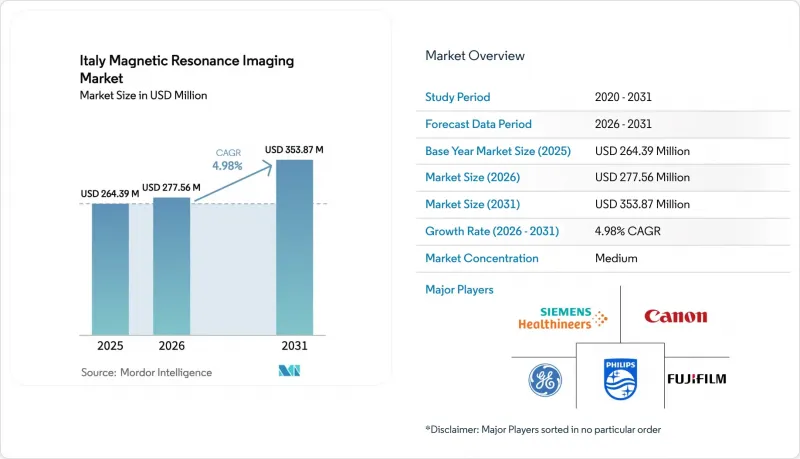
This report is Segmented by Architecture (Closed MRI Systems, and Open MRI Systems), Field Strength (Low Field MRI Systems, and More), Application (Oncology, Neurology, and More), End User (Hospitals, Diagnostic Imaging Centers, and Research Institutes). The Report Offers the Value (in USD Million) for the Above Segments.
Italy Magnetic Resonance Imaging Market Trends and Insights
National Recovery & Resilience (PNRR) Cap-ex for MRI Upgrades
Italy's EUR 194.4 billion PNRR channels unprecedented funds toward hospital equipment modernization, opening a short procurement window that favors immediate replacement of aging scanners . Revised community-hospital targets, cut from 1,350 to 936 because of construction-cost inflation, still translate into hundreds of new MRI installations. The complementary Piano Transizione 5.0 adds EUR 12.7 billion in tax credits for facilities that cut energy consumption by at least 3%, effectively subsidizing zero-boil-off magnets. Together, these measures accelerate purchasing decisions, especially in Southern regions that historically lagged in imaging capacity.
Rising Chronic-Disease Imaging Demand
Population aging to 24% above 65 years fuels MRI use across neurology, oncology, and cardiology. Alzheimer's prevalence already tops 413,715 patients and drives neuroimaging protocols that add to scanner workloads. Annual cancer incidence reached 390,700 cases in 2022 and is poised for a further 15% increase by 2025, intensifying demand for precise staging and follow-up imaging. AI-based reconstruction tools cut scan time by as much as 30%, enabling higher daily volumes without compromising image quality.
High Equipment & Lifecycle Costs
New scanners range between USD 1 million and USD 3 million, while service contracts consume 8-12% of purchase price annually . Helium refill prices have soared 250% over ten years, pushing annual outlays to USD 28,000-36,000 for older magnets. Energy audits in Italian radiology departments show MRI units account for 24% of daily departmental electricity at 214.6 kWh, eroding hospital budgets.
Other drivers and restraints analyzed in the detailed report include:
- Technological Breakthroughs in MRI
- Expanding Clinical Indications for MRI
- Shortage of MRI-Trained Technologists & Radiologists
For complete list of drivers and restraints, kindly check the Table Of Contents.
Segment Analysis
Closed scanners kept 77.62% of Italy MRI market share in 2025, favored for image quality, multichannel coils, and high diagnostic confidence in oncology and neurology. The Italy MRI market size for portable units is modest today yet rising quickly; portable platforms are forecast to record a 5.32% CAGR between 2026-2031. Adoption is fastest in emergency departments and rural clinics where space and helium logistics restrict classic cylindrical designs. Manufacturers are integrating AI reconstruction to uplift image quality, shrinking the performance gap versus closed systems.
Portable scanners support Italy's goal of equitable access, particularly in Calabria and Sicily, where patient travel distances exceed national averages. Esaote's Magnifico Open and O-scan systems use permanent magnets and low acoustic noise to enhance user comfort. Hospitals also deploy mobile trailers to manage surges in oncology referrals. Market consolidation could intensify as global vendors acquire niche portable innovators to broaden their portfolio.
Mid-field (0.5-1.5 T) platforms commanded 47.65% of Italy MRI market size in 2025 and remain the workhorse for routine brain, spine, and joint imaging. The Italy MRI market share advantage stems from clinical versatility and relatively low operating costs. Nonetheless, ultra-high field (>3 T) systems are projected to grow at 5.58% CAGR, propelled by advanced neuro-oncology protocols and research funding flows to Lombardy and Tuscany.
At 7 T, clinicians achieve superior contrast-to-noise and microvascular visualization, helping detect cortical microbleeds and subtle hippocampal sclerosis. Cost remains the primary barrier, yet PNRR incentives could tip the business case for select academic centers. Mid-field scanners are not static; vendors are adding AI-driven sequences that mimic high-field resolution, keeping these systems relevant for community hospitals.
Complete Report Scope:
- By Architecture
- Closed MRI Systems
- Open MRI Systems
- By Field Strength
- Low Field (<0.5 T)
- Mid Field (0.5-1.5 T)
- High Field (1.5-3 T)
- Very-/Ultra-High (>3 T)
- By Application
- Neurology
- Oncology
- Cardiology
- Gastroenterology
- Musculoskeletal
- Other Applications
- By End User
- Hospitals
- Diagnostic Imaging Centers
- Research Institutes
List of Companies Covered in this Report:
- Siemens Healthineers
- GE Healthcare
- Koninklijke Philips
- Canon
- Esaote
- Bruker
- Fujifilm Holdings Corp.
- Hitachi
- United Imaging Healthcare
- Paramed Medical Systems
- Fonar
- Shenzhen Anke High-Tech
- Neusoft Medical Systems
- IMRIS Inc.
- Aspect Imaging
- Medonica
- Samsung Neurologica
- Agilent MR Solutions
- Time Medical Systems
- Oxford Instruments
Additional Benefits:
- The market estimate (ME) sheet in Excel format
- 3 months of analyst support
TABLE OF CONTENTS
1 Introduction
- 1.1 Study Assumptions & Market Definition
- 1.2 Scope of the Study
2 Research Methodology
3 Executive Summary
4 Market Landscape
- 4.1 Market Overview
- 4.2 Market Drivers
- 4.2.1 Rising chronic-disease imaging demand
- 4.2.2 National Recovery & Resilience (PNRR) cap-ex for MRI upgrades
- 4.2.3 Technological breakthroughs in MRI
- 4.2.4 Steady growth in healthcare spending and modernization of hospital & outpatient imaging infrastructure worldwide
- 4.2.5 Expanding clinical indications for MRI
- 4.2.6 Shift toward patient-centric, non-ionizing diagnostic alternatives
- 4.3 Market Restraints
- 4.3.1 High equipment & lifecycle costs
- 4.3.2 Slow, fragmented reimbursement approvals
- 4.3.3 Shortage of MRI-trained technologists & radiologists
- 4.3.4 Volatile helium & energy prices pressuring OPEX
- 4.4 Value / Supply-Chain Analysis
- 4.5 Regulatory Landscape
- 4.6 Technological Outlook
- 4.7 Porter's Five Forces Analysis
- 4.7.1 Threat of New Entrants
- 4.7.2 Bargaining Power of Buyers
- 4.7.3 Bargaining Power of Suppliers
- 4.7.4 Threat of Substitutes
- 4.7.5 Competitive Rivalry
5 Market Size & Growth Forecasts (Value, USD mn)
- 5.1 By Architecture
- 5.1.1 Closed MRI Systems
- 5.1.2 Open MRI Systems
- 5.2 By Field Strength
- 5.2.1 Low Field (<0.5 T)
- 5.2.2 Mid Field (0.5-1.5 T)
- 5.2.3 High Field (1.5-3 T)
- 5.2.4 Very-/Ultra-High (>3 T)
- 5.3 By Application
- 5.3.1 Neurology
- 5.3.2 Oncology
- 5.3.3 Cardiology
- 5.3.4 Gastroenterology
- 5.3.5 Musculoskeletal
- 5.3.6 Other Applications
- 5.4 By End User
- 5.4.1 Hospitals
- 5.4.2 Diagnostic Imaging Centers
- 5.4.3 Research Institutes
6 Competitive Landscape
- 6.1 Market Concentration
- 6.2 Market Share Analysis
- 6.3 Company Profiles (includes Global-level Overview, Market-level Overview, Core Segments, Financials, Strategic Information, Market Rank/Share, Products & Services, Recent Developments)
- 6.3.1 Siemens Healthineers AG
- 6.3.2 GE HealthCare
- 6.3.3 Koninklijke Philips N.V.
- 6.3.4 Canon Medical Systems Corp.
- 6.3.5 Esaote SpA
- 6.3.6 Bruker Corporation
- 6.3.7 Fujifilm Holdings Corp.
- 6.3.8 Hitachi Medical Systems
- 6.3.9 United Imaging Healthcare
- 6.3.10 Paramed Medical Systems
- 6.3.11 Fonar Corporation
- 6.3.12 Shenzhen Anke High-Tech
- 6.3.13 Neusoft Medical Systems
- 6.3.14 IMRIS Inc.
- 6.3.15 Aspect Imaging
- 6.3.16 Medonica Co. Ltd
- 6.3.17 Samsung Neurologica
- 6.3.18 Agilent MR Solutions
- 6.3.19 Time Medical Systems
- 6.3.20 Oxford Instruments
7 Market Opportunities & Future Outlook
- 7.1 White-space & Unmet-Need Assessment

