PUBLISHER: Mordor Intelligence | PRODUCT CODE: 2116761

PUBLISHER: Mordor Intelligence | PRODUCT CODE: 2116761
Medical Kiosk - Market Share Analysis, Industry Trends & Statistics, Growth Forecasts (2026 - 2031)
According to Mordor Intelligence, the medical kiosk market size was valued at USD 1.69 billion in 2025 and estimated to grow from USD 1.91 billion in 2026 to reach USD 3.47 billion by 2031, at a CAGR of 12.74% during the forecast period (2026-2031).
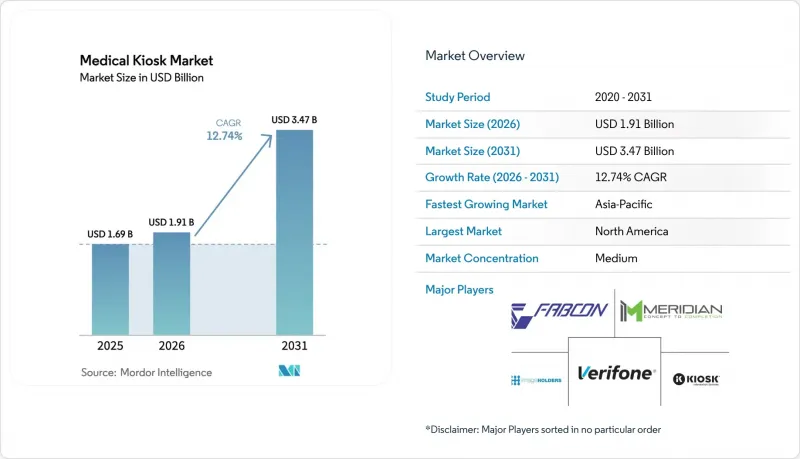
This report is Segmented by Type (Check-In Kiosks, Payment Kiosks, and More), Component (Hardware, Software, Services), Deployment Location (Indoor, Outdoor), Mobility (Freestanding, and More), End User (Hospitals, Clinics and Ambulatory Care Centers, More), and Geography (North America, Europe, Asia-Pacific, Middle East and Africa, South America). The Market Forecasts are Provided in Terms of Value (USD).
Global Medical Kiosk Market Trends and Insights
Expansion of 5G Infrastructure Enabling Real-Time Care
Siriraj Hospital's 5G Smart Hospital project lowered pathology turnaround to minutes and streamed ambulance vitals directly to specialists, proving that ultra-low-latency connectivity makes kiosks viable for critical care interactions. Health systems now plan kiosks as network endpoints rather than stand-alone machines, boosting transaction capacity and reducing unit cost as more devices ride the same 5G backbone. Edge processing further shrinks lag, enabling HD video consults, AI image reads, and remote robotics. The result is a scalable fabric in which each kiosk strengthens the overall care grid-a dynamic underpinning the medical kiosk market worldwide.
Accelerated Healthcare Digitalization Streamlining Patient Remote Monitoring
Remote-monitoring platforms reached 35% AI adoption in 2024, integrating kiosks as public touchpoints for patients lacking connected devices. Turkey's Disease Management Platform already logged 73 million chronic encounters by syncing kiosk outputs with its electronic record hub, illustrating how large-scale digital ecosystems absorb self-service endpoints. The shift pushes vendors to certify HL7-FHIR connectors and population-health dashboards, deepening service revenue in the medical kiosk market.
Stringent Cybersecurity and Data Privacy Regulations
FDA's Software Bill of Materials mandate forces suppliers to list every code library, inflating compliance cycles and favoring firms with mature DevSecOps teams. The PATCH Act and HIPAA updates require live threat monitoring; 67% of US health systems admit they lack resources for 24/7 coverage, slowing purchase decisions.
Other drivers and restraints analyzed in the detailed report include:
- Increased Demand for Contactless, Infection-Controlled Self-Service
- Government-Backed Reimbursement Pilots
- High Capital Expenditure and Integration Costs
For complete list of drivers and restraints, kindly check the Table Of Contents.
Segment Analysis
Check-In Kiosks held 33.02% medical kiosk market share in 2025, yet telemedicine units are expected to grow with 13.86% CAGR between 2026 and 2031 outpaces every other type in the medical kiosk market. Check-in kiosks still dominate day-to-day workflows, but sustained reimbursement for video consults elevates diagnostic kiosks to enterprise-level priority. In busy ambulatory centers, a single telemedicine kiosk can conduct vitals, provide AI-triage, and connect to an off-site physician in one room cycle, freeing in-house staff for acute cases.
Vital-signs and pharmacy kiosks follow a similar clinical logic, supplying chronic-care data and immediate dispensing in one stop. Payment and way-finding models remain relevant for throughput but face mobile-app redundancy. As AI modules mature, suppliers bundle multiple functions, nudging buyers toward platform contracts and enlarging the medical kiosk market.
Hardware held 51.05% medical kiosk market share in 2025, yet services clock the fastest trajectory at 15.22% as hospitals outsource HL7 integration, SBOM documentation, and patch management. Each regulatory cycle expands the service attach rate, turning managed-service agreements into multi-year revenue streams that stabilize vendor cash flow.
Software remains pivotal for user interface and AI inference engines. Still, license revenue often converts into subscription, blurring lines between software and services. Vendors emphasizing turnkey delivery now close larger deals, signaling that ecosystem capabilities trump hardware features in the medical kiosk market.
Complete Report Scope:
- By Type
- Check-In Kiosks
- Payment Kiosks
- Way-Finding & Information Kiosks
- Telemedicine / Telehealth Kiosks
- Vital-Signs Measurement Kiosks
- Pharmacy / Medication-Dispensing Kiosks
- Patient Education Kiosks
- Others
- By Component
- Hardware
- Software
- Services
- By Deployment Location
- Indoor
- Outdoor
- By Mobility
- Freestanding
- Wall-Mounted
- Countertop
- Mobile / Cart
- By End User
- Hospitals
- Clinics & Ambulatory Care Centers
- Pharmacies & Drugstores
- Diagnostic Laboratories
- Long-Term Care Facilities
- Corporate & Industrial Health Centers
- Others
- By Geography
- North America
- United States
- Canada
- Mexico
- Europe
- Germany
- United Kingdom
- France
- Italy
- Spain
- Rest of Europe
- Asia-Pacific
- China
- Japan
- India
- Australia
- South Korea
- Rest of Asia-Pacific
- Middle East & Africa
- GCC
- South Africa
- Rest of Middle East & Africa
- South America
- Brazil
- Argentina
- Rest of South America
- North America
Geography Analysis
North America generated 46.45% of global revenue in 2025 as Medicare policy continuity and grant funding de-risk capital outlays. Regional kiosk density now averages one unit per 42,000 residents, a ratio policymakers deem favorable for preventive-care access. Demand also benefits from cohesive broadband and cloud-hosting ecosystems, giving suppliers predictable service margins in the medical kiosk market.
Europe's blend of aging demographics and universal payer models sustains steady replacement cycles. Yet GDPR's rigorous consent protocols extend deployment lead times, compelling vendors to preload privacy-by-design features. Outdoor telehealth kiosks in Spain's CostadelSol region now support tourist populations without local medical records, showing that interoperability hurdles can be cleared when public funds align with commercial expertise.
Asia-Pacific posts the fastest expansion at 19.56% CAGR, lifting regional procurement budgets for remote-care endpoints. Government smart-hospital grants in Thailand and India's Ayushman Bharat digital mission keep the medical kiosk market in high gear. Meanwhile, South Korea pilots 5G-linked kiosks at metro stations, illustrating infrastructure convergence. Growth in the Middle East, Africa, and South America follows capital investment cycles but remains hampered by patchy connectivity and limited local service partners.
- KIOSK Information Systems
- NCR Corporation
- Olea Kiosks
- Meridian Kiosks
- ADVANCED KIOSKS
- Fabcon
- VeriFone
- RedyRef Interactive Kiosks
- imageHOLDERS
- XIPHIAS Software Technologies
- JCM Global
- Frank Mayer and Associates
- Kiosks4business
- DynaTouch
- UniDoc Health Corp.
- Clearwave Corporation
- HashKiosk
- iDoctorCloud
- NCR Voyix
- Phoenix Kiosk Inc.
Additional Benefits:
- The market estimate (ME) sheet in Excel format
- 3 months of analyst support
TABLE OF CONTENTS
1 Introduction
- 1.1 Study Assumptions & Market Definition
- 1.2 Scope of the Study
2 Research Methodology
3 Executive Summary
4 Market Landscape
- 4.1 Market Overview
- 4.2 Market Drivers
- 4.2.1 Expansion of 5G Infrastructure Enabling Real-Time
- 4.2.2 Accelerated Healthcare Digitalization Streamlining Patient Remote Monitoring
- 4.2.3 Increased Demand for Contactless, Infection-Controlled Self-Service
- 4.2.4 Government-Backed Reimbursement Pilots
- 4.2.5 Integration of AI-Driven Triage and Diagnostics
- 4.2.6 Rising Prevalence of Chronic Diseases and Physician Shortages
- 4.3 Market Restraints
- 4.3.1 Stringent Cybersecurity and Data Privacy Regulations
- 4.3.2 High Capital Expenditure and Integration Costs
- 4.3.3 Limited Adoption Among Elderly Populations
- 4.3.4 Vendor Lock-In Risks Tied To Proprietary Telehealth Ecosystems
- 4.4 Porter's Five Forces Analysis
- 4.4.1 Threat of New Entrants
- 4.4.2 Bargaining Power of Buyers
- 4.4.3 Bargaining Power of Suppliers
- 4.4.4 Threat of Substitutes
- 4.4.5 Competitive Rivalry
5 Market Size & Growth Forecasts (Value in USD)
- 5.1 By Type
- 5.1.1 Check-In Kiosks
- 5.1.2 Payment Kiosks
- 5.1.3 Way-Finding & Information Kiosks
- 5.1.4 Telemedicine / Telehealth Kiosks
- 5.1.5 Vital-Signs Measurement Kiosks
- 5.1.6 Pharmacy / Medication-Dispensing Kiosks
- 5.1.7 Patient Education Kiosks
- 5.1.8 Others
- 5.2 By Component
- 5.2.1 Hardware
- 5.2.2 Software
- 5.2.3 Services
- 5.3 By Deployment Location
- 5.3.1 Indoor
- 5.3.2 Outdoor
- 5.4 By Mobility
- 5.4.1 Freestanding
- 5.4.2 Wall-Mounted
- 5.4.3 Countertop
- 5.4.4 Mobile / Cart
- 5.5 By End User
- 5.5.1 Hospitals
- 5.5.2 Clinics & Ambulatory Care Centers
- 5.5.3 Pharmacies & Drugstores
- 5.5.4 Diagnostic Laboratories
- 5.5.5 Long-Term Care Facilities
- 5.5.6 Corporate & Industrial Health Centers
- 5.5.7 Others
- 5.6 By Geography
- 5.6.1 North America
- 5.6.1.1 United States
- 5.6.1.2 Canada
- 5.6.1.3 Mexico
- 5.6.2 Europe
- 5.6.2.1 Germany
- 5.6.2.2 United Kingdom
- 5.6.2.3 France
- 5.6.2.4 Italy
- 5.6.2.5 Spain
- 5.6.2.6 Rest of Europe
- 5.6.3 Asia-Pacific
- 5.6.3.1 China
- 5.6.3.2 Japan
- 5.6.3.3 India
- 5.6.3.4 Australia
- 5.6.3.5 South Korea
- 5.6.3.6 Rest of Asia-Pacific
- 5.6.4 Middle East & Africa
- 5.6.4.1 GCC
- 5.6.4.2 South Africa
- 5.6.4.3 Rest of Middle East & Africa
- 5.6.5 South America
- 5.6.5.1 Brazil
- 5.6.5.2 Argentina
- 5.6.5.3 Rest of South America
- 5.6.1 North America
6 Competitive Landscape
- 6.1 Market Concentration
- 6.2 Market Share Analysis
- 6.3 Company Profiles (includes Global level Overview, Market level overview, Core Segments, Financials as available, Strategic Information, Market Rank/Share for key companies, Products & Services, and Recent Developments)
- 6.3.1 KIOSK Information Systems
- 6.3.2 NCR Corporation
- 6.3.3 Olea Kiosks Inc.
- 6.3.4 Meridian Kiosks
- 6.3.5 ADVANCED KIOSKS
- 6.3.6 Fabcon, Inc.
- 6.3.7 VeriFone, Inc.
- 6.3.8 RedyRef Interactive Kiosks
- 6.3.9 imageHOLDERS
- 6.3.10 XIPHIAS Software Technologies
- 6.3.11 JCM Global
- 6.3.12 Frank Mayer and Associates, Inc.
- 6.3.13 Kiosks4business Ltd.
- 6.3.14 DynaTouch Corporation
- 6.3.15 UniDoc Health Corp.
- 6.3.16 Clearwave Corporation
- 6.3.17 HashKiosk
- 6.3.18 iDoctorCloud
- 6.3.19 NCR Voyix
- 6.3.20 Phoenix Kiosk Inc.
7 Market Opportunities & Future Outlook
- 7.1 White-space & Unmet-Need Assessment

