PUBLISHER: Mordor Intelligence | PRODUCT CODE: 2116773

PUBLISHER: Mordor Intelligence | PRODUCT CODE: 2116773
South America Athletic Footwear - Market Share Analysis, Industry Trends & Statistics, Growth Forecasts (2026 - 2031)
According to Mordor Intelligence, the south american athletic footwear market size was valued at USD 13.45 billion in 2025 and estimated to grow from USD 14.47 billion in 2026 to reach USD 20.81 billion by 2031, at a CAGR of 7.55% during the forecast period (2026-2031).
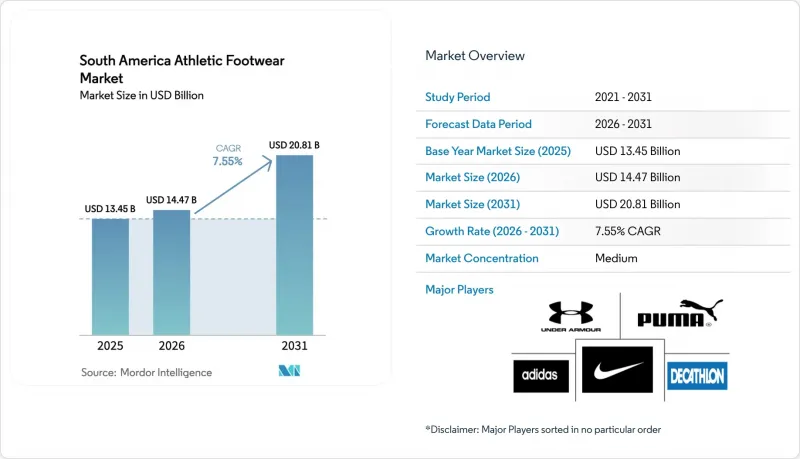
This report is Segmented by Activity Type (Running Shoes, Sports Shoes, and More); Product Type (Shoes and Boots), End User (Men, Women, and Kids/Children); Category (Premium and Mass), Distribution Channel (Sports and Athletic Goods Stores, Supermarkets/Hypermarkets, and More); and Geography (Brazil, Argentina, and Rest of South America). The Market Forecasts are Provided in Terms of Value (USD).
South America Athletic Footwear Market Trends and Insights
Influence of Social Media Platforms and Celebrity Endorsements
Social media platforms have fundamentally transformed athletic footwear marketing strategies in South America through the implementation of direct-to-consumer distribution mechanisms. Nike's strategic collaborations with professional athletes, including LeBron James, Michael Jordan, and Serena Williams, exemplify this methodological approach to market penetration. These athletes function as authorized brand representatives, a factor of considerable significance in South America, where sports figures, predominantly football professionals, maintain substantial cultural influence. Social commerce platforms, specifically Facebook, Instagram, and TikTok, have evolved beyond product discovery to establish comprehensive procurement mechanisms for athletic footwear. The presence of 112.55 million Facebook users in Brazil in 2024 demonstrates the platform's significant market penetration within the geographical region .
Favourable Government Initiatives to Promote Sports Culture
Government initiatives across South America have implemented comprehensive sports development programs as strategic public health measures and economic catalysts, subsequently increasing the demand for athletic footwear. Brazil's strategic investments in sports infrastructure, following its role as host of major international sporting events, have facilitated expanded access to athletic facilities beyond metropolitan regions. Argentina's implementation of trade liberalization policies has restructured the athletic footwear market through increased international market participation and enhanced consumer options within premium segments. The systematic incorporation of sports programs within educational institutions throughout the region has established sustained youth participation in athletic activities, developing a robust foundation for continued market expansion.
Proliferation of Counterfeit Products
The counterfeit athletic footwear market in South America undermines market integrity through its impact on brand value, consumer trust, and legitimate sales channels. INTERPOL reports indicate seizures valued at USD 225 million in 2024 . Counterfeit operations have evolved from basic imitations to sophisticated replicas that closely mirror authentic products, complicating both consumer identification and brand protection efforts. According to the OECD's "Mapping Global Trade in Fakes 2025" report, counterfeit footwear reached USD 467 billion, representing 2.3% of total global imports (OECD/EUIPO). The expansion of e-commerce has inadvertently facilitated counterfeit distribution through small parcel shipments that evade detection systems, prompting brands to implement advanced authentication technologies and consumer awareness programs to mitigate market impact.
Other drivers and restraints analyzed in the detailed report include:
- Significant Growth in Women's Sports Participation Rate
- Technological Innovations in Product Formulations
- High import duties and taxes increase retail prices
For complete list of drivers and restraints, kindly check the Table Of Contents.
Segment Analysis
Sports Shoes hold the dominant position with a 43.88% market share in 2025, driven by their versatility in both athletic activities and casual wear. Running Shoes are expected to achieve the highest growth rate at 8.05% CAGR from 2026 to 2031, driven by the expanding running culture and increased participation in marathons and community events. The segment's growth is enhanced by technological advancements, including Nike's AI-optimized Air technology, which improves performance and customization options. The South American athletic footwear market's activity segmentation reflects distinct consumer preferences influenced by global fitness trends and regional sporting traditions.
Adventure Sports Shoes are experiencing increased demand in Brazil and Argentina, where diverse topography supports outdoor activities among urban consumers. The segment's growth is supported by technical innovations such as Freudenberg's breathable waterproof membranes, which improve performance in challenging conditions. The Other Product Types segment, encompassing footwear for tennis, basketball, and volleyball, maintains consistent growth through specialized sporting communities and international sporting events. The market continues to evolve as athletic functionality merges with fashion preferences, particularly in urban areas where sports footwear serves both performance and style purposes.
Shoes hold 83.10% market share in 2025, driven by their versatility, cost-effectiveness, and suitability for the region's climate. The South American athletic footwear market demonstrates distinct consumer preferences across product types. Adidas reported a 17% increase in global footwear sales in 2024, with Latin America achieving 28% growth. The company projects double-digit growth in Latin America for 2025.
The boots segment is expected to grow at 7.78% CAGR from 2026 to 2031, exceeding the market's overall growth rate. This expansion stems from increased participation in adventure sports and outdoor activities, particularly in Brazil and Argentina. Technical innovations, including Freudenberg's specialized insoles and waterproof membranes, improve performance and comfort in demanding conditions. The segment experiences seasonal demand fluctuations, with peak sales during winter months in southern Argentina and Chile. This seasonality creates inventory management challenges for retailers while enabling premium pricing opportunities during high-demand periods.
Complete Report Scope:
- By Activity
- Running Shoes
- Sports Shoes
- Adventure Sports Shoes
- OtherProduct Types
- By Product Type
- Shoes
- Boots
- By End User
- Men
- Women
- Kids/Children
- By Category
- Premium
- Mass
- By Distribution Channel
- Sports and Athletic Goods Stores
- Supermarkets/Hypermarkets
- Online Retaile Stores
- Other Distribution Channels
- By Geography
- Brazil
- Argentina
- Rest of South America
List of Companies Covered in this Report:
- Nike, Inc.
- Adidas AG
- Puma SE
- Grupo Dass
- Under Armour Inc.
- Skechers USA Inc.
- Mizuno Corporation
- ASICS Corporation
- New Balance Athletics Inc.
- Fila Holdings Corporation
- Cambuci S.A.
- Vulcabras Azakeia
- VF Corporation
- Lotto Sport Italia S.p.A.
- Diadora S.p.A.
- Amer Sports
- Columbia Sportswear Company
- Authentic Brands Group LLC
- Procalcado S.A
- Decathlon SA
Additional Benefits:
- The market estimate (ME) sheet in Excel format
- 3 months of analyst support
TABLE OF CONTENTS
1 INTRODUCTION
- 1.1 Study Assumptions and Market Definition
- 1.2 Scope of the Study
2 RESEARCH METHODOLOGY
3 EXECUTIVE SUMMARY
4 MARKET LANDSCAPE
- 4.1 Market Overview
- 4.2 Market Drivers
- 4.2.1 Influence of Social Media Platforms and Celebrity Endorsements
- 4.2.2 Favourable Government Initiatives to Promote Sports Culture
- 4.2.3 Significant Growth in Women Sports Participation Rate
- 4.2.4 Technological Innovations in Product Formulations
- 4.2.5 Government initiatives promoting sports and physical activities
- 4.2.6 Growing urbanization and the emergence of fitness trends
- 4.3 Market Restraints
- 4.3.1 Proliferation of Counterfeit Products
- 4.3.2 High import duties and taxes increase retail prices
- 4.3.3 Consumer preference for traditional footwear limits market growth
- 4.3.4 Economic instability and currency fluctuations impact purchasing power
- 4.4 Consumer Behaviour Analysis
- 4.5 Regulatory Outlook
- 4.6 Porter's Five Forces Analysis
- 4.6.1 Threat of New Entrants
- 4.6.2 Bargaining Power of Buyers/Consumers
- 4.6.3 Bargaining Power of Suppliers
- 4.6.4 Threat of Substitute Products
- 4.6.5 Intensity of Competitive Rivalry
5 MARKET SIZE AND GROWTH FORECASTS (VALUE)
- 5.1 By Activity
- 5.1.1 Running Shoes
- 5.1.2 Sports Shoes
- 5.1.3 Adventure Sports Shoes
- 5.1.4 OtherProduct Types
- 5.2 By Product Type
- 5.2.1 Shoes
- 5.2.2 Boots
- 5.3 By End User
- 5.3.1 Men
- 5.3.2 Women
- 5.3.3 Kids/Children
- 5.4 By Category
- 5.4.1 Premium
- 5.4.2 Mass
- 5.5 By Distribution Channel
- 5.5.1 Sports and Athletic Goods Stores
- 5.5.2 Supermarkets/Hypermarkets
- 5.5.3 Online Retaile Stores
- 5.5.4 Other Distribution Channels
- 5.6 By Geography
- 5.6.1 Brazil
- 5.6.2 Argentina
- 5.6.3 Rest of South America
6 Competitive Landscape
- 6.1 Market Concentration
- 6.2 Strategic Moves
- 6.3 Market Share Analysis
- 6.4 Company Profiles (includes Global level Overview, Market level overview, Core Segments, Financials as available, Strategic Information, Market Rank/Share for key companies, Products and Services, and Recent Developments)
- 6.4.1 Nike, Inc.
- 6.4.2 Adidas AG
- 6.4.3 Puma SE
- 6.4.4 Grupo Dass
- 6.4.5 Under Armour Inc.
- 6.4.6 Skechers USA Inc.
- 6.4.7 Mizuno Corporation
- 6.4.8 ASICS Corporation
- 6.4.9 New Balance Athletics Inc.
- 6.4.10 Fila Holdings Corporation
- 6.4.11 Cambuci S.A.
- 6.4.12 Vulcabras Azakeia
- 6.4.13 VF Corporation
- 6.4.14 Lotto Sport Italia S.p.A.
- 6.4.15 Diadora S.p.A.
- 6.4.16 Amer Sports
- 6.4.17 Columbia Sportswear Company
- 6.4.18 Authentic Brands Group LLC
- 6.4.19 Procalcado S.A
- 6.4.20 Decathlon SA
7 MARKET OPPORTUNITIES AND FUTURE OUTLOOK

