PUBLISHER: Mordor Intelligence | PRODUCT CODE: 2116779

PUBLISHER: Mordor Intelligence | PRODUCT CODE: 2116779
Africa Renewable Energy - Market Share Analysis, Industry Trends & Statistics, Growth Forecasts (2026 - 2031)
According to Mordor Intelligence, the Africa renewable energy market size in terms of installed base is projected to expand from 77.91 gigawatt in 2025 and 86.95 gigawatt in 2026 to 179.66 gigawatt by 2031, registering a CAGR of 15.62% between 2026 to 2031.
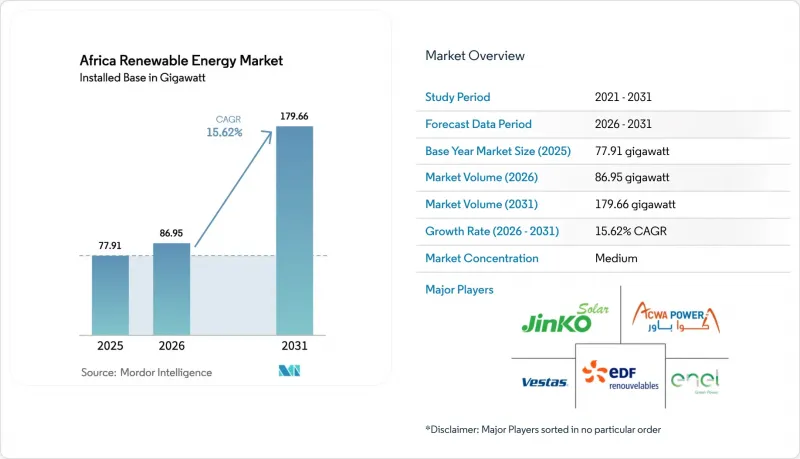
This report is Segmented by Technology (Solar Energy, Wind Energy, Hydropower, Bioenergy, Geothermal, and Ocean Energy), End-User (Utilities, Commercial and Industrial, and Residential), and Geography (South Africa, Egypt, Nigeria, Morocco, Algeria, Ethiopia, Kenya, Ghana, and Rest of Africa). The Market Sizes and Forecasts are Provided in Terms of Installed Capacity (GW).
Africa Renewable Energy Market Trends and Insights
Rapid Decline in Solar PV CAPEX
Auction tariffs for utility-scale solar dropped below USD 0.03 per kWh in Egypt and Morocco during 2025, undercutting new coal and gas by more than 40%. Module prices fell to USD 0.12 per watt in early 2026 as global polysilicon oversupply met tepid demand. Bid Window 7 in South Africa cleared 2.6 GW at an average USD 0.025 per kWh, a 60% reduction from the inaugural round ten years earlier. Algeria's 1 GW solar tender set a ceiling price of USD 0.028 per kWh, confirming photovoltaics as the least-cost baseload option when paired with four-hour lithium-ion storage. These economics allow 20-year fixed-price PPAs, locking in debt tenors from multilateral lenders and helping the Africa renewable energy market overcome currency-risk hurdles.
Utility-Scale Wind Project Pipeline Acceleration in South Africa
South Africa's wind queue reached 48 GW in 2024, clustered in the Northern and Eastern Capes, where capacity factors top 40%. Bid Windows 5-7 collectively awarded 5.3 GW with commercial operation dates sequenced to 2029 to ease grid integration. Eskom can only absorb 2 GW of variable renewables each year without voltage events, forcing co-located batteries or managed curtailment. Vestas captured 1.2 GW of turbine orders by assembling nacelles locally, satisfying domestic-content rules and trimming logistics costs. Kenya's 310 MW Lake Turkana wind farm, meanwhile, proved remote projects can maintain debt-service coverage above 1.4x even when wheeling power 400 km.
Weak Grid Stability & Curtailment Risk
Eskom curtailed 4,363 GWh of renewables in 2024, 12% of total output, due to inflexible coal plants that cannot track solar peaks and evening wind ramps. Kenya's grid operator restricted Lake Turkana's output during 18% of hours in 2025 after voltage excursions on the Loiyangalani-Suswa line. Egypt disconnected sections of the Benban park for 200 hours in 2024 as frequency strayed outside the 49.8-50.2 Hz band. Such events depress project capacity factors below bank-case assumptions, triggering loan renegotiations. South Africa's 2025 Grid Code Amendment now mandates two-hour storage on new projects, adding USD 300 per kW but reducing curtailment exposure and strengthening the Africa renewable energy market's risk profile.
Other drivers and restraints analyzed in the detailed report include:
- Mini-Grid Programs Backed by DFI Concessional Funding
- Emerging Green-Hydrogen Export Hubs
- Currency-Convertibility Limitations for IPPs
For complete list of drivers and restraints, kindly check the Table Of Contents.
Segment Analysis
Solar installations stand out as the fastest-growing technology, with a 27.84% CAGR projected from 2026 to 2031, while hydropower accounted for a dominant 62.25% of the Africa renewable energy market share in 2025. Egypt's 1.8 GW Benban cluster and 500 MW Kom Ombo additions showcase how desert irradiance above 2,500 kWh/m2 enables 28% capacity factors without trackers. Morocco's Noor complex integrates 580 MW of concentrated solar power with molten-salt storage, achieving seven-hour dispatchability that commands a premium over pure PV. Wind benefits from South Africa's 48 GW pipeline and Kenya's proven high-factor sites, yet offshore activity remains limited to pre-feasibility studies. The Africa renewable energy market size for wind and solar combined is forecast to eclipse hydropower by 2029 as procurement windows accelerate, module prices retreat, and battery costs drop.
Hydropower's share will erode gradually as social opposition curtails mega-dam ambitions, exemplified by the stalled USD 80 billion Grand Inga project. Run-of-river and pumped-storage schemes gain favor for their lighter resettlement footprint. Kenya leads geothermal with 985 MW at Olkaria and an 83 MW unit commissioned in 2024, leveraging Rift Valley geology for baseload supply. Bioenergy and ocean-energy pilots remain small, but municipal waste-to-power in South Africa signals a gradual broadening of the Africa renewable energy market technology mix.
Complete Report Scope:
- By Technology
- Solar Energy (PV and CSP)
- Wind Energy (Onshore and Offshore)
- Hydropower (Small, Large, PSH)
- Bioenergy
- Geothermal
- Ocean Energy (Tidal and Wave)
- By End-User
- Utilities
- Commercial and Industrial
- Residential
- By Geography
- South Africa
- Egypt
- Nigeria
- Morocco
- Algeria
- Ethiopia
- Kenya
- Ghana
- Rest of Africa
List of Companies Covered in this Report:
- Vestas Wind Systems A/S
- Juwi Holding AG
- ACWA Power
- Enel Green Power S.p.A.
- EDF Renewables
- Acciona SA
- JinkoSolar Holding Co. Ltd
- Canadian Solar Inc.
- First Solar Inc.
- Hidroelectrica de Cahora Bassa S.A.
- Scatec ASA
- Mainstream Renewable Power
- Siemens Gamesa Renewable Energy
- BTE Renewable
- Orsted A/S
- TotalEnergies Renewables
- Masdar Clean Energy
- ENGIE Africa
- Globeleq
- Abengoa Solar
Additional Benefits:
- The market estimate (ME) sheet in Excel format
- 3 months of analyst support
TABLE OF CONTENTS
1 Introduction
- 1.1 Study Assumptions & Market Definition
- 1.2 Scope of the Study
2 Research Methodology
3 Executive Summary
4 Market Landscape
- 4.1 Market Overview
- 4.2 Market Drivers
- 4.2.1 Rapid decline in solar PV CAPEX
- 4.2.2 Utility-scale wind project pipeline acceleration in South Africa
- 4.2.3 Mini-grid programs backed by DFI concessional funding
- 4.2.4 Emerging green-hydrogen export hubs
- 4.2.5 Growing corporate PPAs from mining companies
- 4.2.6 Expansion of climate-aligned blended-finance platforms
- 4.3 Market Restraints
- 4.3.1 Weak grid stability & curtailment risk
- 4.3.2 Currency-convertibility limitations for IPPs
- 4.3.3 Delays in sovereign guarantees for power-purchase agreements
- 4.3.4 Rising opposition to large hydro projects on social-environment grounds
- 4.4 Supply-Chain Analysis
- 4.5 Regulatory Landscape
- 4.6 Technological Outlook
- 4.7 Porter's Five Forces
- 4.7.1 Bargaining Power of Suppliers
- 4.7.2 Bargaining Power of Consumers
- 4.7.3 Threat of New Entrants
- 4.7.4 Threat of Substitute Products & Services
- 4.7.5 Intensity of Competitive Rivalry
5 Market Size & Growth Forecasts
- 5.1 By Technology
- 5.1.1 Solar Energy (PV and CSP)
- 5.1.2 Wind Energy (Onshore and Offshore)
- 5.1.3 Hydropower (Small, Large, PSH)
- 5.1.4 Bioenergy
- 5.1.5 Geothermal
- 5.1.6 Ocean Energy (Tidal and Wave)
- 5.2 By End-User
- 5.2.1 Utilities
- 5.2.2 Commercial and Industrial
- 5.2.3 Residential
- 5.3 By Geography
- 5.3.1 South Africa
- 5.3.2 Egypt
- 5.3.3 Nigeria
- 5.3.4 Morocco
- 5.3.5 Algeria
- 5.3.6 Ethiopia
- 5.3.7 Kenya
- 5.3.8 Ghana
- 5.3.9 Rest of Africa
6 Competitive Landscape
- 6.1 Market Concentration
- 6.2 Strategic Moves (M&A, JVs, Funding, PPAs)
- 6.3 Market Share Analysis (Market Rank/Share for key companies)
- 6.4 Company Profiles (includes Global-level Overview, Market-level Overview, Core Segments, Financials, Strategic Information, Products & Services, Recent Developments)
- 6.4.1 Vestas Wind Systems A/S
- 6.4.2 Juwi Holding AG
- 6.4.3 ACWA Power
- 6.4.4 Enel Green Power S.p.A.
- 6.4.5 EDF Renewables
- 6.4.6 Acciona SA
- 6.4.7 JinkoSolar Holding Co. Ltd
- 6.4.8 Canadian Solar Inc.
- 6.4.9 First Solar Inc.
- 6.4.10 Hidroelectrica de Cahora Bassa S.A.
- 6.4.11 Scatec ASA
- 6.4.12 Mainstream Renewable Power
- 6.4.13 Siemens Gamesa Renewable Energy
- 6.4.14 BTE Renewable
- 6.4.15 Orsted A/S
- 6.4.16 TotalEnergies Renewables
- 6.4.17 Masdar Clean Energy
- 6.4.18 ENGIE Africa
- 6.4.19 Globeleq
- 6.4.20 Abengoa Solar
7 Market Opportunities & Future Outlook
- 7.1 White-Space & Unmet-Need Assessment

