PUBLISHER: Mordor Intelligence | PRODUCT CODE: 2125618

PUBLISHER: Mordor Intelligence | PRODUCT CODE: 2125618
Nordic Countries Renewable Energy - Market Share Analysis, Industry Trends & Statistics, Growth Forecasts (2026 - 2031)
According to Mordor Intelligence, the Nordic countries renewable energy market size was valued at 121.32 gigawatt in 2025 and estimated to grow from 129.99 gigawatt in 2026 to reach 183.7 gigawatt by 2031, at a CAGR of 7.15% during the forecast period (2026-2031).
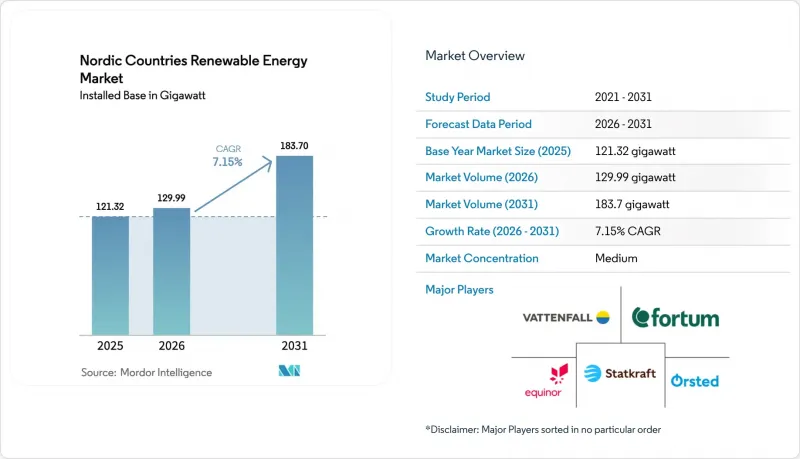
This report is Segmented by Technology (Solar Energy, Wind Energy, Hydropower, Bioenergy, Geothermal, and Ocean Energy), End-User (Utilities, Commercial and Industrial, and Residential), and Geography (Norway, Sweden, Denmark, Finland, and Iceland). The Market Sizes and Forecasts are Provided in Terms of Installed Capacity (GW).
Nordic Countries Renewable Energy Market Trends and Insights
Rapid Build-out of Offshore Wind Hubs
Denmark's North Sea Energy Island, designed to connect 10 GW of offshore capacity by 2030, exemplifies the region's shift toward hub-based development, which maximizes grid utilization and enables high-volume cross-border trading. Complementary projects underway in Sweden and Finland form a continuous offshore wind corridor, leveraging economies of scale in turbine procurement and operations. Floating wind pilots in Norwegian deep waters further enlarge the resource base. Collective progress positions the Nordic countries' renewable energy market as a global proving ground for advanced offshore technologies, creating cost-reduction pathways that are not achievable through isolated projects.
EU Fit-for-55 Targets Accelerating PPAs
The Fit-for-55 package has shifted Nordic procurement dynamics from feed-in tariffs to corporate power purchase agreements, guaranteeing revenue certainty for generators and clean-energy credentials for buyers. Statkraft and regional utilities have structured multi-year PPAs that hedge against price volatility while meeting the countries' additionality rules, as embedded in EU policy. Ambitious national solar strategies, such as Denmark's plan to quadruple capacity, dovetail with EU objectives to produce a sustained demand pull. This convergence maintains premium pricing for exports from the Nordic countries' renewable energy market.
Limited Transmission Capacity in Northern Scandinavia
Resource-rich northern Scandinavia lacks sufficient high-voltage lines to deliver growing wind and hydropower output to southern demand centers. Curtailment risk erodes project economics and dampens investor confidence. Norway's pledge to invest NOK 400 million (USD 37 million) in the Kaggefoss upgrade signals recognition of the infrastructure gap. Yet large-scale reinforcement projects demand multi-year planning, so the constraint will continue to temper the Nordic countries' renewable energy market expansion over the long term.
Other drivers and restraints analyzed in the detailed report include:
- Grid-Balancing Revenues from Nordic Cross-Border Interconnectors
- Declining LCOE for Onshore Wind & Solar PV
- Lengthy Environmental Permitting for New Wind Parks
For complete list of drivers and restraints, kindly check the Table Of Contents.
Segment Analysis
Hydropower retained 48.30% of 2025 capacity and commanded ancillary-services income of EUR 1.2 billion, illustrating its foundational role in the Nordic countries' renewable energy market share. However, solar is expanding at 18.24% CAGR, the fastest among technologies, because bifacial modules and trackers improve yields in snow-covered southern Sweden and Denmark. Offshore wind clusters in Danish and Norwegian waters account for most new capacity, aided by energy-island concepts that aggregate exports via HVDC cables. Pumped-storage feasibility studies using abandoned mines may unlock eight-hour storage, yet capital intensity and decade-long build timelines stall near-term decisions. Geothermal beyond Iceland remains niche, but Sweden's 3 MW Vasteras pilot confirmed technical viability in crystalline bedrock, hinting at long-term diversification.
Bioenergy's role is shifting from baseload to mid-merit. Fortum retrofitted 12 plants in 2024 to ramp 40% faster, and data-center waste-heat capture trims feedstock costs. Ocean energy trials in Norway reached only 1.5 MW amid grid-connection expenses topping EUR 4 million/MW. Overall, hydropower will continue to anchor flexibility, but multi-technology hybrids and solar outperformance will propel the Nordic countries' renewable energy market size over the forecast period.
Complete Report Scope:
- By Technology
- Solar Energy (PV and CSP)
- Wind Energy (Onshore and Offshore)
- Hydropower (Small, Large, PSH)
- Bioenergy
- Geothermal
- Ocean Energy (Tidal and Wave)
- By End-User
- Utilities
- Commercial and Industrial
- Residential
- By Geography
- Norway
- Sweden
- Denmark
- Finland
- Iceland
List of Companies Covered in this Report:
- Orsted A/S
- Vattenfall AB
- Statkraft AS
- Fortum Oyj
- Equinor ASA
- Siemens Gamesa Renewable Energy SA
- GE Vernova
- RES Group
- Scatec ASA
- Svea Renewable Solar AB
- Axpo Holding AG
- InnoVentum AB
- Swedish Biofuels AB
- Nordic Solar A/S
- Ilmatar Energy Oy
- Fred. Olsen Renewables
- OX2 AB
- St1 Nordic Oy
- Wartsila Oyj (renewables & hybrid)
- Hitachi Energy Ltd
Additional Benefits:
- The market estimate (ME) sheet in Excel format
- 3 months of analyst support
TABLE OF CONTENTS
1 Introduction
- 1.1 Study Assumptions & Market Definition
- 1.2 Scope of the Study
2 Research Methodology
3 Executive Summary
4 Market Landscape
- 4.1 Market Overview
- 4.2 Renewable Energy Mix, 2024
- 4.3 Market Drivers
- 4.3.1 Rapid build-out of offshore wind hubs
- 4.3.2 EU Fit-for-55 targets accelerating PPAs
- 4.3.3 Grid-balancing revenues from Nordic cross-border interconnectors
- 4.3.4 Declining LCOE for onshore wind & solar PV
- 4.3.5 Surge in green-hydrogen-linked offtake MOUs
- 4.3.6 Data-centre waste-heat offtake contracts boosting bio-energy CHP
- 4.4 Market Restraints
- 4.4.1 Limited transmission capacity in northern Scandinavia
- 4.4.2 Lengthy environmental permitting for new wind parks
- 4.4.3 Turbine-blade recycling bottlenecks
- 4.4.4 Volatility in Swedish green certificate prices post-2025
- 4.5 Supply-Chain Analysis
- 4.6 Regulatory Landscape
- 4.7 Technological Outlook
- 4.8 Porter's Five Forces
- 4.8.1 Bargaining Power of Suppliers
- 4.8.2 Bargaining Power of Consumers
- 4.8.3 Threat of New Entrants
- 4.8.4 Threat of Substitute Products & Services
- 4.8.5 Intensity of Competitive Rivalry
5 Market Size & Growth Forecasts
- 5.1 By Technology
- 5.1.1 Solar Energy (PV and CSP)
- 5.1.2 Wind Energy (Onshore and Offshore)
- 5.1.3 Hydropower (Small, Large, PSH)
- 5.1.4 Bioenergy
- 5.1.5 Geothermal
- 5.1.6 Ocean Energy (Tidal and Wave)
- 5.2 By End-User
- 5.2.1 Utilities
- 5.2.2 Commercial and Industrial
- 5.2.3 Residential
- 5.3 By Geography
- 5.3.1 Norway
- 5.3.2 Sweden
- 5.3.3 Denmark
- 5.3.4 Finland
- 5.3.5 Iceland
6 Competitive Landscape
- 6.1 Market Concentration
- 6.2 Strategic Moves (M&A, Partnerships, PPAs)
- 6.3 Market Share Analysis (Market Rank/Share for key companies)
- 6.4 Company Profiles (includes Global level Overview, Market level overview, Core Segments, Financials as available, Strategic Information, Products & Services, and Recent Developments)
- 6.4.1 Orsted A/S
- 6.4.2 Vattenfall AB
- 6.4.3 Statkraft AS
- 6.4.4 Fortum Oyj
- 6.4.5 Equinor ASA
- 6.4.6 Siemens Gamesa Renewable Energy SA
- 6.4.7 GE Vernova
- 6.4.8 RES Group
- 6.4.9 Scatec ASA
- 6.4.10 Svea Renewable Solar AB
- 6.4.11 Axpo Holding AG
- 6.4.12 InnoVentum AB
- 6.4.13 Swedish Biofuels AB
- 6.4.14 Nordic Solar A/S
- 6.4.15 Ilmatar Energy Oy
- 6.4.16 Fred. Olsen Renewables
- 6.4.17 OX2 AB
- 6.4.18 St1 Nordic Oy
- 6.4.19 Wartsila Oyj (renewables & hybrid)
- 6.4.20 Hitachi Energy Ltd
7 Market Opportunities & Future Outlook
- 7.1 White-space & Unmet-need Assessment

