PUBLISHER: Mordor Intelligence | PRODUCT CODE: 2116792

PUBLISHER: Mordor Intelligence | PRODUCT CODE: 2116792
Europe Hydrogen Generation - Market Share Analysis, Industry Trends & Statistics, Growth Forecasts (2026 - 2031)
According to Mordor Intelligence, the Europe hydrogen generation market size is estimated at USD 44.59 billion in 2026, and is expected to reach USD 53.44 billion by 2031, at a CAGR of 3.69% during the forecast period (2026-2031).
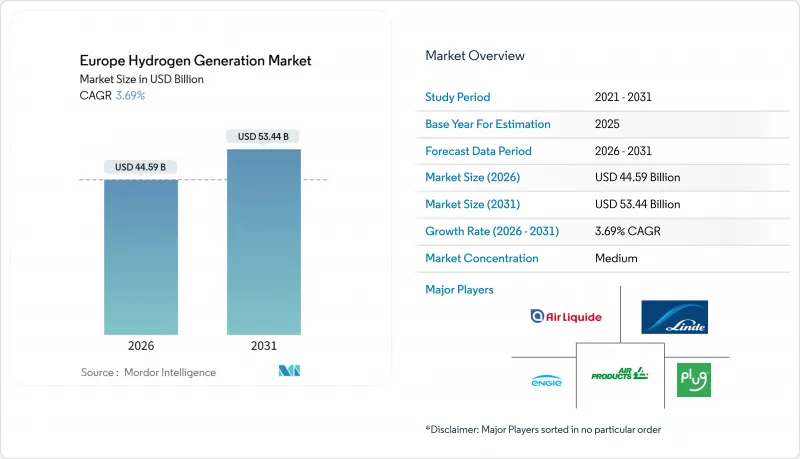
This report is Segmented by Source (Grey, Blue, Green, Turquoise, and Pink), Technology (SMR, Coal Gasification, ATR, POX, and Electrolysis), Application (Oil Refining, Chemical Processing, Iron and Steel, Transportation Fuel, Power and Energy Storage, and Residential and Commercial Heating), and Geography (Germany, France, United Kingdom, Netherlands, Spain, Italy, Norway, Denmark, and More).
Europe Hydrogen Generation Market Trends and Insights
EU "Fit-for-55" & Green Deal Mandates
Binding EU targets of 10 million tonnes of domestic renewable hydrogen and 10 million tonnes of imports by 2030 elevate demand certainty despite near-term cost headwinds. Germany's 2023 strategy earmarked USD 8.1 billion across electrolysis and import corridors, while France allocated USD 7.9 billion through 2030 for industrial decarbonization. July 2025 RFNBO rules introduced additionality and hourly matching, deliberately slowing deployment yet locking in carbon integrity that derisks private capital. Member-state auctions, H2Global in Germany and France's "Hydrogene decarbone" tenders, guarantee offtake prices for ten years, narrowing the grey-green cost gap. Collectively, these measures push the European Hydrogen Generation Market toward structurally lower emissions pathways while providing bankability for first-mover projects.
Electrolyser Cost Decline (Scale & Learning Curves)
Alkaline system prices fell from EUR 1,300 per kW in 2020 to EUR 600-800 per kW by late 2025 as gigafactories came online, achieving parity with imported Chinese stacks. thyssenkrupp nucera's 20 MW modules and Nel's 3.5 MW stacks now ship at sub-EUR 700 per kW, while Sunfire's SOEC pilots show 10-15 percentage-point efficiency gains, albeit at higher capex. Learning curves of 18-22% per capacity doubling suggest that announced gigafactories in Hungary and Berlin will drive alkaline costs below EUR 400 per kW by 2029, positioning green hydrogen for parity in wind-rich zones. Falling equipment prices translate directly into project-level levelized cost reductions, compressing the time needed for the European Hydrogen Generation Market to decouple from subsidies.
High LCOH Gap vs. Grey H2 Without Robust Carbon Price
Green hydrogen averaged EUR 4.50-6.50 kg in 2025 against EUR 1.80-2.30 kg for grey, leaving a EUR 2.70-4.20 gap that sub-EUR 75 t ETS prices do not yet close. Germany's 2024 carbon contracts-for-difference pay a EUR 4.00 kg strike price but covered only 1.2 GW in the first auction, well below the 10 GW 2030 target. The European Hydrogen Bank's fixed-premium auctions offer EUR 0.40-0.48 kg for ten years; while helpful, reliance on public finance exposes projects to shifting fiscal priorities after 2027. Until EUA prices clear EUR 90-110 t, merchants will hedge but delay large free-market purchases, capping the expansion speed of the European Hydrogen Generation Market.
Other drivers and restraints analyzed in the detailed report include:
- Corporate Net-Zero Commitments (Heavy Industry & Mobility)
- EU Funding: IPCEI, Horizon Europe, CEF, ETS Innovation Fund
- Renewable-Power Availability Constraints for Large-Scale Electrolysis
For complete list of drivers and restraints, kindly check the Table Of Contents.
Segment Analysis
Europe's hydrogen generation market size for grey hydrogen equaled USD 31.0 billion in 2025, representing 70.1% of volume, but its share slips below 55% by 2031 as renewable-powered routes outpace legacy. Green output grows 25.5% a year, leveraging falling capex and Fit-for-55 demand guarantees; this surge elevates green hydrogen value to USD 12.6 billion by 2031, translating into notable Europe hydrogen generation market share gains for electrolytic producers. Blue hydrogen rises modestly on projects with >=90% CO2 capture but remains capped by public resistance to CCS infrastructure, while turquoise and pink routes fill niche needs in polymer and nuclear-anchored clusters. Altogether, the shifting source mix confirms a managed glidepath rather than an abrupt switch, smoothing cash-flow risk for incumbent gas suppliers yet opening room for new entrants with RFNBO-compliant volumes.
Second-order effects appear in gas-market hedging and ammonia trade flows. Refiners sign three- to five-year bridge contracts for blue hydrogen while awaiting green parity, whereas chemical majors lean into green-ammonia exports that monetize RFNBO premium credits. As a result, optionality across source routes becomes a hedge strategy, allowing corporate buyers to straddle compliance deadlines without disrupting core operations.
Complete Report Scope:
- By Source
- Grey Hydrogen
- Blue Hydrogen
- Green Hydrogen
- Turquoise Hydrogen
- Pink Hydrogen
- By Technology
- Steam Methane Reforming (SMR)
- Coal Gasification
- Auto-Thermal Reforming (ATR)
- Partial Oxidation (POX)
- Electrolysis (Alkaline Electrolysis, Proton Exchange Membrane (PEM), Solid Oxide Electrolysis (SOE))
- By Application
- Oil Refining
- Chemical Processing (Ammonia, Methanol)
- Iron and Steel (DRI, H2-BF)
- Transportation Fuel (FCEV, Marine, Aviation)
- Power and Energy Storage
- Residential and Commercial Heating
- By Geography
- Germany
- France
- United Kingdom
- Netherlands
- Spain
- Italy
- Norway
- Denmark
- Poland
- Russia
- Rest of Europe
List of Companies Covered in this Report:
- Air Liquide
- Linde plc
- Air Products & Chemicals
- Engie SA
- Plug Power
- Messer Group
- FuelCell Energy
- Enapter AG
- Siemens Energy
- Nel ASA
- McPhy Energy
- thyssenkrupp nucera
- Sunfire GmbH
- ITM Power
- Shell plc
- BP plc
- TotalEnergies SE
- Equinor ASA
- RWE AG
- Iberdrola SA
Additional Benefits:
- The market estimate (ME) sheet in Excel format
- 3 months of analyst support
TABLE OF CONTENTS
1 Introduction
- 1.1 Study Assumptions & Market Definition
- 1.2 Scope of the Study
2 Research Methodology
3 Executive Summary
4 Market Landscape
- 4.1 Market Overview
- 4.2 Market Drivers
- 4.2.1 EU "Fit-for-55" & Green Deal mandates
- 4.2.2 Electrolyser cost decline (scale & learning curves)
- 4.2.3 Corporate net-zero commitments (heavy industry & mobility)
- 4.2.4 EU funding: IPCEI, Horizon Europe, CEF, ETS Innovation Fund
- 4.2.5 North-Sea offshore-wind curtailment creating near-zero-cost power
- 4.2.6 Repurposing gas grid into "Hydrogen Backbone" lowers mid-stream CAPEX
- 4.3 Market Restraints
- 4.3.1 High LCOH gap vs. grey H2 without robust carbon price
- 4.3.2 Renewable-power availability constraints for large-scale electrolysis
- 4.3.3 Iridium/Pt metal shortages limit PEM electrolyser scaling
- 4.3.4 Public opposition to CCS infrastructure for blue hydrogen
- 4.4 Supply-Chain Analysis
- 4.5 Government Policies & Regulations
- 4.6 Technological Outlook (Alkaline, PEM, SOEC, AEM, SMR-CCS etc.)
- 4.7 Porter's Five Forces
- 4.7.1 Bargaining Power of Suppliers
- 4.7.2 Bargaining Power of Buyers
- 4.7.3 Threat of New Entrants
- 4.7.4 Threat of Substitutes
- 4.7.5 Intensity of Rivalry
5 Market Size & Growth Forecasts
- 5.1 By Source
- 5.1.1 Grey Hydrogen
- 5.1.2 Blue Hydrogen
- 5.1.3 Green Hydrogen
- 5.1.4 Turquoise Hydrogen
- 5.1.5 Pink Hydrogen
- 5.2 By Technology
- 5.2.1 Steam Methane Reforming (SMR)
- 5.2.2 Coal Gasification
- 5.2.3 Auto-Thermal Reforming (ATR)
- 5.2.4 Partial Oxidation (POX)
- 5.2.5 Electrolysis (Alkaline Electrolysis, Proton Exchange Membrane (PEM), Solid Oxide Electrolysis (SOE))
- 5.3 By Application
- 5.3.1 Oil Refining
- 5.3.2 Chemical Processing (Ammonia, Methanol)
- 5.3.3 Iron and Steel (DRI, H2-BF)
- 5.3.4 Transportation Fuel (FCEV, Marine, Aviation)
- 5.3.5 Power and Energy Storage
- 5.3.6 Residential and Commercial Heating
- 5.4 By Geography
- 5.4.1 Germany
- 5.4.2 France
- 5.4.3 United Kingdom
- 5.4.4 Netherlands
- 5.4.5 Spain
- 5.4.6 Italy
- 5.4.7 Norway
- 5.4.8 Denmark
- 5.4.9 Poland
- 5.4.10 Russia
- 5.4.11 Rest of Europe
6 Competitive Landscape
- 6.1 Market Concentration
- 6.2 Strategic Moves (M&A, Partnerships, PPAs)
- 6.3 Market Share Analysis (Market Rank/Share for key companies)
- 6.4 Company Profiles (includes Global level Overview, Market level overview, Core Segments, Financials as available, Strategic Information, Products & Services, and Recent Developments)
- 6.4.1 Air Liquide
- 6.4.2 Linde plc
- 6.4.3 Air Products & Chemicals
- 6.4.4 Engie SA
- 6.4.5 Plug Power
- 6.4.6 Messer Group
- 6.4.7 FuelCell Energy
- 6.4.8 Enapter AG
- 6.4.9 Siemens Energy
- 6.4.10 Nel ASA
- 6.4.11 McPhy Energy
- 6.4.12 thyssenkrupp nucera
- 6.4.13 Sunfire GmbH
- 6.4.14 ITM Power
- 6.4.15 Shell plc
- 6.4.16 BP plc
- 6.4.17 TotalEnergies SE
- 6.4.18 Equinor ASA
- 6.4.19 RWE AG
- 6.4.20 Iberdrola SA
7 Market Opportunities & Future Outlook
- 7.1 White-Space & Unmet-Need Assessment

