PUBLISHER: Mordor Intelligence | PRODUCT CODE: 2116831

PUBLISHER: Mordor Intelligence | PRODUCT CODE: 2116831
Europe Online Dating Services - Market Share Analysis, Industry Trends & Statistics, Growth Forecasts (2026 - 2031)
According to Mordor Intelligence, the Europe online dating services market size was valued at USD 1.15 billion in 2025 and estimated to grow from USD 1.22 billion in 2026 to reach USD 1.63 billion by 2031, at a CAGR of 5.99% during the forecast period (2026-2031).
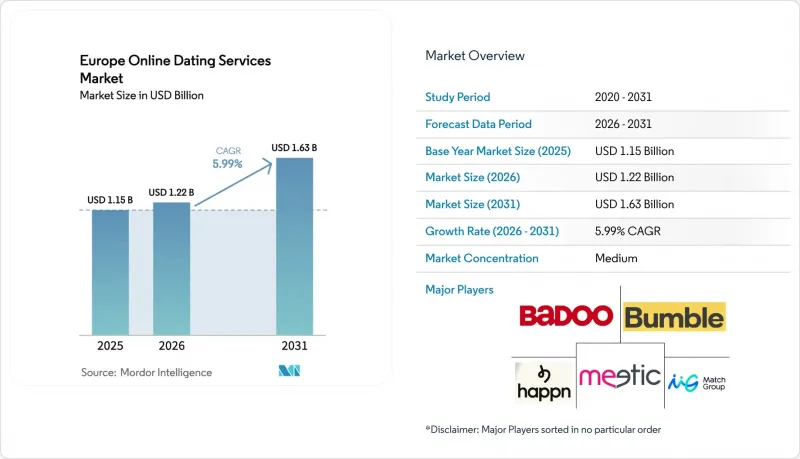
This report is Segmented by Type (Non-Paying Online Dating, and Paying Online Dating), Device Platform (Mobile Applications, and More), Age Group (18-24 Years, 25-34 Years, and More), Relationship Intent (Casual Dating, Long-Term Relationship, and More), Sexual Orientation (Heterosexual Platforms, and LGBTQ+ Platforms), and Country. The Market Forecasts are Provided in Terms of Value (USD).
Europe Online Dating Services Market Trends and Insights
Surge in Millennial and Gen Z Users Seeking Digital-first Socialization
Millennial and Gen Z cohorts treat dating apps as primary social infrastructure rather than add-on experiences. Eurostat reported 97% daily internet usage among 16-29-year-olds in 2024, with 83% of them actively using social networks. Ofcom found that 18% of UK users aged 18-24 and 17% aged 25-34 visited dating services in May 2024. Hinge's 36% revenue jump to USD 145 million in Q3 2024 demonstrates how intentional-dating design resonates with this audience. Delayed marriage, average first-marriage age now above 30 in Germany, France, and the UK, extends monetization windows. HER reached 15 million users, 60% of whom fall in the 18-24 bracket, underscoring youth-driven volume and engagement depth.
AI-driven Matching Algorithms Enhancing User Engagement
Artificial intelligence has moved to the front end of product differentiation, guiding compatibility predictions, conversational nudges, and personalized onboarding flows. Match Group's AI "Matchmaker" suggests profile tweaks, while Bumble's chat coach offers real-time tone advice. Tinder's ID-verification rollout, which uses AI-based liveness checks, lifted matches 67% for verified users in the UK and other markets in 2024. The Schrems decision limits indefinite data aggregation, pressing platforms toward federated learning and on-device inference to stay within GDPR bounds. Incumbents with capital to retrain models enjoy an execution edge over smaller challengers.
Escalating Concerns over Data Privacy and Security Breaches
Norway upheld a NOK 65 million (USD 6.43 million) fine on Grindr in 2024 for sharing location and sexual-orientation data without consent. Italy's regulator fined Nirvam EUR 200,000 (USD 232910) in February 2024 for unlawful processing of 1 million profiles. The European Data Protection Board's October 2024 opinion declared "consent-or-pay" models incompatible with GDPR. A KU Leuven study found that 15 popular apps leaked sensitive data in 2024, six of them revealing precise location. These moves pressure platforms toward subscription-only revenue and stricter data minimization.
Other drivers and restraints analyzed in the detailed report include:
- Integration of Video Dating and Live Streaming Features Post Pandemic
- Niche Dating Apps Targeting Specific Communities Fuel Monetization
- Proliferation of Fake Profiles and Catfishing Incidents
For complete list of drivers and restraints, kindly check the Table Of Contents.
Segment Analysis
Paying services represented 60.72% of 2025 revenue and are forecast to grow at an 7.72% CAGR, buoyed by AI matching, video calls, and priority visibility bundled into subscriptions. The Europe online dating services market size attributable to paying tiers is set to outstrip freemium growth through 2031. Match retained 10 million paying Tinder users, while Hinge's paying base climbed 38% to 1.9 million in Q3 2024. Bumble counted 4 million paying users, although the total number slipped 7%. Price hikes saw Tinder Platinum reach GBP 32.99 (USD 41) per month.
Non-paying tiers held a 39.28% share but face tighter advertising rules. The Europe online dating services market is watching the consent-or-pay debate; should regulators outlaw data-heavy ads, free tiers will shrink to basic swipes, nudging users toward subscriptions. Already, 3-5% of free users convert to paid users, yet they generate up to 90% of the platform's revenue.
Mobile applications captured 71.15% of 2025 revenue and will post an 7.88% CAGR as 5G spreads and push-notification engagement deepens. The Europe online dating services market relies on mobile location discovery, camera-enabled content, and in-app billing, advantages desktop cannot match. Bumble reported USD 221 million mobile revenue versus modest web totals.
Desktop and web kept a 28.85% share, favored by older users who complete long questionnaires on larger screens. Responsive web design and progressive web apps help desktop-heavy brands avoid 30% app-store fees. Regulatory parity under the Digital Services Act removes historic compliance advantages for web-only operators, keeping both platforms in play.
Complete Report Scope:
- By Type
- Non-paying Online Dating
- Paying Online Dating
- By Device Platform
- Mobile Applications
- Desktop and Web Platforms
- By Age Group
- 18-24 Years
- 25-34 Years
- 35-44 Years
- 45 Years and Above
- By Relationship Intent
- Casual Dating
- Long-term Relationship
- Niche Interest Matchmaking
- By Sexual Orientation
- Heterosexual Platforms
- LGBTQ+ Platforms
- By Country
- Germany
- United Kingdom
- France
- Spain
- Italy
- Netherlands
- Nordics (Denmark, Sweden, Norway, Finland)
- Rest of Europe
List of Companies Covered in this Report:
- Match Group Inc.
- Bumble Inc.
- Badoo Ltd
- FTW and Co (happn)
- Meetic SA
- LOVOO GmbH and Co. KG
- Plentyoffish Media ULC
- Hinge Inc.
- eHarmony Inc.
- OkCupid LLC
- Grindr LLC
- Dattch Ltd (HER)
- Once Dating AG
- Parship GmbH
- EliteMedianet GmbH (ElitePartner)
- Zoosk Inc.
- Spark Networks SE
- The Meet Group Inc.
- Feeld Ltd
Additional Benefits:
- The market estimate (ME) sheet in Excel format
- 3 months of analyst support
TABLE OF CONTENTS
1 INTRODUCTION
- 1.1 Study Assumptions and Market Definition
- 1.2 Scope of the Study
2 RESEARCH METHODOLOGY
3 EXECUTIVE SUMMARY
4 MARKET LANDSCAPE
- 4.1 Market Overview
- 4.2 Market Drivers
- 4.2.1 Surge in Millennial and Gen Z Users Seeking Digital-first Socialization
- 4.2.2 Rising Smartphone Penetration and Affordable Mobile Data Plans
- 4.2.3 Increasing Acceptance of Online Dating as Social Norm in Europe
- 4.2.4 Integration of Video Dating and Live Streaming Features Post-Pandemic
- 4.2.5 AI-driven Matching Algorithms Enhancing User Engagement
- 4.2.6 Niche Dating Apps Targeting Specific Communities Fuel Monetization
- 4.3 Market Restraints
- 4.3.1 Escalating Concerns over Data Privacy and Security Breaches
- 4.3.2 Proliferation of Fake Profiles and Catfishing Incidents
- 4.3.3 Saturation of Urban Markets Leading to User Acquisition Costs Inflation
- 4.3.4 Regulatory Scrutiny on Use of Personal Data for Matchmaking Algorithms
- 4.4 Industry Value Chain Analysis
- 4.5 Regulatory Landscape
- 4.6 Impact of Macroeconomic Factors
- 4.7 Technological Outlook
- 4.8 Porter's Five Forces Analysis
- 4.8.1 Bargaining Power of Suppliers
- 4.8.2 Bargaining Power of Consumers
- 4.8.3 Threat of New Entrants
- 4.8.4 Intensity of Competitive Rivalry
- 4.8.5 Threat of Substitutes
5 MARKET SIZE AND GROWTH FORECASTS (VALUE)
- 5.1 By Type
- 5.1.1 Non-paying Online Dating
- 5.1.2 Paying Online Dating
- 5.2 By Device Platform
- 5.2.1 Mobile Applications
- 5.2.2 Desktop and Web Platforms
- 5.3 By Age Group
- 5.3.1 18-24 Years
- 5.3.2 25-34 Years
- 5.3.3 35-44 Years
- 5.3.4 45 Years and Above
- 5.4 By Relationship Intent
- 5.4.1 Casual Dating
- 5.4.2 Long-term Relationship
- 5.4.3 Niche Interest Matchmaking
- 5.5 By Sexual Orientation
- 5.5.1 Heterosexual Platforms
- 5.5.2 LGBTQ+ Platforms
- 5.6 By Country
- 5.6.1 Germany
- 5.6.2 United Kingdom
- 5.6.3 France
- 5.6.4 Spain
- 5.6.5 Italy
- 5.6.6 Netherlands
- 5.6.7 Nordics (Denmark, Sweden, Norway, Finland)
- 5.6.8 Rest of Europe
6 COMPETITIVE LANDSCAPE
- 6.1 Market Concentration
- 6.2 Strategic Moves
- 6.3 Market Share Analysis
- 6.4 Company Profiles (Global Overview, Market Overview, Segments, Financials, Strategy, Market Rank/Share, Products and Services, Recent Developments)
- 6.4.1 Match Group Inc.
- 6.4.2 Bumble Inc.
- 6.4.3 Badoo Ltd
- 6.4.4 FTW and Co (happn)
- 6.4.5 Meetic SA
- 6.4.6 LOVOO GmbH and Co. KG
- 6.4.7 Plentyoffish Media ULC
- 6.4.8 Hinge Inc.
- 6.4.9 eHarmony Inc.
- 6.4.10 OkCupid LLC
- 6.4.11 Grindr LLC
- 6.4.12 Dattch Ltd (HER)
- 6.4.13 Once Dating AG
- 6.4.14 Parship GmbH
- 6.4.15 EliteMedianet GmbH (ElitePartner)
- 6.4.16 Zoosk Inc.
- 6.4.17 Spark Networks SE
- 6.4.18 The Meet Group Inc.
- 6.4.19 Feeld Ltd
7 MARKET OPPORTUNITIES AND FUTURE OUTLOOK
- 7.1 White-space and Unmet-need Assessment

