PUBLISHER: Mordor Intelligence | PRODUCT CODE: 2125404

PUBLISHER: Mordor Intelligence | PRODUCT CODE: 2125404
North America Online Dating Services - Market Share Analysis, Industry Trends & Statistics, Growth Forecasts (2026 - 2031)
According to Mordor Intelligence, North America online dating services market size in 2026 is estimated at USD 2.39 billion, growing from 2025 value of USD 2.21 billion with 2031 projections showing USD 3.51 billion, growing at 7.99% CAGR over 2026-2031.
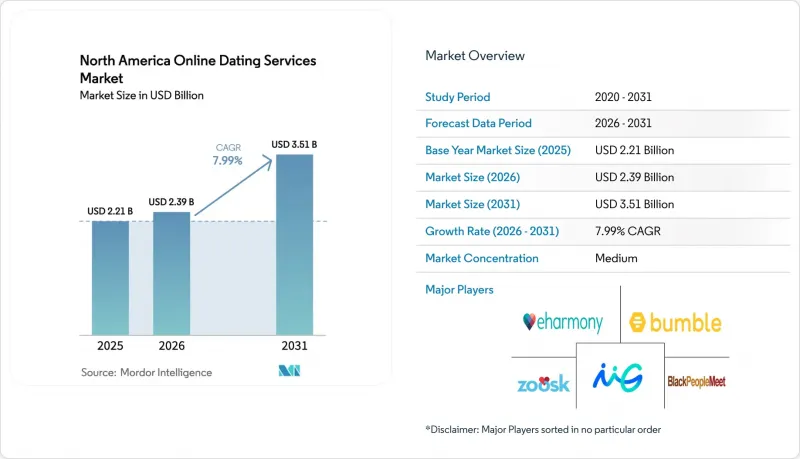
This report is Segmented by Service Type (Non-Paying Online Dating, Paying Online Dating), Revenue Model (Subscription-Based, Freemium, Advertising-Based, A-La-Carte Micro-Transactions), Device Type (Mobile Applications, Desktop / Web Platforms), Demographic Age Group (18-30 Years, 30-40 Years, More Than 40 Years) and Country. The Market Forecasts are Provided in Terms of Value (USD).
North America Online Dating Services Market Trends and Insights
Surging Adoption of AI-Driven Matchmaking Algorithms Tailored to North American Cultural Nuances
Platforms now deploy deep-learning engines that move beyond simple demographic filters to incorporate conversational context, shared values, and region-specific communication cues. eHarmony and OkCupid apply collaborative-filtering models proven to raise long-term match success rates in North America. Match Group is piloting "AI wingmen" that draft opening messages in real time, reducing first-contact friction and boosting subscription conversions. These tools address choice overload and improve perceived value, encouraging users to upgrade for premium algorithmic insights. The result is a measurable uplift in recurring revenue even as overall user growth normalizes.
Rising Acceptance of Niche Faith- & Ethnicity-Focused Platforms among U.S. Gen Z
Demand for culturally aligned communities is reshaping acquisition strategies. Spark Networks, owner of ChristianMingle and JDate, has redirected marketing budgets toward micro-influencers and on-campus events to attract Gen Z users despite short-term revenue contraction. Community-specific platforms gain loyalty advantages and higher engagement time per session, which translate into stronger upsell potential for exclusive features. The trend signals a shift from scale-seeking mass apps to depth-oriented ecosystems serving distinct identity groups.
Intensifying Regulatory Scrutiny around Data Localization & Cross-Border Transfers
Canada now requires personal data to stay within provincial borders unless explicit consent is documented, adding infrastructure costs and complicating data-science workflows. The U.S. Federal Trade Commission's May 2025 "junk-fee" rule demands up-front disclosure of total subscription pricing, constraining stealth upsell tactics and raising churn risk. Compliance spending diverts resources from feature innovation, pressuring margins during the adjustment window.
Other drivers and restraints analyzed in the detailed report include:
- Monetization Upside from Premium Safety Features amid Rising Scam Awareness in Canada
- Integration of Short-Form Video & Livestream Dating Driving User Engagement
- User Fatigue from Swipe-Based Interfaces Reducing Lifetime Value per Customer
For complete list of drivers and restraints, kindly check the Table Of Contents.
Segment Analysis
Non-paying formats remain the on-ramp for mass adoption, yet premium tiers capture superior unit economics. In 2025, non-paying users generated 62.10% of transaction volume across the North America online dating services market. Conversion engines leveraging AI-curated boosts, read receipts, and compatibility analytics lifted paying user ARPU to USD 20.05 at Grindr. The paying category is therefore forecast to grow at a 10.35% CAGR, outpacing overall market momentum.
Platforms blend ad-supported free access with strategically placed paywalls-such as profile super-likes or advanced search filters-to shift high-intent users into recurring plans. Subscription stack depth, bundled with identity verification and fraud protections, enhances stickiness and reduces regulatory compliance risk. Consequently, the North America online dating services market size for paying users is expected to climb steadily through 2031.
Subscription dominance is plateauing at 53.60% market contribution as transparency regulation limits hidden premium upgrades. In response, operators emphasize a-la-carte offerings priced between USD 1 and USD 5, allowing users to test specific value propositions. This micro-transaction segment is projected to expand 12.35% annually, making it the fastest-growing component of the North America online dating services market.
Granular pricing aligns with shifting consumer behavior in the broader digital economy, where users favor paying only for features they perceive as immediately useful. For management teams, micro-transactions provide an analytics-rich environment to refine feature portfolios and optimize product-market fit, thereby lifting retention without inflating headline subscription costs.
Complete Report Scope:
- By Service Type
- Non-Paying Online Dating
- Paying Online Dating
- By Revenue Model
- Subscription-Based
- Freemium
- Advertising-Based
- A-la-Carte Micro-Transactions
- By Device Type
- Mobile Applications
- Desktop / Web Platforms
- By Demographic Age Group
- 18-30 Years
- 30-40 Years
- More than 40 Years
- By Country
- United States
- Canada
- Mexico
List of Companies Covered in this Report:
- Match Group, Inc.
- Zoosk, Inc.
- Badoo
- BlackPeopleMeet.com, Inc.
- Bumble Inc.
- The Meet Group, Inc.
- Coffee Meets Bagel, Inc.
- The League App, Inc.
- HER (Dattch Ltd.)
- Taimi Inc.
- Grindr LLC
- eHarmony, Inc.
- Hily Corp.
- Raya App, Inc.
- PlentyOfFish Media ULC
- OkCupid LLC
- Spark Networks SE
- OurTime.com
- SilverSingles
- ChristianMingle (Spark)
- Ashley Madison (Ruby Corp.)
Additional Benefits:
- The market estimate (ME) sheet in Excel format
- 3 months of analyst support
TABLE OF CONTENTS
1 INTRODUCTION
- 1.1 Study Assumptions and Market Definition
- 1.2 Scope of the Study
2 RESEARCH METHODOLOGY
3 EXECUTIVE SUMMARY
4 MARKET LANDSCAPE
- 4.1 Market Overview
- 4.2 Market Drivers
- 4.2.1 Surging Adoption of AI-driven Matchmaking Algorithms Tailored to North American Cultural Nuances
- 4.2.2 Rising Acceptance of Niche Faith- & Ethnicity-Focused Platforms among U.S. Gen-Z
- 4.2.3 Monetization Upside from Premium Safety Features amid Rising Scam Awareness in Canada
- 4.2.4 Integration of Short-Form Video & Livestream Dating Driving User Engagement
- 4.2.5 Growing LGBTQ+ Community Visibility Accelerating Platform Expansion in Urban Corridors
- 4.3 Market Restraints
- 4.3.1 Intensifying Regulatory Scrutiny around Data Localization & Cross-Border Transfers
- 4.3.2 User Fatigue from Swipe-Based Interfaces Reducing Lifetime Value per Customer
- 4.3.3 Heightened Competition from Social-Media-Embedded Dating Features (e.g., Facebook Dating)
- 4.3.4 Rising Acquisition Costs on Digital Ad Channels Pressuring Smaller Apps
- 4.4 Value Chain Analysis
- 4.5 Regulatory Outlook
- 4.6 Porter's Five Forces Analysis
- 4.6.1 Bargaining Power of Suppliers
- 4.6.2 Bargaining Power of Consumers
- 4.6.3 Threat of New Entrants
- 4.6.4 Intensity of Competitive Rivalry
- 4.6.5 Threat of Substitutes
- 4.7 Investment Analysis
- 4.8 Assessment of Macro Economic Trends on the Market
- 4.9 Major Use-Cases & Case-Studies
5 MARKET SIZE AND GROWTH FORECASTS (VALUES)
- 5.1 By Service Type
- 5.1.1 Non-Paying Online Dating
- 5.1.2 Paying Online Dating
- 5.2 By Revenue Model
- 5.2.1 Subscription-Based
- 5.2.2 Freemium
- 5.2.3 Advertising-Based
- 5.2.4 A-la-Carte Micro-Transactions
- 5.3 By Device Type
- 5.3.1 Mobile Applications
- 5.3.2 Desktop / Web Platforms
- 5.4 By Demographic Age Group
- 5.4.1 18-30 Years
- 5.4.2 30-40 Years
- 5.4.3 More than 40 Years
- 5.5 By Country
- 5.5.1 United States
- 5.5.2 Canada
- 5.5.3 Mexico
6 COMPETITIVE LANDSCAPE
- 6.1 Market Concentration
- 6.2 Strategic Moves & Funding Activity
- 6.3 Market Share Analysis
- 6.4 Company Profiles (includes Global Level Overview, Market Level Overview, Core Segments, Financials as available, Strategic Information, Market Rank/Share for key companies, Products & Services, and Recent Developments)
- 6.4.1 Match Group, Inc.
- 6.4.2 Zoosk, Inc.
- 6.4.3 Badoo
- 6.4.4 BlackPeopleMeet.com, Inc.
- 6.4.5 Bumble Inc.
- 6.4.6 The Meet Group, Inc.
- 6.4.7 Coffee Meets Bagel, Inc.
- 6.4.8 The League App, Inc.
- 6.4.9 HER (Dattch Ltd.)
- 6.4.10 Taimi Inc.
- 6.4.11 Grindr LLC
- 6.4.12 eHarmony, Inc.
- 6.4.13 Hily Corp.
- 6.4.14 Raya App, Inc.
- 6.4.15 PlentyOfFish Media ULC
- 6.4.16 OkCupid LLC
- 6.4.17 Spark Networks SE
- 6.4.18 OurTime.com
- 6.4.19 SilverSingles
- 6.4.20 ChristianMingle (Spark)
- 6.4.21 Ashley Madison (Ruby Corp.)
7 MARKET OPPORTUNITIES AND FUTURE OUTLOOK
- 7.1 White-Space and Unmet-Need Assessment
- 7.2 Scenario Outlook: Metaverse Dating & Virtual Reality Integration

