PUBLISHER: Mordor Intelligence | PRODUCT CODE: 2116856

PUBLISHER: Mordor Intelligence | PRODUCT CODE: 2116856
Europe Industrial Valves - Market Share Analysis, Industry Trends & Statistics, Growth Forecasts (2026 - 2031)
According to Mordor Intelligence, the Europe industrial valves market size reached USD 9.07 billion in 2026 and is projected to expand to USD 12.94 billion by 2031, translating into a 7.37% CAGR over the forecast period.
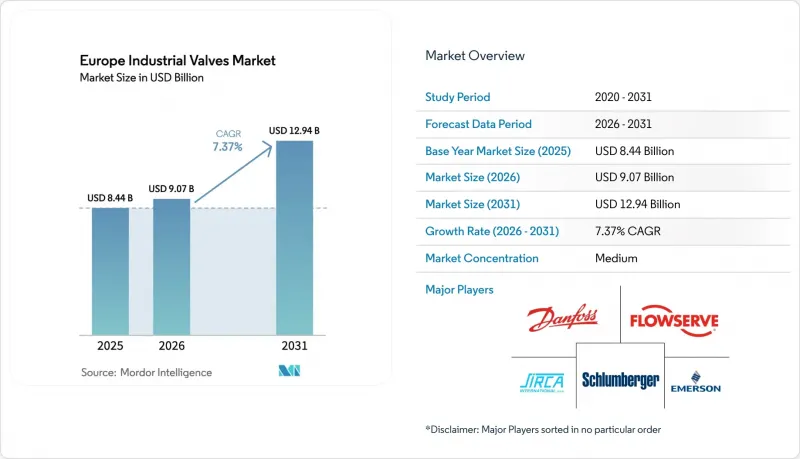
This report is Segmented by Valve Type (Globe, Ball, Butterfly, Gate, and More), Actuation Technology (Manual, Electric, Pneumatic, Hydraulic, and Electro-Hydraulic), Material (Carbon Steel, Stainless Steel, and More), End-User Industry (Oil and Gas, Power and Energy, Chemicals and Petrochemicals, Water and Waste-Water, and More), and Country. The Market Forecasts are Provided in Terms of Value (USD).
Europe Industrial Valves Market Trends and Insights
Expanding Hydrogen and CCUS Project Pipeline Post-2026
Thirty-two hydrogen infrastructure projects designated under the IPCEI Hy2Infra scheme unlock EUR 5.2 billion (USD 5.88 billion) in state aid, creating demand for roughly 120,000 valves rated to 100 bar hydrogen service by 2030. Germany's H2Global auctions and the EU Industrial Carbon Management Strategy add parallel requirements for cryogenic and supercritical-carbon-dioxide designs, specifications currently certified by only six European manufacturers. Import terminals in Hamburg and Wilhelmshaven already specify minus 33 °C ball valves, and cross-border CO2 pipelines now call for elastomer-sealed throttling valves resistant to carbonic-acid corrosion. Electro-hydraulic actuators with fail-safe spring return are favored for unmanned compression stations, accelerating adoption across the Europe industrial valves market.
Mandatory Leak-Detection and Fugitive-Emission Norms
EN ISO 15848-1 became enforceable in January 2024, compelling refineries and chemical plants to replace or retrofit roughly 400,000 legacy valves by 2027. Real-time acoustic monitoring, as deployed via Flowserve's RedRaven platform, alerts operators before emissions exceed 10 ppm limits, helping avoid fines of up to EUR 500,000 (USD 565,000) per incident. Suppliers have responded with live-loaded packing and bellows-sealed bonnets that add 15-25% to initial costs but slash lifetime labor. Compliance urgency, especially in Germany and France, is pushing demand for certified designs across the Europe industrial valves market.
Extended EPC Lead-Times from Localization Rules
The Critical Raw Materials Act obliges 40% domestic processing of nickel, chromium, and molybdenum by 2030, prompting manufacturers to re-shore foundries at higher labor and energy costs. Flowserve's EUR 45 million Essen expansion adds capacity but lengthens delivery cycles to 38 weeks for stainless and nickel-alloy valves. Traceability under the EU Deforestation Regulation inflates administrative overhead, squeezing smaller suppliers in the Europe industrial valves market.
Other drivers and restraints analyzed in the detailed report include:
- Digital Retrofit Programs for Brown-Field Assets
- Offshore Wind Balance-of-Plant Valve Demand
- Skilled Valve-Maintenance Labor Shortage
For complete list of drivers and restraints, kindly check the Table Of Contents.
Segment Analysis
Check valves are projected to rise at a 7.88% CAGR through 2031 as operators add passive back-flow prevention to meet EN ISO 15848-1 standards. Ball valves retained 34.73% share in 2025, supported by quarter-turn simplicity in natural-gas and chemical services. Gate valves dominate large-bore water networks, though slow actuation dampens automation prospects. Butterfly valves are preferred for district heating owing to slim wafer profiles, while globe valves continue in throttling duties where precise modulation offsets higher pressure drop. Passive dual-plate designs, closing faster than swing checks, curb water hammer in offshore wind cooling loops.
Ball-valve dominance is reinforced by compatibility with electric and electro-hydraulic actuators, crucial for hydrogen and subsea applications. Recent metal-seated models resist hydrogen embrittlement over 10,000 cycles. Butterfly valves benefit from high-temperature elastomers that boost service life in 150 °C hot-water loops. Gate valves face headwinds except in legacy systems where replacement costs remain prohibitive, whereas specialty safety valves undergo seat-tolerance upgrades to curb hydrogen leakage.
Electro-hydraulic actuators will post a 7.93% CAGR, favored for fail-safe spring return and high torque density in offshore wind, nuclear, and hydrogen compression. Electric actuation, with 39.74% share in 2025, thrives on digital positioner integration and predictive algorithms. Manual operation lingers in hazardous zones where explosion-proof gear is cost-prohibitive, while pneumatic units remain in plants with legacy air infrastructure but face long-term energy-efficiency headwinds.
Rotork's IQ3 electro-hydraulic design eliminates centralized hydraulic circuits, trimming topside weight 30% on floating platforms. Auma's latest electric series delivers 40% more torque per kilogram, enabling direct drive of large butterfly valves. Fraunhofer research indicates shifting from pneumatic to electric actuators can cut auxiliary power by 8-12%, speeding retrofits across the Europe industrial valves industry.
Complete Report Scope:
- By Valve Type
- Globe
- Ball
- Butterfly
- Gate
- Plug
- Check
- Safety / Relief
- Other Valve Types
- By Actuation Technology
- Manual
- Electric
- Pneumatic
- Hydraulic
- Electro-hydraulic
- By Material
- Carbon Steel
- Stainless Steel
- Alloy and Cryogenic Alloys
- Cast Iron and Ductile Iron
- By End-user Industry
- Oil and Gas
- Power and Energy (incl. Nuclear and Renewables BOP)
- Chemicals and Petrochemicals
- Water and Waste-water
- Food and Beverage
- Pulp and Paper
- Other End-user Industries
- By Country
- Germany
- United Kingdom
- France
- Italy
- Spain
- Rest of Europe
List of Companies Covered in this Report:
- Emerson Electric Co.
- Flowserve Corporation
- Schlumberger Ltd.
- Danfoss A/S
- Pentair plc
- Bray International, Inc.
- Alfa Laval AB
- Crane Company
- Eaton Corporation plc
- KITZ Corporation
- The Weir Group PLC
- Velan Inc.
- Metso Oyj
- Sirca International
- Spirax-Sarco Engineering plc
- SAMSON AG
- SMC Corporation
- Parker-Hannifin Corporation
- Leser GmbH and Co. KG
- Bohmer GmbH
- AVK Holding A/S
- AKO Armaturen and Separationstechnik GmbH
- KLINGER Fluid Control GmbH
- ITT Inc.
- Ari-Armaturen Albert Richter GmbH and Co. KG
Additional Benefits:
- The market estimate (ME) sheet in Excel format
- 3 months of analyst support
TABLE OF CONTENTS
1 INTRODUCTION
- 1.1 Study Assumptions and Market Definition
- 1.2 Scope of the Study
2 RESEARCH METHODOLOGY
3 EXECUTIVE SUMMARY
4 MARKET LANDSCAPE
- 4.1 Market Overview
- 4.2 Market Drivers
- 4.2.1 Expanding Hydrogen and CCUS Project Pipeline Post-2026
- 4.2.2 Mandatory Leak-Detection and Fugitive-Emission Norms (EN ISO 15848-1)
- 4.2.3 Digital Retrofit Programs for Brown-Field Flow Control Assets
- 4.2.4 Offshore Wind Balance-of-Plant Valve Demand Surge
- 4.2.5 Revival of European Petrochemical CAPEX (2027-2030)
- 4.2.6 Rising District-Heating Upgrades in CEE and Nordics
- 4.3 Market Restraints
- 4.3.1 Extended EPC Lead-Times Owing to Supply-Chain Localization Rules
- 4.3.2 Skilled Valve-Maintenance Labor Shortage in Europe
- 4.3.3 Price Volatility in Nickel and Special Alloys
- 4.3.4 Stringent End-User Cybersecurity Compliance Delaying Smart-Valve Rollouts
- 4.4 Indusy Value Chain Analysis
- 4.5 Regulatory Landscape
- 4.6 Technological Outlook
- 4.7 Porter's Five Forces Analysis
- 4.7.1 Bargaining Power of Buyers
- 4.7.2 Bargaining Power of Suppliers
- 4.7.3 Threat of New Entrants
- 4.7.4 Threat of Substitute Products
- 4.7.5 Intensity of Competitive Rivalry
5 MARKET SIZE AND GROWTH FORECASTS (VALUE)
- 5.1 By Valve Type
- 5.1.1 Globe
- 5.1.2 Ball
- 5.1.3 Butterfly
- 5.1.4 Gate
- 5.1.5 Plug
- 5.1.6 Check
- 5.1.7 Safety / Relief
- 5.1.8 Other Valve Types
- 5.2 By Actuation Technology
- 5.2.1 Manual
- 5.2.2 Electric
- 5.2.3 Pneumatic
- 5.2.4 Hydraulic
- 5.2.5 Electro-hydraulic
- 5.3 By Material
- 5.3.1 Carbon Steel
- 5.3.2 Stainless Steel
- 5.3.3 Alloy and Cryogenic Alloys
- 5.3.4 Cast Iron and Ductile Iron
- 5.4 By End-user Industry
- 5.4.1 Oil and Gas
- 5.4.2 Power and Energy (incl. Nuclear and Renewables BOP)
- 5.4.3 Chemicals and Petrochemicals
- 5.4.4 Water and Waste-water
- 5.4.5 Food and Beverage
- 5.4.6 Pulp and Paper
- 5.4.7 Other End-user Industries
- 5.5 By Country
- 5.5.1 Germany
- 5.5.2 United Kingdom
- 5.5.3 France
- 5.5.4 Italy
- 5.5.5 Spain
- 5.5.6 Rest of Europe
6 COMPETITIVE LANDSCAPE
- 6.1 Market Concentration
- 6.2 Strategic Moves
- 6.3 Market Share Analysis
- 6.4 Company Profiles (includes Global-level Overview, Market-level Overview, Core Segments, Financials, Strategic Information, Market Rank/Share, Products and Services, Recent Developments)
- 6.4.1 Emerson Electric Co.
- 6.4.2 Flowserve Corporation
- 6.4.3 Schlumberger Ltd.
- 6.4.4 Danfoss A/S
- 6.4.5 Pentair plc
- 6.4.6 Bray International, Inc.
- 6.4.7 Alfa Laval AB
- 6.4.8 Crane Company
- 6.4.9 Eaton Corporation plc
- 6.4.10 KITZ Corporation
- 6.4.11 The Weir Group PLC
- 6.4.12 Velan Inc.
- 6.4.13 Metso Oyj
- 6.4.14 Sirca International
- 6.4.15 Spirax-Sarco Engineering plc
- 6.4.16 SAMSON AG
- 6.4.17 SMC Corporation
- 6.4.18 Parker-Hannifin Corporation
- 6.4.19 Leser GmbH and Co. KG
- 6.4.20 Bohmer GmbH
- 6.4.21 AVK Holding A/S
- 6.4.22 AKO Armaturen and Separationstechnik GmbH
- 6.4.23 KLINGER Fluid Control GmbH
- 6.4.24 ITT Inc.
- 6.4.25 Ari-Armaturen Albert Richter GmbH and Co. KG
7 MARKET OPPORTUNITIES AND FUTURE OUTLOOK
- 7.1 White-space and Unmet-need Assessment

