PUBLISHER: Mordor Intelligence | PRODUCT CODE: 2121361

PUBLISHER: Mordor Intelligence | PRODUCT CODE: 2121361
Industrial Valves - Market Share Analysis, Industry Trends & Statistics, Growth Forecasts (2026 - 2031)
According to Mordor Intelligence, the industrial valves market size is expected to increase from USD 77.69 billion in 2025 to USD 81.21 billion in 2026 and reach USD 101.40 billion by 2031, growing at a CAGR of 4.54% over 2026-2031.
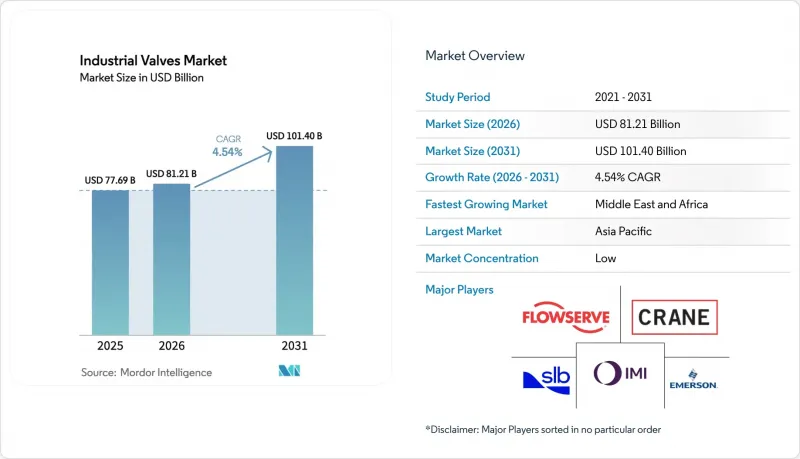
This report is Segmented by Type (Ball, Butterfly, Gate, and More), Product (Quarter-Turn, Multi-Turn, and More), Valve Function (Isolation, Regulation, and More), Body Material (Steel, Alloy-Based, and More), Application (Oil and Gas, Power, and More), and Geography (Asia-Pacific, North America, Europe, South America, and Middle East and Africa). Market Forecasts are Provided in Terms of Value (USD).
Global Industrial Valves Market Trends and Insights
LNG-Terminal Build-Outs Across APAC
Singapore's Energy Market Authority awarded the country's second LNG terminal contract in 2024, specifying a floating storage and regasification unit with 200,000 cubic meters of storage and 5 million tonnes per annum throughput, operational by the end of the decade. Moreover, Thailand's 7.5 million tpa Nong Fab facility and Indonesia's 3.8 million tpa Tangguh Train 3 collectively require thousands of cryogenic ball and butterfly valves rated for -162°C service. Nickel-alloy supply constraints are stretching lead times to 24 weeks, favoring OEMs with captive foundries. Specification drift toward ASME B16.34-qualified nickel-alloy bodies is lifting average selling prices, bolstering margin potential for integrated suppliers in the industrial valves market.
Desalination CAPEX Surge in GCC States
The UAE's Hassyan desalination plant, awarded in early 2025 with a USD 920 million EPC contract, will produce 180 million imperial gallons per day by 2027 and stood 55% complete as of February 2025, employing reverse-osmosis technology that demands corrosion-resistant duplex-steel valves for high-salinity brine handling. Each plant needs 2,000-3,000 duplex-steel gate and butterfly valves to handle high-salinity brine. Local foundry shortages push utilities to pre-qualify European and North American vendors, reallocating regional spend and creating joint-venture openings that enhance Gulf prospects for the industrial valves market.
Nickel-Alloy Casting Shortages Extending Lead Times
Indonesia's 2020 nickel-ore export ban, extended through 2024 and 2025, and the Philippines' parallel restrictions have concentrated 70% to 80% of global refined-nickel output in China, creating a chokepoint for duplex and Inconel valve castings that require nickel content above 20%. Smaller fabricators lacking the balance-sheet strength to pre-purchase nickel are exiting specialty-alloy segments, ceding market share to vertically integrated players such as Flowserve and Velan that operate captive foundries or hold multi-year supply agreements. This consolidation dynamic is likely to persist until new nickel-refining capacity in Indonesia and the Philippines comes online in 2027 to 2028.
Other drivers and restraints analyzed in the detailed report include:
- Predictive-Maintenance-Driven Replacement Cycles in North American Chemicals
- Hydrogen & CCS Mega-Projects Demanding Ultra-High-Pressure Valves
- Stricter Fugitive-Emission Testing Costs for SMEs
For complete list of drivers and restraints, kindly check the Table Of Contents.
Segment Analysis
Ball valves captured 40.48% of market share in 2025, reflecting their quarter-turn simplicity and tight shut-off in oil, gas, and chemical applications, while check valves are expanding at 7.18% CAGR through 2031, the fastest rate among valve types. This acceleration stems from process-safety regulations mandating backflow prevention in hydrogen pipelines and CCS networks, where reverse flow can trigger catastrophic pressure excursions. Butterfly valves serve large-diameter, low-pressure water and wastewater systems, offering cost advantages over gate valves in municipal projects, yet their share remains stable as operators prioritize ball valves for critical isolation duties.
Steeper fire-safe and low-emission revisions to API 6D now favor ball-valve geometries, while dual-plate check valves protect LNG cryogenic pumps during emergency shutdowns. Butterfly valves retain water-sector relevance, and gate valves persist in high-pressure steam service. Plug valves capture slurry niches, rounding out the industrial valves market landscape for flow-control types.
Quarter-turn valves held 55.18% share in 2025, a dominance rooted in their rapid actuation-90 degrees from open to closed-that reduces cycle time in automated batch processes and emergency shutdown systems. Multi-turn valves are projected to grow at a 5.81% CAGR as hydrogen and CCS projects specify gate and globe designs for sealing under 1,000-bar loads.
The shift toward electric actuators is reshaping product-mix economics. Emerson's Q3 2024 earnings call highlighted a 12% year-over-year increase in electric-actuator attachments for multi-turn valves, driven by petrochemical complexes replacing pneumatic systems to eliminate instrument-air compressors and reduce energy consumption by 15% to 20%. ISO 5211 mounting versatility keeps quarter-turn devices popular in retrofit work, while custom kits add cost complexity to multi-turn upgrades, shaping product-choice dynamics across the industrial valves market.
Complete Report Scope:
- By Type
- Ball Valve
- Butterfly Valve
- Gate Valve
- Globe Valve
- Plug Valve
- Other Types
- By Product
- Quarter-Turn Valve
- Multi-Turn Valve
- Other Products
- By Valve Function
- Isolation Valves
- Regulation Valves
- Check and Safety Valves
- By Body Material
- Steel (Carbon and Stainless Steel)
- Alloy-Based (Duplex, Inconel, etc.)
- Cast/Ductile Iron
- Cryogenic Nickel Alloys
- Others
- By Application
- Oil and Gas
- Power
- Water and Wastewater Management
- Chemicals
- New Energy
- Other Applications (Includes Food Processing, Mining, and Marine)
- By Geography
- Asia-Pacific
- China
- India
- Japan
- South Korea
- Indonesia
- Vietnam
- Malaysia
- Thailand
- Rest of Asia-Pacific
- North America
- United States
- Canada
- Mexico
- Europe
- Germany
- United Kingdom
- Italy
- France
- NORDIC Countries
- Turkey
- Russia
- Spain
- Rest of Europe
- South America
- Brazil
- Argentina
- Colombia
- Rest of South America
- Middle East and Africa
- Saudi Arabia
- United Arab Emirates
- Qatar
- Egypt
- Nigeria
- South Africa
- Rest of Middle East and Africa
- Asia-Pacific
Geography Analysis
Asia-Pacific held 40.47% revenue in 2025, led by LNG terminals and semiconductor fabs that each require thousands of precision valves. China, Taiwan, and South Korea underpin fab demand, whereas Southeast Asia scales gas infrastructure to replace coal.
North America generates high aftermarket revenue from its vast installed base. The CHIPS Act's USD 39 billion incentives spurred Intel, Micron, and Samsung fabs in Arizona, Texas, and Ohio, incorporating ultrapure-water loops with stringent valve cleanliness specs.
The Middle East and Africa will post a 6.57% CAGR to 2031, fastest worldwide, on the back of GCC desalination CAPEX and Saudi petrochemical expansions. Europe's offshore wind and CCS hubs partially offset fossil-power retirements, while Latin America's pre-salt and shale projects sustain regional valve demand, illustrating geographic spread in the industrial valves market.
- Alfa Laval
- AVK Holding A/S
- Baker Hughes Company
- Circor International Inc.
- Crane Company
- Curtiss-Wright Corporation
- Danfoss A/S
- Emerson Electric Co.
- Engipro Solutions LLP,
- Flowserve Corporation
- Georg Fischer Ltd.
- Hitachi Ltd
- Honeywell International Inc.
- IMI Critical Engineering (IMI PLC)
- ITT Inc.
- KITZ Corporation
- KLINGER Holding
- Metso
- Mueller Co. LLC
- Nibco Inc.
- Okano Valve Mfg. Co. Ltd.
- SAMSON AKTIENGESELLSCHAFT
- SLB
- Technipfmc PLC
- The Weir Group PLC
- Valvitalia SpA
- Velan
- Xylem
Additional Benefits:
- The market estimate (ME) sheet in Excel format
- 3 months of analyst support
TABLE OF CONTENTS
1 Introduction
- 1.1 Study Assumptions & Market Definition
- 1.2 Scope of the Study
2 Research Methodology
3 Executive Summary
4 Market Landscape
- 4.1 Market Overview
- 4.2 Market Drivers
- 4.2.1 LNG-terminal build-outs across APAC
- 4.2.2 Desalination CAPEX surge in GCC states
- 4.2.3 Predictive-maintenance-driven replacement cycles in NA chemical sector
- 4.2.4 Hydrogen & CCS mega-projects demanding ultra-high-pressure valves
- 4.2.5 Semiconductor-fab ultrapure-valve boom
- 4.3 Market Restraints
- 4.3.1 Nickel-alloy casting shortages extending lead-times
- 4.3.2 Stricter fugitive-emission testing costs for SMEs
- 4.3.3 Rapid shift to electric actuators cannibalising manual-valve demand
- 4.4 Value Chain Analysis
- 4.5 Porter's Five Forces
- 4.5.1 Bargaining Power of Suppliers
- 4.5.2 Bargaining Power of Buyers
- 4.5.3 Threat of New Entrants
- 4.5.4 Threat of Substitutes
- 4.5.5 Degree of Competition
5 Market Size & Growth Forecasts (Value)
- 5.1 By Type
- 5.1.1 Ball Valve
- 5.1.2 Butterfly Valve
- 5.1.3 Gate Valve
- 5.1.4 Globe Valve
- 5.1.5 Plug Valve
- 5.1.6 Other Types
- 5.2 By Product
- 5.2.1 Quarter-Turn Valve
- 5.2.2 Multi-Turn Valve
- 5.2.3 Other Products
- 5.3 By Valve Function
- 5.3.1 Isolation Valves
- 5.3.2 Regulation Valves
- 5.3.3 Check and Safety Valves
- 5.4 By Body Material
- 5.4.1 Steel (Carbon and Stainless Steel)
- 5.4.2 Alloy-Based (Duplex, Inconel, etc.)
- 5.4.3 Cast/Ductile Iron
- 5.4.4 Cryogenic Nickel Alloys
- 5.4.5 Others
- 5.5 By Application
- 5.5.1 Oil and Gas
- 5.5.2 Power
- 5.5.3 Water and Wastewater Management
- 5.5.4 Chemicals
- 5.5.5 New Energy
- 5.5.6 Other Applications (Includes Food Processing, Mining, and Marine)
- 5.6 By Geography
- 5.6.1 Asia-Pacific
- 5.6.1.1 China
- 5.6.1.2 India
- 5.6.1.3 Japan
- 5.6.1.4 South Korea
- 5.6.1.5 Indonesia
- 5.6.1.6 Vietnam
- 5.6.1.7 Malaysia
- 5.6.1.8 Thailand
- 5.6.1.9 Rest of Asia-Pacific
- 5.6.2 North America
- 5.6.2.1 United States
- 5.6.2.2 Canada
- 5.6.2.3 Mexico
- 5.6.3 Europe
- 5.6.3.1 Germany
- 5.6.3.2 United Kingdom
- 5.6.3.3 Italy
- 5.6.3.4 France
- 5.6.3.5 NORDIC Countries
- 5.6.3.6 Turkey
- 5.6.3.7 Russia
- 5.6.3.8 Spain
- 5.6.3.9 Rest of Europe
- 5.6.4 South America
- 5.6.4.1 Brazil
- 5.6.4.2 Argentina
- 5.6.4.3 Colombia
- 5.6.4.4 Rest of South America
- 5.6.5 Middle East and Africa
- 5.6.5.1 Saudi Arabia
- 5.6.5.2 United Arab Emirates
- 5.6.5.3 Qatar
- 5.6.5.4 Egypt
- 5.6.5.5 Nigeria
- 5.6.5.6 South Africa
- 5.6.5.7 Rest of Middle East and Africa
- 5.6.1 Asia-Pacific
6 Competitive Landscape
- 6.1 Market Concentration
- 6.2 Strategic Moves
- 6.3 Market Share(%)/Ranking Analysis
- 6.4 Company Profiles (includes Global level Overview, Market level overview, Core Segments, Financials as available, Strategic Information, Market Rank/Share, Products & Services, Recent Developments)
- 6.4.1 Alfa Laval
- 6.4.2 AVK Holding A/S
- 6.4.3 Baker Hughes Company
- 6.4.4 Circor International Inc.
- 6.4.5 Crane Company
- 6.4.6 Curtiss-Wright Corporation
- 6.4.7 Danfoss A/S
- 6.4.8 Emerson Electric Co.
- 6.4.9 Engipro Solutions LLP,
- 6.4.10 Flowserve Corporation
- 6.4.11 Georg Fischer Ltd.
- 6.4.12 Hitachi Ltd
- 6.4.13 Honeywell International Inc.
- 6.4.14 IMI Critical Engineering (IMI PLC)
- 6.4.15 ITT Inc.
- 6.4.16 KITZ Corporation
- 6.4.17 KLINGER Holding
- 6.4.18 Metso
- 6.4.19 Mueller Co. LLC
- 6.4.20 Nibco Inc.
- 6.4.21 Okano Valve Mfg. Co. Ltd.
- 6.4.22 SAMSON AKTIENGESELLSCHAFT
- 6.4.23 SLB
- 6.4.24 Technipfmc PLC
- 6.4.25 The Weir Group PLC
- 6.4.26 Valvitalia SpA
- 6.4.27 Velan
- 6.4.28 Xylem
7 Market Opportunities & Future Outlook
- 7.1 White-Space & Unmet-Need Assessment
- 7.2 Increasing in demand from food processing industries

