PUBLISHER: Mordor Intelligence | PRODUCT CODE: 2116873

PUBLISHER: Mordor Intelligence | PRODUCT CODE: 2116873
Japan Telecom MNO - Market Share Analysis, Industry Trends & Statistics, Growth Forecasts (2026 - 2031)
According to Mordor Intelligence, the Japan telecom MNO market size is projected to be USD 125.98 billion in 2026 and reach USD 148.06 billion by 2031, growing at a CAGR of 3.28% from 2026 to 2031.
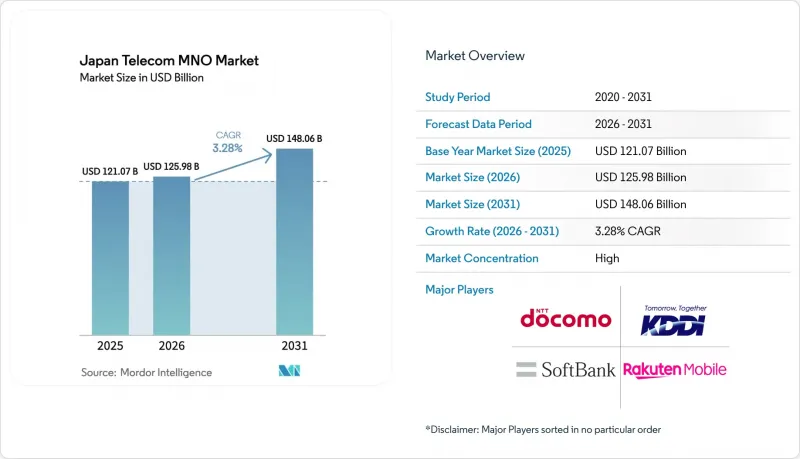
This report is Segmented by Service Type (Voice Services, Data and Internet Services, Messaging Services, Iot and M2M Services, OTT and PayTV Services, and Other Services), and End User (Enterprises, Consumer). The Market Forecasts are Provided in Terms of Value (USD) and Volume (Subscribers).
Japan Telecom MNO Market Trends and Insights
5G Standalone Expansion and Private Network Monetization
NTT Docomo activated 6.6 Gbps downlink service in early 2025 by aggregating sub-6 GHz and millimeter-wave bands, showcasing real-time 8K video and machine-vision control. Enterprises are licensing n79 spectrum slices for robotics, semiconductor tooling, and smart logistics, supported by the Ministry of Internal Affairs and Communications (MIC) registration regime that obliges carriers to appoint certified chief telecommunication engineers, a structure that protects incumbents' margins. SoftBank's latency-optimization trial with Ericsson in late 2024 achieved sub-5 ms round-trip delay, bolstering standalone cores as revenue generators for deterministic industrial traffic. MIC's 2025 Beyond 5G white paper projects enterprise private networks to absorb 15% of total mobile infrastructure outlays by 2030.
Explosion of Ultra-HD Video and XR Data Traffic
Fixed-line traffic jumped 15.3% year-over-year in May 2025, while 5G handset growth lifted mobile usage in parallel. MIC forecasts immersive content to push volumes ten-fold by 2030, forcing operators to densify small cells and deploy edge computers. NTT Docomo's fiscal-2025 interim report logged double-digit data growth, with premium unlimited tiers shielding ARPU. Ericsson's mid-2025 Mobility Report cites artificial-intelligence spectrum allocation as key to handling asymmetric uplinks from live XR streams. Bundling streaming or metaverse access into tiered plans lets carriers upsell without proportional cost, provided content-delivery caches sit close to users.
Aging and Declining Population Limiting Subscriber Growth
Japan's population fell below 123 million in 2025 with a median age above 49, trimming organic handset uptake. Cellular lines stood at 193 million, leaving scant headroom outside IoT. Rakuten Mobile's 8.5 million users in early 2025 faced churn as price hunters rotated to promotions. Operators tailor elder-care voice assistants, yet these generate modest data income. MIC's Mobile Software Competition Act, effective 2025, enhances portability, boosting price sensitivity and eroding loyalty.
Other drivers and restraints analyzed in the detailed report include:
- Digital Garden City Nation Strategy Catalyzing Regional IoT Uptake
- Fixed-Mobile Convergence Driving Premium Bundled ARPU
- Continued Government Pressure on Tariffs Depressing ARPU
For complete list of drivers and restraints, kindly check the Table Of Contents.
Segment Analysis
Data and Internet Services accounted for over half of 2025 revenue, supported by 92.367 million 5G subscriptions and double-digit fixed broadband traffic growth. The Japan telecom MNO market size tied to IoT and M2M Services is forecast to expand fastest at a 3.44% CAGR thanks to fleet telematics, industrial robotics, and rural smart-city sensors, a trajectory underscored by KDDI ConnectIN's 45.5 million lines and NTT Docomo's business SIGN IoT rollout. Voice and SMS continue to shrink as over-the-top applications dominate, while pay-TV bundles cushion ARPU through premium content licensing.
Operators are now packaging network APIs into developer marketplaces, an initiative aligned with the GSMA Open Gateway framework demonstrated by KDDI at Mobile World Congress 2025. The Japan telecom MNO market size for these APIs remains nascent, yet global projections reach USD 300 billion by 2030. Regulatory oversight of interconnection under the Telecommunications Business Law tempers innovation velocity but ensures nondiscriminatory wholesale pricing, balancing competition and stability.
Complete Report Scope:
- Overall Telecom Revenue and ARPU
- Service Type
- Voice Services
- Data and Internet Services
- Messaging Services
- IoT and M2M Services
- OTT and PayTV Services
- Other Services, Roaming and International Services, Enterprise and Wholesale Services
- End-User
- Enterprises
- Consumer
List of Companies Covered in this Report:
- NTT Docomo, Inc.
- KDDI Corporation
- SoftBank Corp.
- Rakuten Mobile, Inc.
Additional Benefits:
- The market estimate (ME) sheet in Excel format
- 3 months of analyst support
TABLE OF CONTENTS
1 INTRODUCTION
- 1.1 Study Assumptions and Market Definition
- 1.2 Scope of the Study
2 RESEARCH METHODOLOGY
3 EXECUTIVE SUMMARY
4 MARKET LANDSCAPE
- 4.1 Market Overview
- 4.2 Regulatory and Policy Framework
- 4.3 Spectrum Landscape and Competitive Holdings
- 4.4 Telecom Industry Ecosystem
- 4.5 Macroeconomic and External Drivers
- 4.6 Porter's Five Forces Analysis
- 4.6.1 Competitive Rivalry
- 4.6.2 Threat of New Entrants
- 4.6.3 Bargaining Power of Suppliers
- 4.6.4 Bargaining Power of Buyers
- 4.6.5 Threat of Substitutes
- 4.7 Key MNO KPIs (2020-2025)
- 4.7.1 Unique Mobile Subscribers and Penetration Rate
- 4.7.2 Mobile Internet Users and Penetration Rate
- 4.7.3 SIM Connections by Access Technology and Penetration
- 4.7.4 Cellular IoT and M2M Connections
- 4.7.5 Broadband Connections (Mobile and Fixed)
- 4.7.6 ARPU (Average Revenue per User)
- 4.7.7 Average Data Usage per Subscription (GB/month)
- 4.8 Market Drivers
- 4.8.1 5G Standalone Expansion and Private Network Monetization
- 4.8.2 Explosion of Ultra-HD Video and XR Data Traffic
- 4.8.3 Digital Garden City Nation Strategy Catalyzing Regional IoT Uptake
- 4.8.4 Fixed-Mobile Convergence Driving Premium Bundled ARPU
- 4.8.5 Satellite-Cellular Hybrid Connectivity Licenses Opening Rural Markets
- 4.8.6 Monetization of Network APIs via GSMA Open Gateway Framework
- 4.9 Market Restraints
- 4.9.1 Aging and Declining Population Limiting Subscriber Growth
- 4.9.2 Continued Government Pressure on Tariffs Depressing ARPU
- 4.9.3 Carbon-Neutral Energy Transition Elevating Network TCO
- 4.9.4 Supply Chain Security Rules Slowing Open RAN Deployment
- 4.10 Technological Outlook
- 4.11 Analysis of Key Business Models in Telecom Sector
- 4.12 Analysis of Pricing Models and Pricing
5 MARKET SIZE AND GROWTH FORECASTS (VALUE)
- 5.1 Overall Telecom Revenue and ARPU
- 5.2 Service Type
- 5.2.1 Voice Services
- 5.2.2 Data and Internet Services
- 5.2.3 Messaging Services
- 5.2.4 IoT and M2M Services
- 5.2.5 OTT and PayTV Services
- 5.2.6 Other Services, Roaming and International Services, Enterprise and Wholesale Services
- 5.3 End-User
- 5.3.1 Enterprises
- 5.3.2 Consumer
6 COMPETITIVE LANDSCAPE
- 6.1 Market Concentration
- 6.2 Strategic Moves and Investments by Key Vendors, 2023-2025
- 6.3 Market Share Analysis for MNOs, 2025
- 6.4 Product Benchmarking Analysis for Mobile Network Services
- 6.5 MNO Snapshot (Subscribers, Churn Rate, ARPU, etc.)
- 6.6 Company Profiles of MNOs (Includes Business Overview, Service Portfolio, Financials, Business Strategy and Recent Development, SWOT Analysis)
- 6.6.1 NTT Docomo, Inc.
- 6.6.2 KDDI Corporation
- 6.6.3 SoftBank Corp.
- 6.6.4 Rakuten Mobile, Inc.
7 MARKET OPPORTUNITIES AND FUTURE OUTLOOK
- 7.1 White-Space and Unmet-Need Assessment

