PUBLISHER: Mordor Intelligence | PRODUCT CODE: 2125544

PUBLISHER: Mordor Intelligence | PRODUCT CODE: 2125544
ASEAN Mobile Virtual Network Operator (MVNO) - Market Share Analysis, Industry Trends & Statistics, Growth Forecasts (2026 - 2031)
According to Mordor Intelligence, the ASEAN MVNO market size is expected to grow from USD 666.22 million in 2025 to USD 692.57 million in 2026 and is forecast to reach USD 840.58 million by 2031 at 3.95% CAGR over 2026-2031.
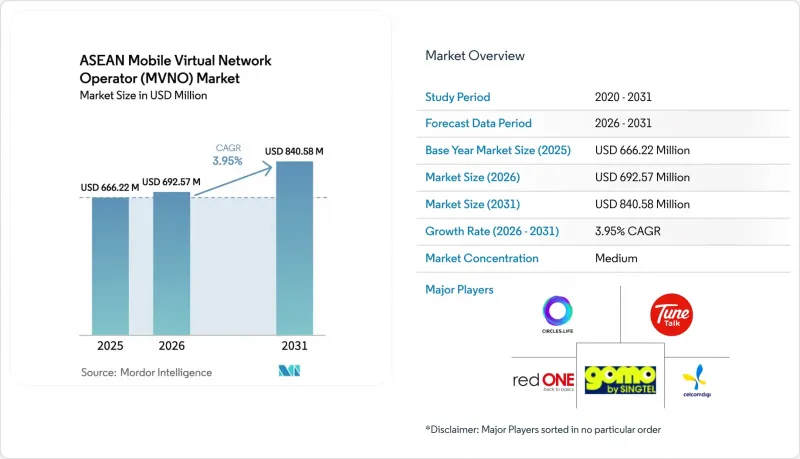
This report is Segmented by Deployment Model (Cloud and On-Premise), Operational Mode (Reseller, and More), Subscriber Type (Consumer, and More), Application (Discount, Business, Cellular M2M, and More), Network Technology (2G/3G, 4G/LTE, and More), Distribution Channel (Online/Digital-Only, and More), and Geography. The Market Forecasts are Provided in Terms of Value (USD).
ASEAN Mobile Virtual Network Operator (MVNO) Market Trends and Insights
Rising Mobile-Subscriber Base and Smartphone Penetration
ASEAN counted more than 450 million mobile broadband lines in 2025, led by Vietnam with 104.7 million subscriptions under three dominant networks that control over 90% of capacity. Urban smartphone penetration already tops 80 percent in Singapore, Malaysia, and Thailand, but lower-income and rural zones across Indonesia and the Philippines still rely on prepaid data packs, creating headroom for value-driven MVNOs. Youthful demographics median age below 30 across key markets propel data usage that outpaces voice traffic, so virtual operators design plans centered on large data buckets and minimal voice minutes. Historical data show every 1-percentage-point uptick in smartphone penetration adds roughly 1.5 points to MVNO subscriber growth, reinforcing the positive feedback loop. As standalone 5G rolls out, MVNOs can launch differentiated low-latency services, yet adoption lags in areas where 4G coverage remains incomplete, preserving the near-term role of LTE networks.
Demand for Low-Cost Voice and Data Plans
Average monthly ARPU ranges between USD 5 and USD 8 in Indonesia and the Philippines, compared with USD 15-20 in Singapore, so price competition is acute. Discount MVNOs captured 28.71% of applications in 2025 by marketing prepaid SIMs with 100-300 GB for the local equivalent of USD 5-15, undercutting MNO sub-brands. Migrant workers about 10 million region-wide favour unlimited international calls and regional roaming, niches that global brands exploit with bundled remittance services. Thailand's 20% wholesale-fee reduction scheduled for 2026 will widen retail price headroom, but sustained undercutting lengthens subscriber payback periods to 18-24 months, stretching cash flow. Operators therefore bundle data rollover or loyalty rewards to lift effective ARPU without headline price hikes.
Margin Squeeze from Intense Price Competition
MNO digital brands such as GOMO and Giga price 100-300 GB plans at SGD 10-18, matching independent MVNO offers while enjoying network cost advantages. Wholesale fees absorb up to 60% of MVNO retail revenue, leaving slender 15-20% gross margins after marketing and support. Singapore saw multiple shutdowns between 2023 and 2025 because acquisition costs of SGD 40-60 per user demanded two-year payback periods that cash-strapped entrants could not sustain. Malaysia's dual 5G network introduces official price oversight, yet disclosed contracts show host operators still retain rate-setting leverage. Minimum-guarantee clauses penalize under-utilization, prompting virtual operators to pivot toward higher-value enterprise and IoT niches where volume commitments align with predictable demand.
Other drivers and restraints analyzed in the detailed report include:
- Expansion of IoT and M2M Connections
- Regulatory Push for Open Wholesale Access and eSIM-Enabled Entry
- Dependence on Host MNOs for Network Quality and Wholesale Fees
For complete list of drivers and restraints, kindly check the Table Of Contents.
Segment Analysis
Cloud-hosted solutions captured 56.71% of the ASEAN MVNO market share in 2025, and the ASEAN MVNO market size for cloud deployments is forecast to expand at a 4.58% CAGR through 2031. Reduced capital outlay shift from USD 3-5 million upfront to pay-as-you-grow operating expense has convinced many start-ups to adopt AWS, Azure, or Google Cloud for BSS and OSS. MyRepublic launched in just 90 days after migrating to Tata Communications' cloud stack, whereas on-premises builds require up to 18 months. Single-tenant cloud instances also simplify multi-country expansion because localization modules plug in quickly, which is critical for pan-ASEAN growth strategies. On-premises systems still hold 56.71% share because full MVNOs and regulated verticals prefer local data custody and ultra-low latency. Circles.Life trimmed per-subscriber costs by almost 40% after shifting to a cloud-native core in 2024, an efficiency that is hard for legacy deployments to replicate. Regulatory nuances matter: Indonesia's data-sovereignty rules oblige certain data classes to reside domestically, so hybrid clouds that keep billing in-country while running CRM in public cloud will dominate the transition period. Looking ahead, over 70% of new ASEAN MVNO market launches are expected to be cloud-first by 2028, reflecting a strategic pivot from hardware ownership to service orchestration.
The competitive payoff is speed and flexibility. Cloud APIs support rapid integration of value-added apps mobile payments, content streaming, or IoT dashboards allowing virtual operators to refresh offers weekly rather than quarterly. However, vendor lock-in is emerging as a concern since migrating between clouds could cost 20-30% of annual IT spend, offsetting some agility gains. Operators are experimenting with multi-cloud for redundancy, though added complexity may outweigh benefits for smaller teams. Overall, cloud adoption is redefining cost structures and lowering entry barriers, intensifying rivalry within the ASEAN MVNO market.
Reseller models led with 38.57% share in 2025, yet the ASEAN MVNO market size for full MVNO configurations is projected to grow at a 4.91% CAGR to 2031. Resellers thrive on simplicity, purchasing bulk minutes and data, then rebranding, which keeps initial investment under USD 1 million. Still, they surrender control over routing, quality of service, and wholesale costs. As price competition intensifies, virtual operators are upgrading to full MVNO status, installing HLRs, packet gateways, and policy engines to reclaim margin and service differentiation. Circles.Life and StarHub's giga illustrate the shift, each adding core-network elements to manage QoS and launch value-added features like private APN for enterprises. Service Operator and Light/Brand MVNOs provide a middle path, balancing cost with limited differentiation, but growth rates lag the full MVNO frontier.
Capital remains the hurdle: basic core deployments need USD 5-10 million and skilled engineers, so many entrants partner with managed-service providers who amortize infrastructure across multiple clients. Regulatory changes help; Thailand and Vietnam mandate open wholesale access, giving would-be full MVNOs better bargaining power to justify investment. Profitability evidence is building early movers report gross margins rising from 20 percent as resellers to near 35 percent after full migration. Consequently, the share of full MVNOs in the ASEAN MVNO market is expected to overtake resellers after 2029, pushing the industry toward deeper vertical integration.
Complete Report Scope:
- By Deployment Model
- Cloud
- On-Premise
- By Operational Mode
- Reseller
- Service Operator
- Full MVNO
- Light, Brand MVNO
- By Subscriber Type
- Consumer
- Enterprise
- IoT-Specific
- By Application
- Discount
- Business
- Cellular M2M
- Media and Entertainment
- Retail
- Roaming
- Migrant
- Telecom Wholesale
- By Network Technology
- 2G, 3G
- 4G, LTE
- 5G
- Satellite, NTN
- By Distribution Channel
- Online, Digital-Only
- Traditional Retail Stores
- Carrier Sub-Brand Stores
- Third-Party, Wholesale
List of Companies Covered in this Report:
- TracFone Wireless, Inc.
- Tesco Mobile Limited
- Virgin Mobile (Virgin Media O2)
- Lycamobile Group
- Lebara Group B.V.
- Boost Mobile LLC
- Cricket Wireless LLC
- Giffgaff Limited
- 1&1 Drillisch AG
- PosteMobile S.p.A.
- Truphone Limited
- Kajeet, Inc.
- Ting Mobile (Dish Wireless)
- Google Fi Wireless
- Altice Mobile (Optimum Mobile)
- Asahi Net, Inc.
- FreedomPop, Inc.
- Airvoice Wireless LLC
- FRiENDi Mobile
- Voiceworks B.V.
Additional Benefits:
- The market estimate (ME) sheet in Excel format
- 3 months of analyst support
TABLE OF CONTENTS
1 INTRODUCTION
- 1.1 Study Assumptions and Market Definition
- 1.2 Scope of the Study
2 RESEARCH METHODOLOGY
3 EXECUTIVE SUMMARY
4 MARKET LANDSCAPE
- 4.1 Market Overview
- 4.2 Industry Value-Chain Analysis
- 4.3 Market Drivers
- 4.3.1 Rising Mobile-Subscriber Base and Smartphone Penetration
- 4.3.2 Demand for Low-Cost Voice and Data Plans
- 4.3.3 Expansion of IoT, M2M Connections
- 4.3.4 Regulatory Push for Open Wholesale Access and eSIM-Enabled Entry
- 4.3.5 Fintech and Telco Convergence Spawning Bank-Branded MVNOs
- 4.3.6 Satellite-to-Cell Partnerships Enabling Global MVNO Coverage
- 4.4 Market Restraints
- 4.4.1 Margin Squeeze from Intense Price Competition
- 4.4.2 Dependence on Host MNOs for Network Quality and Wholesale Fees
- 4.4.3 Device-OEM Control of eSIM Ownership Bypassing MVNO Model
- 4.4.4 Private-Spectrum Sharing Lets Enterprises Self-Provision Service
- 4.5 Impact of Macroeconomic Factors on the Market
- 4.6 Regulatory Landscape
- 4.7 Technological Outlook
- 4.8 Porter's Five Forces Analysis
- 4.8.1 Threat of New Entrants
- 4.8.2 Bargaining Power of Buyers
- 4.8.3 Bargaining Power of Suppliers
- 4.8.4 Threat of Substitutes
- 4.8.5 Intensity of Competitive Rivalry
- 4.9 Investment Analysis
5 MARKET SIZE AND GROWTH FORECASTS (VALUE)
- 5.1 By Deployment Model
- 5.1.1 Cloud
- 5.1.2 On-Premise
- 5.2 By Operational Mode
- 5.2.1 Reseller
- 5.2.2 Service Operator
- 5.2.3 Full MVNO
- 5.2.4 Light, Brand MVNO
- 5.3 By Subscriber Type
- 5.3.1 Consumer
- 5.3.2 Enterprise
- 5.3.3 IoT-Specific
- 5.4 By Application
- 5.4.1 Discount
- 5.4.2 Business
- 5.4.3 Cellular M2M
- 5.4.4 Media and Entertainment
- 5.4.5 Retail
- 5.4.6 Roaming
- 5.4.7 Migrant
- 5.4.8 Telecom Wholesale
- 5.5 By Network Technology
- 5.5.1 2G, 3G
- 5.5.2 4G, LTE
- 5.5.3 5G
- 5.5.4 Satellite, NTN
- 5.6 By Distribution Channel
- 5.6.1 Online, Digital-Only
- 5.6.2 Traditional Retail Stores
- 5.6.3 Carrier Sub-Brand Stores
- 5.6.4 Third-Party, Wholesale
6 COMPETITIVE LANDSCAPE
- 6.1 Market Concentration
- 6.2 Strategic Moves
- 6.3 Market Share Analysis
- 6.4 Company Profiles (includes Global Level Overview, Market Level Overview, Core Segments, Financials as available, Strategic Information, Market Rank, Share, Products and Services, Recent Developments)
- 6.4.1 TracFone Wireless, Inc.
- 6.4.2 Tesco Mobile Limited
- 6.4.3 Virgin Mobile (Virgin Media O2)
- 6.4.4 Lycamobile Group
- 6.4.5 Lebara Group B.V.
- 6.4.6 Boost Mobile LLC
- 6.4.7 Cricket Wireless LLC
- 6.4.8 Giffgaff Limited
- 6.4.9 1&1 Drillisch AG
- 6.4.10 PosteMobile S.p.A.
- 6.4.11 Truphone Limited
- 6.4.12 Kajeet, Inc.
- 6.4.13 Ting Mobile (Dish Wireless)
- 6.4.14 Google Fi Wireless
- 6.4.15 Altice Mobile (Optimum Mobile)
- 6.4.16 Asahi Net, Inc.
- 6.4.17 FreedomPop, Inc.
- 6.4.18 Airvoice Wireless LLC
- 6.4.19 FRiENDi Mobile
- 6.4.20 Voiceworks B.V.
7 MARKET OPPORTUNITIES AND FUTURE OUTLOOK
- 7.1 White-Space and Unmet-Need Assessment

