PUBLISHER: Mordor Intelligence | PRODUCT CODE: 2117242

PUBLISHER: Mordor Intelligence | PRODUCT CODE: 2117242
China Telecom MNO - Market Share Analysis, Industry Trends & Statistics, Growth Forecasts (2026 - 2031)
According to Mordor Intelligence, the China telecom MNO market size is expected to grow from USD 246.42 billion in 2025 to USD 255.34 billion in 2026 and is forecast to reach USD 304.96 billion by 2031 at 3.62% CAGR over 2026-2031.
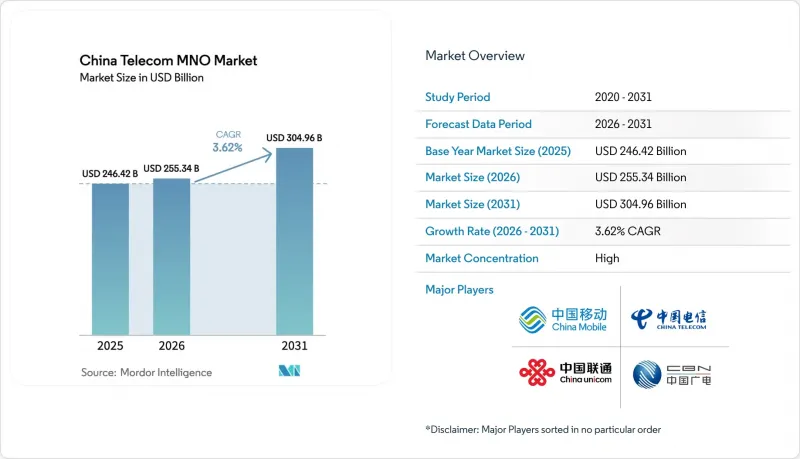
This report is Segmented by Service Type (Voice Services, Data and Internet Services, Messaging Services, Iot and M2M Services, OTT and PayTV Services, and Other Services), and End User (Enterprises, Consumer). The Market Forecasts are Provided in Terms of Value (USD) and Volume (Subscribers).
China Telecom MNO Market Trends and Insights
National 5G-Advanced Rollout and CAPEX Support
China's three state-owned operators are in the middle of the world's largest 5G-Advanced build-out, backed by MIIT's preferential financing and 6 GHz spectrum allocations. China Mobile plans 2.8 million 5G cells, and China Unicom targets blanket coverage across 300 cities by 2025, enabling network slicing and edge-cloud synergies essential for industrial automation. Shared-infrastructure agreements reduce redundant spending, while access to state bank credit lines sustains the multi-year capex cycle. The resulting densification supports ultra-low-latency services, positioning the China Telecom MNO market as the global reference for massive machine-type communications.
Enterprise Cloud-Network Convergence Demand Surge
Digital-transformation mandates across manufacturing and e-government are pushing organizations toward integrated connectivity and cloud stacks. Operators are leveraging nationwide fiber backbones and IDC assets to deliver one-stop SD-WAN, private 5G, and hybrid-cloud offerings, such as China Mobile's Dayin computing platform . The shift lifts average contract values and deepens stickiness via managed security, accelerating the China Telecom MNO market's B2B revenue mix. Demand is clustered in Tier 1 tech corridors yet ripples into provincial industrial parks where policy incentives promote smart-factory pilots.
Mobile-Subscriber Saturation
Penetration exceeding 115% in the largest conurbations leaves little room for organic SIM additions. Growth now hinges on retention, multi-device data plans, and IoT provisioning. While family buckets and smart-device bundles slow churn, ARPU uplift remains modest, pressing operators to extract more lifetime value per account. The saturation ceiling weighs on the consumer slice of the China Telecom MNO market, shifting strategic weight toward enterprise and vertical-IoT contracts.
Other drivers and restraints analyzed in the detailed report include:
- Explosive Mobile-Data Traffic from Short-Video and XR
- Green-Network Incentives for AI-Optimized Energy Savings
- OTT Substitution of Legacy Voice and SMS
For complete list of drivers and restraints, kindly check the Table Of Contents.
Segment Analysis
Data and Internet Services held 43.58% China Telecom MNO market share in 2025, reflecting the nation's mobile-first digital ecosystem anchored by cloud gaming, HD streaming, and cash-light retail. High-capacity 5G-Advanced cells and converged fiber backbones underpin sustained data-traffic growth, while differentiated speed tiers and unlimited bundles sustain incremental ARPU. The rise of edge-computing nodes near manufacturing belts drives premium connectivity demand, converting bandwidth into productivity gains for Industry 4.0 adopters. Conversely, Voice and Messaging revenues continue their structural decline as OTT channels absorb person-to-person communications. Operators mitigate dilution through voice-over-NR and enterprise-grade unified-communications packages that piggyback on existing MPLS circuits.
In parallel, IoT and M2M Services are expanding at a 3.78% CAGR, set to capture outsized incremental value within the China Telecom MNO market size. Over 2 billion licensed cellular IoT endpoints are expected online by 2030, spanning smart-meter clusters, AGV fleets, and connected agriculture zones. Operators exploit platform economics, device management portals, SIM lifecycle automation, and integrated billing to deepen client lock-in. Revenue per connection is lower than consumer lines, yet gross margins improve owing to minimal customer-care overhead. Government mandates for vehicle telematics and electricity metering further institutionalize IoT traffic growth, reinforcing long-run revenue visibility.
Complete Report Scope:
- Overall Telecom Revenue and ARPU
- Service Type
- Voice Services
- Data and Internet Services
- Messaging Services
- IoT and M2M Services
- OTT and PayTV Services
- Other Services (VAS, Roaming and International Services, Enterprise and Wholesale Services, etc.)
- End-user
- Enterprises
- Consumer
List of Companies Covered in this Report:
- China Mobile Limited
- China Telecom Corporation Limited
- China United Network Communications Group Co., Ltd.
- China Broadnet (China Broadcast Network Co., Ltd.)
Additional Benefits:
- The market estimate (ME) sheet in Excel format
- 3 months of analyst support
TABLE OF CONTENTS
1 INTRODUCTION
- 1.1 Study Assumptions and Market Definition
- 1.2 Scope of the Study
2 RESEARCH METHODOLOGY
3 EXECUTIVE SUMMARY
4 MARKET LANDSCAPE
- 4.1 Market Overview
- 4.2 Regulatory and Policy Framework
- 4.3 Spectrum Landscape and Competitive Holdings
- 4.4 Telecom Industry Ecosystem
- 4.5 Macroeconomic and External Drivers
- 4.6 Porter's Five Forces Analysis
- 4.6.1 Competitive Rivalry
- 4.6.2 Threat of New Entrants
- 4.6.3 Bargaining Power of Suppliers
- 4.6.4 Bargaining Power of Buyers
- 4.6.5 Threat of Substitutes
- 4.7 Key MNO KPIs (2020-2025)
- 4.7.1 Unique Mobile Subscribers and Penetration Rate
- 4.7.2 Mobile Internet Users and Penetration Rate
- 4.7.3 SIM Connections by Access Technology and Penetration
- 4.7.4 Cellular IoT/M2M Connections
- 4.7.5 Broadband Connections (Mobile and Fixed)
- 4.7.6 ARPU (Average Revenue Per User)
- 4.7.7 Average Data Usage per Subscription (GB/month)
- 4.8 Market Drivers
- 4.8.1 National 5G-Advanced rollout and CAPEX support
- 4.8.2 Enterprise cloud-network convergence demand surge
- 4.8.3 Gigabit-fiber adoption lifting broadband ARPU
- 4.8.4 Explosive mobile-data traffic from short-video and XR
- 4.8.5 Monetisation of open-network APIs (GSMA Open Gateway)
- 4.8.6 Green-network incentives for AI-optimised energy savings
- 4.9 Market Restraints
- 4.9.1 Mobile-subscriber saturation
- 4.9.2 OTT substitution of legacy voice and SMS
- 4.9.3 Provincial price wars in digital-government tenders
- 4.9.4 Export-control risk for 5G core semiconductor supply
- 4.10 Technological Outlook
- 4.11 Analysis of key business models in Telecom Sector
- 4.12 Analysis of Pricing Models and Pricing
5 MARKET SIZE AND GROWTH FORECASTS (VALUE AND VOLUME)
- 5.1 Overall Telecom Revenue and ARPU
- 5.2 Service Type
- 5.2.1 Voice Services
- 5.2.2 Data and Internet Services
- 5.2.3 Messaging Services
- 5.2.4 IoT and M2M Services
- 5.2.5 OTT and PayTV Services
- 5.2.6 Other Services (VAS, Roaming and International Services, Enterprise and Wholesale Services, etc.)
- 5.3 End-user
- 5.3.1 Enterprises
- 5.3.2 Consumer
6 COMPETITIVE LANDSCAPE
- 6.1 Market Concentration
- 6.2 Strategic Moves and Investments by key vendors, 2023-2025
- 6.3 Market share analysis for MNOs, 2024
- 6.4 Product Benchmarking Analysis for mobile network services
- 6.5 MNO snapshot (subscribers, churn rate, ARPU, etc.)
- 6.6 Company Profiles* of MNOs (Includes Business Overview | Service Portfolio | Financials | Business Strategy and Recent Developments | SWOT Analysis)
- 6.6.1 China Mobile Limited
- 6.6.2 China Telecom Corporation Limited
- 6.6.3 China United Network Communications Group Co., Ltd.
- 6.6.4 China Broadnet (China Broadcast Network Co., Ltd.)
7 MARKET OPPORTUNITIES AND FUTURE OUTLOOK
- 7.1 White-space and Unmet-Need Assessment

