PUBLISHER: Mordor Intelligence | PRODUCT CODE: 2116955

PUBLISHER: Mordor Intelligence | PRODUCT CODE: 2116955
Italy Metal Packaging - Market Share Analysis, Industry Trends & Statistics, Growth Forecasts (2026 - 2031)
According to Mordor Intelligence, the italy metal packaging market size was valued at USD 5.27 billion in 2025 and estimated to grow from USD 5.52 billion in 2026 to reach USD 6.95 billion by 2031, at a CAGR of 4.72% during the forecast period (2026-2031).
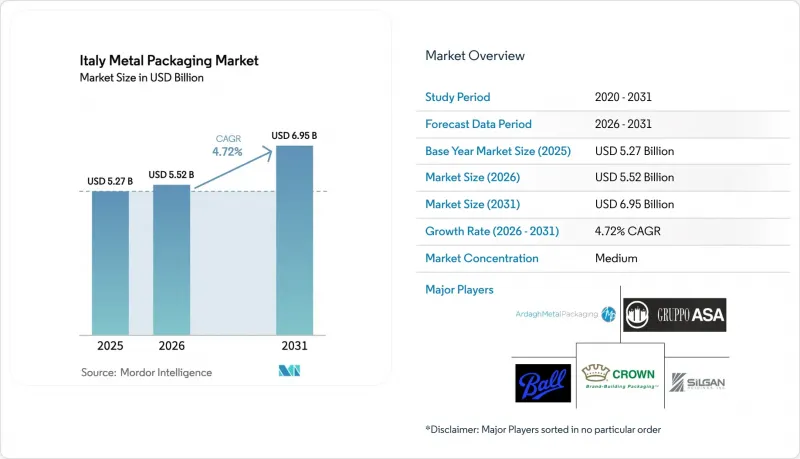
This report is Segmented by Material Type (Aluminum, Steel, and Tin), Product Type (Cans, Bulk Containers, Drums and Barrels, Caps and Closures, and More), End-User Industry (Food, Beverage, and More), and Coating Type (Epoxy Phenolic, Acrylic, Polyester, BPA-Free Alternatives, and More). The Market Forecasts are Provided in Terms of Value (USD).
Italy Metal Packaging Market Trends and Insights
Surge in Ready-to-Eat Food Consumption
Ready-to-eat meals remain popular with urban households that value convenience and portion control. Frozen goods hit 1.02 million t and EUR 5.8 billion (USD 6.4 billion) turnover in 2024, while processed vegetable exports rose to EUR 2.5 billion (USD 2.7 billion). Metal cans ensure a long shelf life for these premium items, thereby protecting the brand's reputation in distant markets. E-commerce adds momentum because rigid cans withstand parcel handling better than flexible films. As Italian producers increasingly sell to regions with less-reliable logistics, barrier integrity becomes a non-negotiable purchase criterion. The trend also accelerates demand for smaller metal formats that suit single-person households.
Growing Craft Beverage Production in Italy
The country counted 1,326 craft breweries with 17.6 million hl output valued at EUR 10.2 billion (USD 11.2 billion) in 2024. Artisanal brewers overwhelmingly favor aluminum cans for light protection and shipping efficiency. Digital printing enables colorful graphics in low volumes, aligning with limited-edition releases. The craft spirits niche follows a similar path, placing small-batch gin or amaro in sleek metal bottles designed for export. Northern clusters benefit from proximity to can makers, shortening lead times. Because brand storytelling matters to independent brewers, suppliers offering rapid design changes gain a competitive edge.
Supply Volatility of Primary Aluminum
Primary aluminum prices swung 15-20% during 2024 amid energy shocks and geopolitical strains. Italy imports roughly 95% of its ingots, exposing converters to exchange-rate risk and freight surcharges. Although Hydro invested EUR 14.8 million (USD 16.3 million) to lift Atessa's recycling capacity by 10,000 t yr-1, food-grade scrap remains scarce. Producers hedge with long-term contracts yet still face margin compression. The volatility briefly prompts some buyers to consider steel or composite solutions for non-critical uses, tempering near-term growth in aluminum cans.
Other drivers and restraints analyzed in the detailed report include:
- Mandatory EU Recycling Targets for Metal
- Rising Demand for Aerosol Personal-Care Products
- Consumer Shift Toward Lightweight Plastics in Paints
For complete list of drivers and restraints, kindly check the Table Of Contents.
Segment Analysis
Aluminum held 63.35% Italy metal packaging market share in 2025, mirroring its entrenched role in beverages and shelf-stable foods. Steel, however, is poised for a 5.63% CAGR on the back of drum, pail, and IBC demand from automotive fluids, agrochemicals, and lubricants. Italy metal packaging market size, attributed to aluminum, is projected to approach USD 4.55 billion by 2031, while steel could surpass USD 2.05 billion. Aluminum's growth stays tethered to increasing craft beer and energy drink production, but its high electricity intensity poses cost risks that favor closed-loop scrap systems. Steel benefits from Italy's upstream coil capacity clustered around Lombardy, offering short lead times for industrial fillers.
Advanced coatings ensure both metals comply with EU food-contact regulations. BPA-free variants such as Accelshield 700 widen aluminum's use in infant formula cans, whereas polyester-epoxy hybrids enable steel aerosol cans for solvent-heavy hair sprays. High recycled content targets-75% by 2030 for aluminum containers-encourage alloy optimization without sacrificing drawability. Simultaneously, lightweight steel designs using micro-alloying technologies lower gauge by up to 8%, helping industrial packers meet eco-tax thresholds. As procurement teams evaluate total cost of ownership, value propositions pivot on circularity credentials rather than upfront material price.
Cans retained 39.65% of the revenue in 2025 and remain the face of consumer-contact applications; yet, bulk containers are forecast to grow at a rate of 4.86% annually through 2031 as the export-heavy chemical and pharmaceutical industries scale. Within cans, sleek 250ml beverage formats are gaining favor among craft brewers seeking differentiation on crowded retail shelves. Meanwhile, Italy metal packaging market size generated by bulk containers could hit USD 1.14 billion by 2031, reflecting shifting industrial logistics. Rigid IBCs, tight-head drums, and large pails cater to the increasing volumes of lubricant blends associated with electric-vehicle part manufacturing.
Digital printing unlocks SKU proliferation for cans without prohibitive plate costs. Ball's Dynamark platform, relaunched across EMEA, prints variable graphics at commercial speed, ideal for seasonal beer lines. Conversely, bulk container manufacturers focus on UN-certified designs, corrosion-resistant linings, and RFID tagging for supply chain transparency. Demand for aerosol cans also advances, buoyed by double-digit growth in sun-care sprays marketed to tourists in Southern Italy. Decorative tins for olive oil and confectionery maintain a small but stable niche, capitalizing on the nation's gift-oriented gourmet culture.
Complete Report Scope:
- By Material Type
- Aluminum
- Steel
- Tin
- By Product Type
- Cans
- Food Cans
- Beverage Cans
- Aerosol Cans
- Decorative Cans
- Bulk Containers
- Drums and Barrels
- Caps and Closures
- Other Product Types
- Cans
- By End-User Industry
- Food
- Beverage
- Paints, Coatings and Chemicals
- Pharmaceuticals and Healthcare
- Industrial
- Other End-user Industries
- By Coating Type
- Epoxy Phenolic
- Acrylic
- Polyester
- BPA-Free Alternatives
- Other Coating Types
List of Companies Covered in this Report:
- Ardagh Metal Packaging Italy S.r.l.
- Ball Beverage Packaging Italia S.r.l.
- Crown Packaging Manufacturing UK Limited - Italian Operations
- Silgan Holdings Inc.
- Gruppo ASA S.p.A.
- Tecnocap S.p.A.
- Nespak S.p.A.
- Trivium Packaging Italy S.p.A.
- Verallia Italia S.p.A.
- Envases Group Italy S.r.l.
- Massilly Italia S.r.l.
- Emballator Metal Group Italy
- Berlin Packaging Italy S.p.A.
- Colep Packaging Italia S.p.A.
- I.M.C. S.p.A.
- Nuova Sansone S.r.l.
- Contital S.p.A.
- C.T.S. Italia S.r.l.
- Metalpack S.r.l.
Additional Benefits:
- The market estimate (ME) sheet in Excel format
- 3 months of analyst support
TABLE OF CONTENTS
1 INTRODUCTION
- 1.1 Study Assumptions and Market Definition
- 1.2 Scope of the Study
2 RESEARCH METHODOLOGY
3 EXECUTIVE SUMMARY
4 MARKET LANDSCAPE
- 4.1 Market Overview
- 4.2 Market Drivers
- 4.2.1 Surge in Ready-to-Eat Food Consumption
- 4.2.2 Growing Craft Beverage Production in Italy
- 4.2.3 Mandatory EU Recycling Targets for Metal
- 4.2.4 Rising Demand for Aerosol Personal-Care Products
- 4.2.5 Advanced Digital Printing on Metal Packaging
- 4.2.6 Expansion of Italian Export-Oriented Gourmet Foods
- 4.3 Market Restraints
- 4.3.1 Supply Volatility of Primary Aluminum
- 4.3.2 Consumer Shift Toward Lightweight Plastics in Paints
- 4.3.3 Regulatory Uncertainty Around BPA Substitutes
- 4.3.4 High Initial Capital for Metal Can Manufacturing
- 4.4 Industry Value Chain Analysis
- 4.5 Regulatory Landscape
- 4.6 Technological Outlook
- 4.7 Impact of Macroeconomic Factors
- 4.8 Porter's Five Forces Analysis
- 4.8.1 Threat of New Entrants
- 4.8.2 Bargaining Power of Buyers
- 4.8.3 Bargaining Power of Suppliers
- 4.8.4 Threat of Substitutes
- 4.8.5 Intensity Competitive Rivalry
5 MARKET SIZE AND GROWTH FORECASTS (VALUE)
- 5.1 By Material Type
- 5.1.1 Aluminum
- 5.1.2 Steel
- 5.1.3 Tin
- 5.2 By Product Type
- 5.2.1 Cans
- 5.2.1.1 Food Cans
- 5.2.1.2 Beverage Cans
- 5.2.1.3 Aerosol Cans
- 5.2.1.4 Decorative Cans
- 5.2.2 Bulk Containers
- 5.2.3 Drums and Barrels
- 5.2.4 Caps and Closures
- 5.2.5 Other Product Types
- 5.2.1 Cans
- 5.3 By End-User Industry
- 5.3.1 Food
- 5.3.2 Beverage
- 5.3.3 Paints, Coatings and Chemicals
- 5.3.4 Pharmaceuticals and Healthcare
- 5.3.5 Industrial
- 5.3.6 Other End-user Industries
- 5.4 By Coating Type
- 5.4.1 Epoxy Phenolic
- 5.4.2 Acrylic
- 5.4.3 Polyester
- 5.4.4 BPA-Free Alternatives
- 5.4.5 Other Coating Types
6 COMPETITIVE LANDSCAPE
- 6.1 Market Concentration
- 6.2 Strategic Moves
- 6.3 Market Share Analysis
- 6.4 Company Profiles (includes Global level Overview, Market level overview, Core Segments, Financials as available, Strategic Information, Market Rank/Share for key companies, Products and Services, and Recent Developments)
- 6.4.1 Ardagh Metal Packaging Italy S.r.l.
- 6.4.2 Ball Beverage Packaging Italia S.r.l.
- 6.4.3 Crown Packaging Manufacturing UK Limited - Italian Operations
- 6.4.4 Silgan Holdings Inc.
- 6.4.5 Gruppo ASA S.p.A.
- 6.4.6 Tecnocap S.p.A.
- 6.4.7 Nespak S.p.A.
- 6.4.8 Trivium Packaging Italy S.p.A.
- 6.4.9 Verallia Italia S.p.A.
- 6.4.10 Envases Group Italy S.r.l.
- 6.4.11 Massilly Italia S.r.l.
- 6.4.12 Emballator Metal Group Italy
- 6.4.13 Berlin Packaging Italy S.p.A.
- 6.4.14 Colep Packaging Italia S.p.A.
- 6.4.15 I.M.C. S.p.A.
- 6.4.16 Nuova Sansone S.r.l.
- 6.4.17 Contital S.p.A.
- 6.4.18 C.T.S. Italia S.r.l.
- 6.4.19 Metalpack S.r.l.
7 MARKET OPPORTUNITIES AND FUTURE OUTLOOK
- 7.1 White-space and unmet-need assessment

