PUBLISHER: Mordor Intelligence | PRODUCT CODE: 2154747

PUBLISHER: Mordor Intelligence | PRODUCT CODE: 2154747
South America Metal Packaging - Market Share Analysis, Industry Trends & Statistics, Growth Forecasts (2026 - 2031)
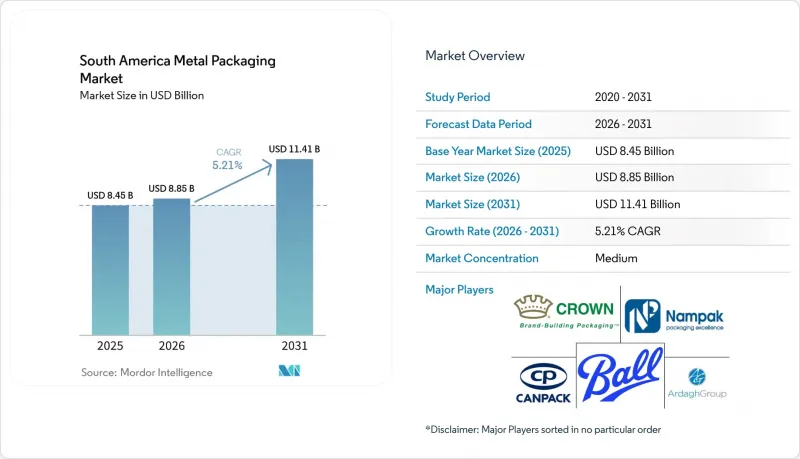
According to Mordor Intelligence, the South America metal packaging market size was valued at USD 8.45 billion in 2025, USD 8.85 billion in 2026, and is estimated to grow from USD 8.85 billion in 2026 to reach USD 11.41 billion by 2031, at a CAGR of 5.21% during the forecast period (2026-2031).
South America Metal Packaging Market Trends and Insights
Growth in Canned Beer and Ready-to-Drink Beverage Consumption
Canned beer and ready-to-drink beverages are the largest drivers of demand for the South America Metal Packaging Market. Brazil sold 34.1 billion aluminum cans in 2025, with canned water, ready-to-drink beverages, and canned cachaca adding volume as established beverage categories slowed. These formats usually use single-serve aluminum or steel cans rather than glass or PET. This gives new beverage launches a direct effect on can demand. Abralatas expected a new growth cycle in 2026, supported by the FIFA World Cup and broader category demand. The South America Metal Packaging Market benefits as the demand mix becomes less dependent on conventional beer volumes.
Recyclability and Circular-Economy Commitments
Brazil's aluminum can collection system supports a major cost and sourcing advantage for the South America Metal Packaging Market. The country recycled 97.3% of beverage cans in 2024 and reached 100% in 2025. More than 80% of the aluminum sheet used for Brazilian can production came from recycled material, according to Abralatas. Recycled content can reduce producers' exposure to primary metal costs and meet procurement requirements from multinational beverage customers. Ball Beverage Packaging South America and Ardagh Metal Packaging Brasil received Aluminum Stewardship Initiative Performance Standard V3.1 certifications in 2025. These credentials strengthen the South America Metal Packaging Market's position in supply contracts that require traceability and responsible material management.
Aluminum, Steel, and Energy Price Volatility
Commodity prices are the most immediate cost restraint for the South America Metal Packaging Market. LME aluminum reached USD 3,672 per metric ton in April 2026 after conflict in the Middle East threatened 9% of global primary aluminum smelting capacity. South American converters are exposed because many depend on imported aluminum coil. Input costs can rise faster than selling prices when contracts restrict mid-season increases. Energy costs can add further pressure because aluminum production and recycling depend on a reliable power supply. The result is a choice between absorbing higher costs and passing them through to customers, which can constrain margins and near-term investment.
Other drivers and restraints analyzed in the detailed report include:
- Longer Shelf Life and Barrier Protection for Food and Beverages
- Expansion of Processed Food and Convenience Consumption
- High Conversion, Tooling, and Compliance Costs
For complete list of drivers and restraints, kindly check the Table Of Contents.
Segment Analysis
Aluminum held 64.28% of South America Metal Packaging Market revenue in 2025. Its position reflects lightweighting, recyclability, and barrier performance in beverage cans. Brazil's 100% beverage-can recycling rate in 2025 strengthens local access to secondary material. The system reduces dependence on primary ingot compared with markets with weaker collection systems. Ball and Ardagh's 2025 ASI certifications also support sourcing requirements from multinational beverage companies.
Steel remains relevant for food cans, industrial drums, and bulk containers where strength and retort processing matter. Greif received the Best Metal Packaging Supplier award in the drums category at Brazil's 2025 Paint and Pintura Award. Aluminum is forecast to grow at a 6.74% CAGR through 2031 as producers expand capacity to meet demand for canned water, ready-to-drink cocktails, and energy drinks. These beverage formats are increasingly shifting from PET to aluminum. The South America Metal Packaging Market will therefore retain a two-material structure, with aluminum leading in beverages and steel maintaining specialized uses in food and industry.
Beverage cans accounted for 41.33% of product-type revenue in 2025. Beer, soft drinks, canned water, and ready-to-drink beverages underpin this leading position. Brazil's growth in canned water and emerging beverage categories has reduced reliance on traditional beer demand. Aerosol cans are forecast to grow at a 6.89% CAGR through 2031. Demand comes from personal care and household products, including deodorants, hair sprays, and cleaning products.
Food cans remain important because they support ambient distribution over long distances. Bulk containers and drums serve agribusiness, chemicals, paints, and industrial customers. Caps and closures benefit from premium beer and spirits formats that require higher-specification components. Food cans and aerosols also face reformulation requirements for their coatings under the current regulatory direction. The South America Metal Packaging Market, therefore, contains both high-volume beverage demand and smaller product lines with more specialized technical needs.
Complete Report Scope:
- By Material Type
- Aluminum
- Steel
- By Product Type
- Cans
- Food Cans
- Beverage Cans
- Aerosol Cans
- Bulk Containers
- Shipping Barrels and Drums
- Caps and Closures
- Cans
- By End-User Industry
- Beverage
- Food
- Cosmetics and Personal Care
- Household
- Other End-User Industry
- By Coating and Lining Type
- BPA-Based Epoxy
- BPA-NI Epoxy
- Polyester / PET
- Other Coating / Lining Type
- By Container Capacity
- Less than 250 ml
- 251-500 ml
- 501-1000 ml
- More than 1000 ml
- By Geography
- Brazil
- Argentina
- Colombia
- Chile
- Rest of South America
List of Companies Covered in this Report:
- Ardagh Metal Packaging S.A.
- Ball Corporation
- Crown Holdings, Inc.
- CANPACK S.A.
- Silgan Holdings Inc.
- Nampak Limited
- Toyo Seikan Group Holdings, Ltd.
- CPMC Holdings Limited
- Daiwa Can Company
- Hokkan Holdings Limited
- ORG Technology Co., Ltd.
- Baosteel Packaging Co., Ltd.
- Mauser Packaging Solutions
- Greif, Inc.
- TUBEX Holding GmbH
- Colep Packaging
- Envases Group
- Tecnocap S.p.A.
- Massilly Holding S.A.S.
- Pelliconi & C. S.p.A.
- Astir Vitogiannis Bros S.A.
- Trivium Packaging B.V.
- Jamestrong Packaging Pty Ltd
- Independent Can Company
- United Can Company
Additional Benefits:
- The market estimate (ME) sheet in Excel format
- 3 months of analyst support
TABLE OF CONTENTS
1 INTRODUCTION
- 1.1 Study Assumptions and Market Definition
- 1.2 Scope of the Study
2 RESEARCH METHODOLOGY
3 EXECUTIVE SUMMARY
4 MARKET LANDSCAPE
- 4.1 Market Overview
- 4.2 Market Drivers
- 4.2.1 Growth in Canned Beer and Ready-to-Drink Beverage Consumption
- 4.2.2 Recyclability and Circular-Economy Commitments
- 4.2.3 Longer Shelf Life and Barrier Protection for Food and Beverages
- 4.2.4 Expansion of Processed Food and Convenience Consumption
- 4.2.5 Premiumization of Beverage and Personal Care Packaging
- 4.2.6 Brazil-Led Localization of Can Supply and Regional Beer Logistics
- 4.3 Market Restraints
- 4.3.1 Aluminum, Steel, and Energy Price Volatility
- 4.3.2 High Conversion, Tooling, and Compliance Costs
- 4.3.3 Uneven Collection Economics Across Secondary South American Cities
- 4.3.4 Coating Qualification Bottlenecks for Localized Supply
- 4.4 Impact of Macroeconomic Factors on the Market
- 4.5 Industry Supply-Chain Analysis
- 4.6 Technology Outlook
- 4.7 Regulatory Landscape
- 4.8 Porter's Five Forces Analysis
- 4.8.1 Threat of New Entrants
- 4.8.2 Bargaining Power of Suppliers
- 4.8.3 Bargaining Power of Buyers
- 4.8.4 Threat of Substitutes
- 4.8.5 Intensity of Competitive Rivalry
5 MARKET SIZE AND GROWTH FORECASTS (VALUE)
- 5.1 By Material Type
- 5.1.1 Aluminum
- 5.1.2 Steel
- 5.2 By Product Type
- 5.2.1 Cans
- 5.2.1.1 Food Cans
- 5.2.1.2 Beverage Cans
- 5.2.1.3 Aerosol Cans
- 5.2.2 Bulk Containers
- 5.2.3 Shipping Barrels and Drums
- 5.2.4 Caps and Closures
- 5.2.1 Cans
- 5.3 By End-User Industry
- 5.3.1 Beverage
- 5.3.2 Food
- 5.3.3 Cosmetics and Personal Care
- 5.3.4 Household
- 5.3.5 Other End-User Industry
- 5.4 By Coating and Lining Type
- 5.4.1 BPA-Based Epoxy
- 5.4.2 BPA-NI Epoxy
- 5.4.3 Polyester / PET
- 5.4.4 Other Coating / Lining Type
- 5.5 By Container Capacity
- 5.5.1 Less than 250 ml
- 5.5.2 251-500 ml
- 5.5.3 501-1000 ml
- 5.5.4 More than 1000 ml
- 5.6 By Geography
- 5.6.1 Brazil
- 5.6.2 Argentina
- 5.6.3 Colombia
- 5.6.4 Chile
- 5.6.5 Rest of South America
6 COMPETITIVE LANDSCAPE
- 6.1 Market Concentration
- 6.2 Strategic Moves
- 6.3 Market Share Analysis
- 6.4 Company Profiles (includes Global Level Overview, Market Level Overview, Core Segments, Financials as available, Strategic Information, Market Rank/Share, Products and Services, Recent Developments)
- 6.4.1 Ardagh Metal Packaging S.A.
- 6.4.2 Ball Corporation
- 6.4.3 Crown Holdings, Inc.
- 6.4.4 CANPACK S.A.
- 6.4.5 Silgan Holdings Inc.
- 6.4.6 Nampak Limited
- 6.4.7 Toyo Seikan Group Holdings, Ltd.
- 6.4.8 CPMC Holdings Limited
- 6.4.9 Daiwa Can Company
- 6.4.10 Hokkan Holdings Limited
- 6.4.11 ORG Technology Co., Ltd.
- 6.4.12 Baosteel Packaging Co., Ltd.
- 6.4.13 Mauser Packaging Solutions
- 6.4.14 Greif, Inc.
- 6.4.15 TUBEX Holding GmbH
- 6.4.16 Colep Packaging
- 6.4.17 Envases Group
- 6.4.18 Tecnocap S.p.A.
- 6.4.19 Massilly Holding S.A.S.
- 6.4.20 Pelliconi & C. S.p.A.
- 6.4.21 Astir Vitogiannis Bros S.A.
- 6.4.22 Trivium Packaging B.V.
- 6.4.23 Jamestrong Packaging Pty Ltd
- 6.4.24 Independent Can Company
- 6.4.25 United Can Company
7 MARKET OPPORTUNITIES AND FUTURE OUTLOOK
- 7.1 White-Space and Unmet-Need Assessment

