PUBLISHER: Mordor Intelligence | PRODUCT CODE: 2117211

PUBLISHER: Mordor Intelligence | PRODUCT CODE: 2117211
Asia Pacific Swimwear - Market Share Analysis, Industry Trends & Statistics, Growth Forecasts (2026 - 2031)
According to Mordor Intelligence, Asia-Pacific swimwear market size in 2026 is estimated at USD 9.08 billion, growing from 2025 value of USD 8.53 billion with 2031 projections showing USD 12.42 billion, growing at 6.47% CAGR over 2026-2031.
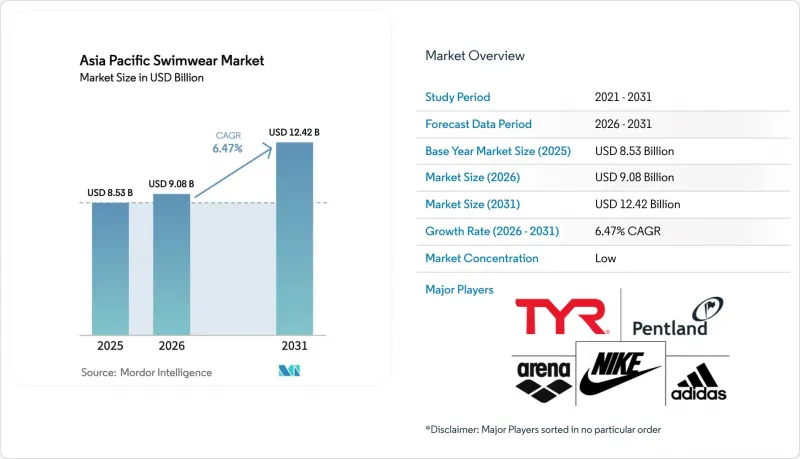
This report is Segmented by Product Type (Women's Swimwear, Men's Swimwear, Kids' Swimwear, and Accessories), Material Type (Nylon, Polyester, Spandex, and More), Category (Mass and Premium), Distributional Channel (Supermarkets/Hypermarkets, Specialty Stores, Online Retail Stores, and More), and Geography. The Market Forecasts are Provided in Terms of Value (USD).
Asia Pacific Swimwear Market Trends and Insights
Rising Health Consciousness and Fitness Trends
Across the region, government-led wellness initiatives are fueling a growing demand for performance-oriented swimwear, moving beyond mere recreational use. In 2025, Singapore's Health Promotion Board bolstered workplace wellness programs, co-funding up to SGD 65 per session for physical activities, contingent on a minimum of 15 participants. This move directly champions the adoption of a corporate fitness culture. Such institutional backing aligns with a broader behavioral shift: Singapore's populace is increasingly engaging in regular sports, underscoring a momentum towards active living. Data from the Singapore Department of Statistics reveal a notable increase in sports bookings: in 2023, football field reservations reached approximately 34,550, while tennis courts saw bookings of around 205,700 This trend isn't limited to individual pursuits; community-driven activities are on the rise. China's vibrant marathon scene is not only spotlighting the demand for moisture-wicking fabrics but also setting new benchmarks for swimwear materials. In China, premium sportswear brands are experiencing growth rates that surpass those of general apparel, underscoring a consumer trend: a willingness to invest in specialized, activity-centric apparel. This discerning, health-focused consumer demographic is reshaping perceptions of swimwear, viewing it increasingly as essential performance gear. As a result, there's a heightened demand for advanced features like chlorine resistance, UV protection, and quick-dry technologies.
Growth of Tourism and Leisure Activities
As the Asia-Pacific's tourism rebounds, key destination markets see a surge in swimwear demand, bolstered by infrastructure investments that hint at sustained growth. Thailand, aiming for 35.99 million foreign tourist arrivals by 2025, nearly back to pre-pandemic levels, is introducing a THB 300 (USD 8.20) tourism fee. This fee aims to bolster attraction development and enhance safety infrastructure. Meanwhile, the 2025 World Aquatics Championships in Singapore underscore the lasting impact of major sporting events on tourism. With 40,000 international visitors projected, the event is expected to generate an additional SGD 60 million in tourism receipts, according to the Ministry of Culture, Community and Youth. The championships necessitated the construction of temporary facilities, boasting a water capacity of 2.06 million gallons. This not only underscores the event's scale but also highlights the dual benefit: an immediate uptick in swimwear demand and the long-term utility of such facilities. As regional tourism trends shift towards experiential and wellness-centric travel, swimwear purchases are increasingly seen as integral to the travel experience, rather than mere pre-trip shopping. This evolution paves the way for premium, multifunctional swimwear that seamlessly blends performance with lifestyle appeal.
Raw Material Price Volatility
Price instability in spandex and polyester is squeezing margins and complicating inventory management, hampering market growth due to supply chain disruptions and limited ability to pass on costs. China's spandex sector is grappling with a persistent oversupply, despite annual capacity expansion. While demand growth is pushing prices for the mainstream 40D spandex, this oversupply leads to instability. Producers are contemplating production cuts to better manage inventories. Meanwhile, feedstock costs for 1,4-Butanediol (BDO) and Polytetramethylene Ether Glycol (PTMEG), although at multi-year lows, are under downward pressure, raising concerns about potential supply disruptions. In the polyester filament yarn market, a notable shift is observed: inventory levels have plummeted from 20 days to just one week, and operating rates are exceeding 90%. This suggests a tighter balance between supply and demand, yet it's a balance that could easily tip with any changes in demand. Given the ongoing challenges of overcapacity, the spandex market's recovery appears sluggish. This unpredictability in input costs poses challenges for swimwear manufacturers, who depend on a consistent elastane content for optimal performance. As raw material prices fluctuate, manufacturers face a crossroads: either compress margins by maintaining fixed retail prices or risk demand destruction through price hikes. Both choices limit the potential for market expansion.
Other drivers and restraints analyzed in the detailed report include:
- Technological Advancements in Fabric
- Rise of Athleisure and Multifunctional Swimwear
- Proliferation of Counterfeit Products
For complete list of drivers and restraints, kindly check the Table Of Contents.
Segment Analysis
In 2025, women's swimwear holds a dominant 42.02% market share in the Asia-Pacific region, driven by demographic purchasing habits and higher average selling prices resulting from product complexity. The accessories segment is projected to grow at a 7.57% CAGR through 2031, driven by multifunctional innovations such as UV-protective cover-ups, waterproof fitness trackers, and customizable modular swimwear. Men's swimwear continues to grow steadily, focusing on performance-driven designs for competitive swimming and water sports, while benefiting from the athleisure trend that blends swim trunks with casual shorts. Kids' swimwear experiences consistent growth, driven by demographic trends and an increase in swimming program participation, with safety features such as built-in flotation and bright, visibility-enhancing colors becoming standard.
Arena's lifestyle expansion showcases how performance brands are capitalizing on accessories growth by incorporating beachwear collections, including bags, outerwear, and mini-dresses, which complement their swimwear offerings. Women's swimwear benefits from fashion-forward designs and seasonal refreshes, encouraging multiple purchases annually, while accessories provide year-round revenue, reducing seasonal dependency. Accessories innovation focuses on tech integration, with waterproof cases, UV-monitoring devices, and performance-tracking wearables creating new market intersections. The segment's growth reflects consumer preference for holistic swim ecosystems over standalone products, offering opportunities for brands with cohesive collections across product types.
In 2025, polyester leads with a 39.22% market share, thanks to its durability and scalable manufacturing, which balance cost optimization and performance. Spandex is expected to grow at the fastest rate, with an 7.97% CAGR through 2031, driven by advancements in chlorine resistance, UV protection, stretch recovery, and the integration of recycled content. Nylon dominates premium segments, such as women's fashion swimwear, where its superior hand feel and drape justify the higher costs. Emerging bio-based and recycled materials are gaining market share through innovations in sustainability and performance, challenging traditional materials.
LYCRA's lastingFIT technology enhances swimwear longevity, lasting up to 10 times longer than standard spandex by improving resistance to chlorine, UV exposure, and washing. Speedo's biodegradable polyamide addresses environmental concerns while maintaining performance, with garments decomposing within three years when disposed of properly. China's spandex oversupply, characterized by capacity growth outpacing demand and historic low prices, enables manufacturers to incorporate higher spandex content into mid-market products while remaining competitive. Material selection reflects brand strategies, with premium brands focusing on technical performance and sustainability, while mass-market products prioritize cost efficiency. Rising performance demands and environmental responsibility drive material innovation toward superior technical and eco-friendly solutions.
Complete Report Scope:
- By Product Type
- Women's Swimwear
- Men's Swimwear
- Kids' Swimwear
- Accessories
- By Material Type
- Nylon
- Polyester
- Spandex
- Other Fabric Types
- By Category
- Mass
- Premium
- By Distribution Channel
- Supermarkets/Hypermarkets
- Specialty Stores
- Online Retail Stores
- Other Distribution Channels
- By Geography
- China
- Japan
- India
- Thailand
- Singapore
- Indonesia
- South Korea
- Australia
- New Zealand
- Rest of Asia-Pacific
List of Companies Covered in this Report:
- adidas AG
- PUMA SE
- Nike Inc.
- Pentland Group (Speedo)
- Arena S.p.A.
- TYR Sport Inc.
- Seafolly Australia
- Rip Curl Pty Ltd
- Billabong (-Boardriders-)
- Bamba Swim
- Zivame
- Wacoal Holdings
- Fast Retailing (UNIQLO)
- Decathlon SA
- Lululemon Athletica
- La Perla
- The Beach Company
- Oysho (Inditex)
- Triumph International
- FILA Holdings
Additional Benefits:
- The market estimate (ME) sheet in Excel format
- 3 months of analyst support
TABLE OF CONTENTS
1 INTRODUCTION
- 1.1 Study Assumptions and Market Definition
- 1.2 Scope of the Study
2 RESEARCH METHODOLOGY
3 EXECUTIVE SUMMARY
4 MARKET LANDSCAPE
- 4.1 Market Overview
- 4.2 Market Drivers
- 4.2.1 Rising health consciousness and fitness trends
- 4.2.2 Growth of tourism and leisure activities
- 4.2.3 Technological advancements in fabric
- 4.2.4 Rise of athleisure and multifunctional swimwear
- 4.2.5 Expansion of aquatic facilities
- 4.2.6 Increased focus on sustainability
- 4.3 Market Restraints
- 4.3.1 Raw material price volatility
- 4.3.2 Proliferation of counterfeit products
- 4.3.3 Environmental concerns and sustainability costs
- 4.3.4 Intense market competition and fragmentation
- 4.4 Supply-Chain Analysis
- 4.5 Regulatory Landscape
- 4.6 Technological Outlook
- 4.7 Porter's Five Forces
- 4.7.1 Threat of New Entrants
- 4.7.2 Bargaining Power of Buyers
- 4.7.3 Bargaining Power of Suppliers
- 4.7.4 Threat of Substitutes
- 4.7.5 Competitive Rivalry
5 MARKET SIZE AND GROWTH FORECASTS
- 5.1 By Product Type
- 5.1.1 Women's Swimwear
- 5.1.2 Men's Swimwear
- 5.1.3 Kids' Swimwear
- 5.1.4 Accessories
- 5.2 By Material Type
- 5.2.1 Nylon
- 5.2.2 Polyester
- 5.2.3 Spandex
- 5.2.4 Other Fabric Types
- 5.3 By Category
- 5.3.1 Mass
- 5.3.2 Premium
- 5.4 By Distribution Channel
- 5.4.1 Supermarkets/Hypermarkets
- 5.4.2 Specialty Stores
- 5.4.3 Online Retail Stores
- 5.4.4 Other Distribution Channels
- 5.5 By Geography
- 5.5.1 China
- 5.5.2 Japan
- 5.5.3 India
- 5.5.4 Thailand
- 5.5.5 Singapore
- 5.5.6 Indonesia
- 5.5.7 South Korea
- 5.5.8 Australia
- 5.5.9 New Zealand
- 5.5.10 Rest of Asia-Pacific
6 COMPETITIVE LANDSCAPE
- 6.1 Market Concentration
- 6.2 Strategic Moves
- 6.3 Market Share Analysis
- 6.4 Company Profiles (includes Global level Overview, Market level overview, Core Segments, Financials as available, Strategic Information, Market Rank/Share for key companies, Products and Services, and Recent Developments)
- 6.4.1 adidas AG
- 6.4.2 PUMA SE
- 6.4.3 Nike Inc.
- 6.4.4 Pentland Group (Speedo)
- 6.4.5 Arena S.p.A.
- 6.4.6 TYR Sport Inc.
- 6.4.7 Seafolly Australia
- 6.4.8 Rip Curl Pty Ltd
- 6.4.9 Billabong (-Boardriders-)
- 6.4.10 Bamba Swim
- 6.4.11 Zivame
- 6.4.12 Wacoal Holdings
- 6.4.13 Fast Retailing (UNIQLO)
- 6.4.14 Decathlon SA
- 6.4.15 Lululemon Athletica
- 6.4.16 La Perla
- 6.4.17 The Beach Company
- 6.4.18 Oysho (Inditex)
- 6.4.19 Triumph International
- 6.4.20 FILA Holdings
7 MARKET OPPORTUNITIES AND FUTURE OUTLOOK

