PUBLISHER: Mordor Intelligence | PRODUCT CODE: 2117217

PUBLISHER: Mordor Intelligence | PRODUCT CODE: 2117217
Centrifugal Blowers - Market Share Analysis, Industry Trends & Statistics, Growth Forecasts (2026 - 2031)
According to Mordor Intelligence, the centrifugal blowers market size in 2026 is estimated at USD 3.21 billion, growing from 2025 value of USD 3.07 billion with 2031 projections showing USD 3.96 billion, growing at 4.35% CAGR over 2026-2031.
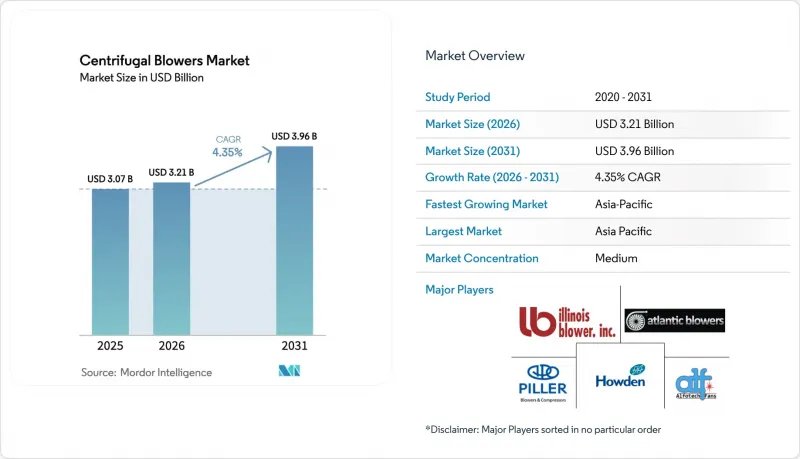
This report is Segmented by Pressure (High Pressure, Medium Pressure, and Low Pressure), Stage (Single-Stage, Multistage, High-Speed Turbo and More), Drive Type (Direct Drive, Belt Drive, Integrated VSD Drive, and More), End-Use Industry (Mining, Cement, Pulp and Paper, Construction, Steel, Chemicals and Petrochemicals, and More), and Geography. The Market Forecasts are Provided in Terms of Value (USD).
Global Centrifugal Blowers Market Trends and Insights
Energy-efficiency regulations and retrofits
California's Title 20 rules that took effect in April 2024 set a 1.00 Fan Energy Index threshold, prompting industrial owners to swap legacy fans for variable-speed centrifugal packages. Con Edison pays up to USD 1 million per account each year toward qualified HVAC upgrades, further compressing payback periods. Although the U.S. Department of Energy withdrew a federal standard in January 2025, state codes and EU Ecodesign requirements continue to push global operators toward high-efficiency impeller and motor combinations. Suppliers with factory-integrated drives and predictive analytics win bids because owners want documented performance and remote compliance reporting. These moves adds to the projected growth for the centrifugal blowers market.
Expansion of global wastewater treatment capacity
Only 58% of the world's 268 billion m3 of wastewater received safe treatment in 2022, creating an urgent build-out agenda. The South Bay plant is doubling throughput to 50 million gpd under a USD 600 million program that specifies oil-free high-efficiency aeration blowers. U.S. Clean Water SRF allotments reached USD 851.2 million in fiscal 2024, while the Drinking Water SRF provided USD 494.4 million, underwriting hundreds of municipal tenders. Sulzer's HST turbocompressors showed 34% energy savings at a Derby plant in the U.K., demonstrating why utilities upgrade instead of repairing dated roots blowers. Capacity growth combined with energy-reduction targets adds 0.9 percentage points to the market growth curve.
High capital and maintenance cost of high-speed turbo blowers
Magnetic-bearing turbo models list well above multistage or rotary-screw alternatives. Atlas Copco's Q1 2025 update showed softness in large compressor bookings where budget pressure is acute.Field support for high-speed rotors requires specialized diagnostic rigs that many regional OEM partners lack. KPMG's sector review cites EV/2024E EBITDA multiples of 15.6X for process-flow assets, a premium that eventually trickles down to end-user costs. This cost hurdle adversaly impacts the centrifugal blowers market.
Other drivers and restraints analyzed in the detailed report include:
- Chemical and petrochemical capacity build-out in Asia-Pacific
- Biogas and hydrogen blending demand
- Competition from alternative blower technologies
For complete list of drivers and restraints, kindly check the Table Of Contents.
Segment Analysis
High-pressure machines held 42.35% share of the centrifugal blowers market in 2025 and are forecast to grow 4.71% annually through 2031. Plants handling pneumatic transport, catalyst regeneration and underground ventilation prioritize pressure stability, which supports higher margins on duplex-steel casings and precision-machined impellers. Mining operators, including Epiroc customers, add automation that relies on stable airflow to clear dust and methane pockets.
The centrifugal blowers market size for medium-pressure units remains sizeable as general manufacturing, cement kilns and biomass boilers require dependable airflow without extreme pressure levels. Low-pressure models continue to serve HVAC and simple combustion air but face retrofit losses as owners adopt high-efficiency axial designs. Hydrogen-ready and biogas projects accelerate demand for high-pressure stainless or nickel-alloy blowers that resist embrittlement, improving the revenue mix even as volumes shift among pressure classes.
Multistage configurations delivered 36.62% of centrifugal blowers market size in 2025 by offering rugged performance and easy overhaul. Operators appreciate rotational speeds below 4,000 rpm that allow field balancing and straightforward bearing swaps. However, high-speed turbo packages are gaining at a 5.28% CAGR owing to magnetic-bearing impellers finding application in high precision edn-use application. Utility-scale wastewater plants adopt these oil-free units to cut energy bills and avoid lube-oil disposal.
Single-stage overhung wheels still dominate low-pressure HVAC jobs, while integrally-geared models find favor where floor space is tight and discharge pressure falls between multistage and turbo capabilities. OEMs integrate cloud sensors across all configurations, enabling runtime comparisons that guide buyers toward the optimum life-cycle-cost curve. As predictive analytics quantify savings, centrifugal blowers market share is expected to tilt gradually toward turbo designs that sustain performance guarantees.
Complete Report Scope:
- By Pressure
- High Pressure
- Medium Pressure
- Low Pressure
- By Stage/Configuration
- Single-Stage
- Multistage
- High-Speed Turbo
- Integrally Geared
- By Drive Type
- Direct Drive
- Belt Drive
- Integrated VSD Drive
- Magnetic-Bearing Drive
- By End-use Industry
- Mining
- Cement
- Pulp and Paper
- Construction
- Steel
- Chemicals and Petrochemicals
- Power Generation
- Water and Wastewater Treatment
- Food and Beverage
- HVAC and Commercial Buildings
- Other Industries
- By Geography
- North America
- United States
- Canada
- South America
- Brazil
- Argentina
- Europe
- Germany
- United Kingdom
- France
- Italy
- Russia
- Asia-Pacific
- China
- Japan
- India
- South Korea
- ASEAN
- Middle East and Africa
- Middle East
- Saudi Arabia
- United Arab Emirates
- Africa
- South Africa
- Nigeria
- Middle East
- North America
Geography Analysis
Asia-Pacific held 47.55% of centrifugal blowers market share in 2025 and is forecast to grow 4.47% annually to 2031. India's petrochemical capacity expansion from 29.62 million tons to 46 million tons drives continuous bids for high-pressure process air. Chinese refinery additions and Southeast Asian specialty-chemicals projects bolster regional order books. Malaysia's chemicals roadmap and tax incentives attract global polyolefin players that need corrosion-resistant blowers for slurry-loop reactors. Local casting clusters in Gujarat and Shandong shorten lead times and cushion freight costs, sustaining competitive landed pricing.
North America remains a mature but opportunity-rich territory. The South Bay wastewater upgrade and similar SRF-funded projects keep municipal demand steady. California's Title 20 and New York utility incentives accelerate replacement of fixed-speed fans with VSD units. Hydrogen hubs financed through the Infrastructure Investment and Jobs Act require oil-free blowers for electrolyzers, opening a pipeline of orders that extends through the decade.
Europe delivers consistent but policy-linked growth. Sulzer recorded 15.6% order uptick in Europe, the Middle East and Africa during 2024 driven by wastewater mandates and refinery turnarounds. The bloc's 34 million-tonne hydrogen goal by 2040 necessitates pressure-stable, oil-free air for PEM and alkaline stacks. The Middle East supplements volumes as ADNOC and Saudi Aramco shift toward ammonia and chemicals, each requiring dedicated blower trains for air separation, sulfur recovery and nitric-acid loops.
- Atlas Copco AB
- Howden Group
- Ingersoll Rand Inc. (Gardner Denver)
- Kaeser Kompressoren SE
- Aerzen Maschinenfabrik GmbH
- Sulzer Ltd.
- EBARA Corp.
- Piller Blowers and Compressors
- Boldrocchi Group
- Aeromeccanica Stranich SpA
- Illinois Blower Inc.
- Spencer Turbine Company
- Continental Blower LLC
- Atlantic Blowers LLC
- Alfotech Fans
- Aerotek Equipment
- Lontra Ltd.
- Xylem Inc. (Flygt)
- Tuthill Corp.
- Multi-Wing Group
Additional Benefits:
- The market estimate (ME) sheet in Excel format
- 3 months of analyst support
TABLE OF CONTENTS
1 INTRODUCTION
- 1.1 Study Assumptions and Market Definition
- 1.2 Scope of the Study
2 RESEARCH METHODOLOGY
3 EXECUTIVE SUMMARY
4 MARKET LANDSCAPE
- 4.1 Market Overview
- 4.2 Market Drivers
- 4.2.1 Energy-efficiency regulations and retrofits
- 4.2.2 Expansion of global wastewater treatment capacity
- 4.2.3 Chemical and petrochemical capacity build-out in Asia-Pacific
- 4.2.4 Biogas and hydrogen blending projects need corrosion-resistant blowers
- 4.2.5 OEM-integrated IIoT blower packages for predictive maintenance
- 4.2.6 Urban low-noise incentives for HVAC upgrades
- 4.3 Market Restraints
- 4.3.1 High capital and maintenance cost of high-speed turbo blowers
- 4.3.2 Competition from alternative blower technologies
- 4.3.3 Critical-alloy price volatility
- 4.3.4 Shortage of magnetic-bearing service technicians
- 4.4 Industry Ecosystem Analysis
- 4.5 Technological Outlook
- 4.6 Porter's Five Forces Analysis
- 4.6.1 Threat of New Entrants
- 4.6.2 Bargaining Power of Buyers
- 4.6.3 Bargaining Power of Suppliers
- 4.6.4 Threat of Substitute Products
- 4.6.5 Intensity of Competitive Rivalry
5 MARKET SIZE AND GROWTH FORECASTS (VALUES)
- 5.1 By Pressure
- 5.1.1 High Pressure
- 5.1.2 Medium Pressure
- 5.1.3 Low Pressure
- 5.2 By Stage/Configuration
- 5.2.1 Single-Stage
- 5.2.2 Multistage
- 5.2.3 High-Speed Turbo
- 5.2.4 Integrally Geared
- 5.3 By Drive Type
- 5.3.1 Direct Drive
- 5.3.2 Belt Drive
- 5.3.3 Integrated VSD Drive
- 5.3.4 Magnetic-Bearing Drive
- 5.4 By End-use Industry
- 5.4.1 Mining
- 5.4.2 Cement
- 5.4.3 Pulp and Paper
- 5.4.4 Construction
- 5.4.5 Steel
- 5.4.6 Chemicals and Petrochemicals
- 5.4.7 Power Generation
- 5.4.8 Water and Wastewater Treatment
- 5.4.9 Food and Beverage
- 5.4.10 HVAC and Commercial Buildings
- 5.4.11 Other Industries
- 5.5 By Geography
- 5.5.1 North America
- 5.5.1.1 United States
- 5.5.1.2 Canada
- 5.5.2 South America
- 5.5.2.1 Brazil
- 5.5.2.2 Argentina
- 5.5.3 Europe
- 5.5.3.1 Germany
- 5.5.3.2 United Kingdom
- 5.5.3.3 France
- 5.5.3.4 Italy
- 5.5.3.5 Russia
- 5.5.4 Asia-Pacific
- 5.5.4.1 China
- 5.5.4.2 Japan
- 5.5.4.3 India
- 5.5.4.4 South Korea
- 5.5.4.5 ASEAN
- 5.5.5 Middle East and Africa
- 5.5.5.1 Middle East
- 5.5.5.1.1 Saudi Arabia
- 5.5.5.1.2 United Arab Emirates
- 5.5.5.2 Africa
- 5.5.5.2.1 South Africa
- 5.5.5.2.2 Nigeria
- 5.5.5.1 Middle East
- 5.5.1 North America
6 COMPETITIVE LANDSCAPE
- 6.1 Market Concentration
- 6.2 Strategic Moves
- 6.3 Market Share Analysis
- 6.4 Company Profiles (includes Global level Overview, Market level overview, Core Segments, Financials as available, Strategic Information, Market Rank/Share for key companies, Products and Services, and Recent Developments)
- 6.4.1 Atlas Copco AB
- 6.4.2 Howden Group
- 6.4.3 Ingersoll Rand Inc. (Gardner Denver)
- 6.4.4 Kaeser Kompressoren SE
- 6.4.5 Aerzen Maschinenfabrik GmbH
- 6.4.6 Sulzer Ltd.
- 6.4.7 EBARA Corp.
- 6.4.8 Piller Blowers and Compressors
- 6.4.9 Boldrocchi Group
- 6.4.10 Aeromeccanica Stranich SpA
- 6.4.11 Illinois Blower Inc.
- 6.4.12 Spencer Turbine Company
- 6.4.13 Continental Blower LLC
- 6.4.14 Atlantic Blowers LLC
- 6.4.15 Alfotech Fans
- 6.4.16 Aerotek Equipment
- 6.4.17 Lontra Ltd.
- 6.4.18 Xylem Inc. (Flygt)
- 6.4.19 Tuthill Corp.
- 6.4.20 Multi-Wing Group
7 MARKET OPPORTUNITIES AND FUTURE OUTLOOK
- 7.1 White-space and Unmet-Need Assessment

