PUBLISHER: Mordor Intelligence | PRODUCT CODE: 2117226

PUBLISHER: Mordor Intelligence | PRODUCT CODE: 2117226
North America IT Services - Market Share Analysis, Industry Trends & Statistics, Growth Forecasts (2026 - 2031)
According to Mordor Intelligence, the North America IT services market size was valued at USD 552 billion in 2025 and estimated to grow from USD 591.58 billion in 2026 to reach USD 836.31 billion by 2031, at a CAGR of 7.17% during the forecast period (2026-2031).
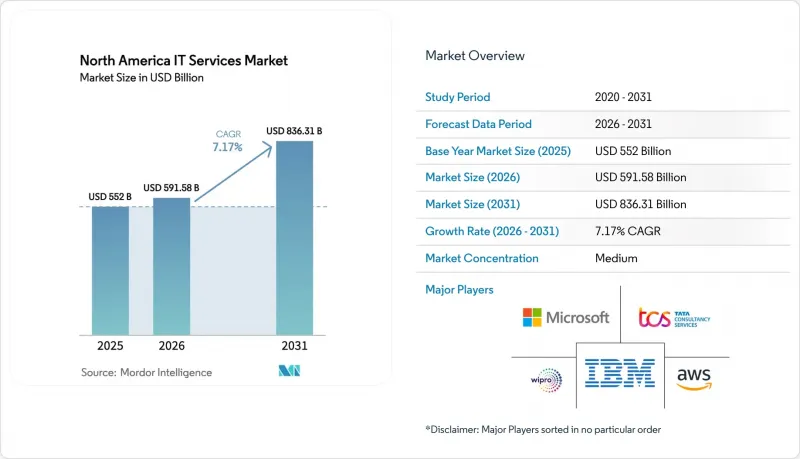
This report is Segmented by Service Type (IT Consulting and Implementation, Managed Services, and More), Deployment Model (On-Premise and Cloud), Organization Size (Large Enterprises and Small and Medium Enterprises (SMEs)), End-User Industry (BFSI, Government and Public Sector, and More), and Country. The Market Forecasts are Provided in Terms of Value (USD).
North America IT Services Market Trends and Insights
Acceleration of Enterprise-Wide Digital Transformation
Seventy-two percent of digital leaders expect bigger 2025 budgets, signaling that transformation has evolved into full business-model reinvention. North American firms spend an average of USD 33 million annually on IT, reflecting higher adoption rates and labor costs. Contracts increasingly embed AI-driven decision support, autonomous operations, and real-time customer-engagement platforms, granting providers multi-year revenue visibility.
Rapid Cloud and Hybrid-Multi-Cloud Migration
Hybrid architectures balance performance, compliance, and cost across hyperscalers; 75% of IT workloads are forecast to run in the cloud by 2027. Enterprises adopt multi-cloud to avoid vendor lock-in, prompting demand for orchestration and governance services. The top three hyperscalers hold 67% market share, yet users diversify to lower concentration risk.
Data-Sovereignty and Compliance Complexity
Fragmented privacy rules are forcing enterprises to operate overlapping frameworks that raise cost and architectural complexity. Region-specific mandates such as enhanced AI transparency rules in the EU and state-level statutes in California, Oregon, and Texas demand localized processing and real-time auditability. Multi-cloud environments must integrate data-localization controls, adding orchestration overhead. Specialized governance platforms and legal advisory services are increasingly bundled into transformation deals, influencing project timelines and pricing in the North America IT Services market.
Other drivers and restraints analyzed in the detailed report include:
- Escalating Cyber-Security and Zero-Trust Adoption
- Near-Shore Talent Hubs Ease US Skills Gap
- Acute Talent Shortage and Wage Inflation
For complete list of drivers and restraints, kindly check the Table Of Contents.
Segment Analysis
IT consulting and implementation held 45.02% of North America IT Services market share in 2025, underlining the premium placed on strategic guidance and change management. Engagements now encompass AI-infused business-process redesign, regulatory alignment, and data-governance blueprints. Managed services, forecasting an 8.22% CAGR, capture demand for predictable, outcome-linked operations across hybrid estates. Growth is fueled by AI-enabled service desks, AIOps platforms, and proactive incident prevention. The IT outsourcing segment remains resilient, offering cost optimization and access to scarce skills, while BPO is evolving toward intelligent automation. Emergent categories such as AI-as-a-service and quantum advisory signal future white-space, though they collectively account for a modest slice of the current North America IT Services market.
Providers are reshaping portfolios via M&A, deploying roughly USD 20 billion annually to bolt on automation, cybersecurity, and vertical-domain capabilities. Successful integrators standardize delivery frameworks early, accelerate cross-selling, and embed unified service catalogs. Those who stumble on post-merger integration leave value on the table for nimble competitors.
On-premise installations still represent 67.12% of 2025 revenue, but their role has shifted to anchor nodes within highly distributed fabrics. The cloud cohort, slated for parity by 2031 on a 8.71% CAGR, centers on workload portability, data-resident compliance, and elastic scaling for AI training. The North America IT Services market size for cloud services is expanding fastest in regulated verticals, where sovereign-cloud variants provide compliance assurance without sacrificing hyperscale benefits.
Market-leading providers differentiate through end-to-end observability, edge-to-core data integration, and cross-platform policy enforcement. Demand is especially strong for re-platforming legacy applications onto Kubernetes, implementing service mesh architectures, and instituting FinOps practices that optimize spend against value benchmarks.
Complete Report Scope:
- By Service Type
- IT Consulting and Implementation
- Managed Services
- IT Outsourcing (ITO)
- Business Process Outsourcing (BPO)
- Other Service Types
- By Deployment Model
- On-premise
- Cloud
- By Organization Size
- Large Enterprises
- Small and Medium Enterprises (SMEs)
- By End-user Industry
- BFSI
- Government and Public Sector
- Manufacturing
- Healthcare and Life Sciences
- Retail and Consumer Goods
- Logistics and Transportation
- Other End-user Industries
- By Country
- United States
- Canada
- Mexico
List of Companies Covered in this Report:
- Accenture plc
- IBM Corporation
- Microsoft Corporation
- Tata Consultancy Services (TCS)
- Infosys Limited
- Wipro Limited
- HCLTech
- Capgemini SE
- Cognizant Technology Solutions
- Deloitte Consulting
- Amazon Web Services (AWS) Professional Services
- DXC Technology
- CGI Inc.
- NTT DATA Services
- Kyndryl Holdings
- EPAM Systems
- Tech Mahindra
- Rackspace Technology
- Softchoice Corporation
- Insight Enterprises
- Perficient Inc.
- ThoughtWorks
Additional Benefits:
- The market estimate (ME) sheet in Excel format
- 3 months of analyst support
TABLE OF CONTENTS
1 INTRODUCTION
- 1.1 Study Assumptions and Market Definition
- 1.2 Scope of the Study
2 RESEARCH METHODOLOGY
3 EXECUTIVE SUMMARY
4 MARKET LANDSCAPE
- 4.1 Market Overview
- 4.2 Market Drivers
- 4.2.1 Acceleration of enterprise-wide digital transformation
- 4.2.2 Rapid cloud and hybrid-multi-cloud migration
- 4.2.3 Escalating cyber-security and zero-trust adoption
- 4.2.4 Near-shore talent hubs ease U.S. skills gap
- 4.2.5 Outcome-based pricing unlocking mid-market demand
- 4.2.6 Managed GenAI accelerators as a service
- 4.3 Market Restraints
- 4.3.1 Data-sovereignty and compliance complexity
- 4.3.2 Acute talent shortage and wage inflation
- 4.3.3 Carbon-disclosure rules hinder data-center outsourcing
- 4.3.4 Higher interest-rate-driven contract risk aversion
- 4.4 Value Chain Analysis
- 4.5 Regulatory Landscape
- 4.6 Technological Outlook
- 4.7 Porter's Five Forces Analysis
- 4.7.1 Bargaining Power of Suppliers
- 4.7.2 Bargaining Power of Buyers
- 4.7.3 Threat of New Entrants
- 4.7.4 Threat of Substitutes
- 4.7.5 Intensity of Competitive Rivalry
- 4.8 Assessment of the Impact of Macroeconomic Trends on the Market
5 MARKET SIZE AND GROWTH FORECASTS (VALUE)
- 5.1 By Service Type
- 5.1.1 IT Consulting and Implementation
- 5.1.2 Managed Services
- 5.1.3 IT Outsourcing (ITO)
- 5.1.4 Business Process Outsourcing (BPO)
- 5.1.5 Other Service Types
- 5.2 By Deployment Model
- 5.2.1 On-premise
- 5.2.2 Cloud
- 5.3 By Organization Size
- 5.3.1 Large Enterprises
- 5.3.2 Small and Medium Enterprises (SMEs)
- 5.4 By End-user Industry
- 5.4.1 BFSI
- 5.4.2 Government and Public Sector
- 5.4.3 Manufacturing
- 5.4.4 Healthcare and Life Sciences
- 5.4.5 Retail and Consumer Goods
- 5.4.6 Logistics and Transportation
- 5.4.7 Other End-user Industries
- 5.5 By Country
- 5.5.1 United States
- 5.5.2 Canada
- 5.5.3 Mexico
6 COMPETITIVE LANDSCAPE
- 6.1 Market Concentration
- 6.2 Strategic Moves
- 6.3 Market Share Analysis
- 6.4 Company Profiles (includes Global level Overview, Market level overview, Core Segments, Financials as available, Strategic Information, Market Rank/Share for key companies, Products and Services, and Recent Developments)
- 6.4.1 Accenture plc
- 6.4.2 IBM Corporation
- 6.4.3 Microsoft Corporation
- 6.4.4 Tata Consultancy Services (TCS)
- 6.4.5 Infosys Limited
- 6.4.6 Wipro Limited
- 6.4.7 HCLTech
- 6.4.8 Capgemini SE
- 6.4.9 Cognizant Technology Solutions
- 6.4.10 Deloitte Consulting
- 6.4.11 Amazon Web Services (AWS) Professional Services
- 6.4.12 DXC Technology
- 6.4.13 CGI Inc.
- 6.4.14 NTT DATA Services
- 6.4.15 Kyndryl Holdings
- 6.4.16 EPAM Systems
- 6.4.17 Tech Mahindra
- 6.4.18 Rackspace Technology
- 6.4.19 Softchoice Corporation
- 6.4.20 Insight Enterprises
- 6.4.21 Perficient Inc.
- 6.4.22 ThoughtWorks
7 MARKET OPPORTUNITIES AND FUTURE OUTLOOK
- 7.1 White-space and Unmet-need Assessment

