PUBLISHER: Mordor Intelligence | PRODUCT CODE: 2099482

PUBLISHER: Mordor Intelligence | PRODUCT CODE: 2099482
Personalization Services - Market Share Analysis, Industry Trends & Statistics, Growth Forecasts (2026 - 2031)
According to Mordor Intelligence, the personalization services market size is projected to expand from USD 13.25 billion in 2025 and USD 14.36 billion in 2026 to USD 24.75 billion by 2031, registering a CAGR of 11.50% between 2026 and 2031.
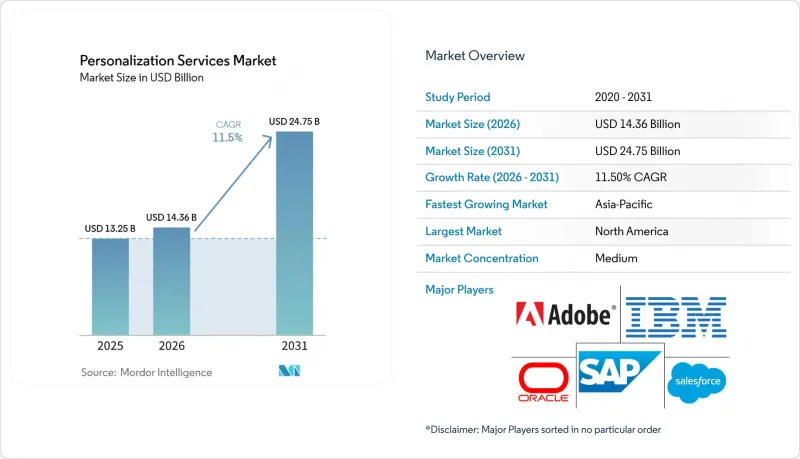
This report is Segmented by Service Type (Personalization Strategy and Consulting, and More), Deployment (Cloud-Based, On-Premise, and Hybrid), Technology (Web Personalization Platforms, and More), Enterprise Size (Large Enterprises, and Small and Medium Enterprises), End-User Industry (Retail and E-Commerce, BFSI, and More), and Geography. The Market Forecasts are Provided in Terms of Value (USD).
Global Personalization Services Market Trends and Insights
Rising Demand for Real-Time Customer Experience Orchestration
Real-time orchestration has moved closer to the center of enterprise customer strategy in the Personalization Services Market. Enterprises now want systems that can react to customer behavior in real time, rather than waiting for fixed campaign cycles. Adobe introduced CX Enterprise in April 2026, and the launch centered on agentic AI across audience assembly, content decisions, and journey execution. Amperity also introduced real-time site personalization and cart abandonment tools in May 2026, which showed that instant recognition and triggered recovery journeys are becoming more operationally accessible. This shift is driving demand for integration and consulting support, as many enterprises still run disconnected marketing, commerce, and service systems. It is also widening the advantage for vendors that can shorten the path from data capture to action across the full customer journey.
Wider Adoption of AI-Led Recommendation and Decision Engines
AI-led recommendation tools are one of the clearest growth engines in the Personalization Services Market because buyers can connect them directly to conversion and relevance goals. The market is moving away from rule-based recommendation logic and toward models that can interpret behavioral, transactional, and contextual signals together. Databricks introduced CustomerLake in 2026 as an agentic CDP within its lakehouse environment, and the launch showed how autonomous campaign analysis and audience activation are moving closer to standard deployment practice. Salesforce also completed the Cimulate acquisition in March 2026, which added AI-powered product discovery and agentic commerce capability to its broader platform stack. These developments are reducing the distance between product discovery, recommendation logic, and execution. They are also increasing demand for managed support because enterprises need continuous tuning after the initial rollout.
Weak Personalization Performance Caused by Poor Data Quality
Poor data quality remains one of the clearest operational limits on the Personalization Services Market. In 2025, a report found that 76% of organizations had less than half of their CRM data accurate and complete, even though 90% recognized CRM data as central to operations. That gap matters because weak records not only reduce recommendation precision but also create poor customer experiences that are harder to correct after launch. Many enterprises still manage customer information across CRM, commerce, loyalty, marketing automation, point-of-sale, and mobile systems, and every break in that chain raises the risk of identity and messaging errors. This keeps demand high for data cleaning, identity resolution, and customer data platform services before broader personalization goals can be met. It also slows returns for vendors that enter the account before the buyer has fixed its core customer data foundation.
Other drivers and restraints analyzed in the detailed report include:
- Expansion of First-Party Data Activation Across Digital Touchpoints
- Need for Higher Conversion Rates Across E-Commerce and Retail Funnels
- Enterprise Concerns Over Consent Management and Data Governance
For complete list of drivers and restraints, kindly check the Table Of Contents.
Segment Analysis
Implementation and system integration held 28.41% share in 2025, and that position reflects the amount of work required to connect personalization tools with CRM, CDP, commerce, and execution systems. In the Personalization Services Market, buyers still face large operational gaps between the platform they purchase and the outcomes they expect. This is why implementation revenue remains concentrated even as the technology itself becomes easier to access. Strategy, design, support, and training services continue to matter because enterprises need more than software licenses to run personalized engagement across channels. AI-driven personalization platforms are projected to grow at a 14.82% CAGR through 2031, and that pace shows where future service demand is moving as automation becomes more central to delivery.
The next shift in this segment is not the removal of services, but the change in which services matter most after launch. Training and enablement are gaining relevance because many buyers still lack in-house teams that can manage AI-led decision systems over time. OECD findings in 2026 showed that AI integration remained uneven across organizations of different sizes, with time constraints and skill gaps still the main barriers. That same pressure supports advisory and managed delivery work because enterprises want performance continuity after implementation. Managed personalization support is therefore becoming a practical extension of deployment rather than a separate optional layer. In this part of the Personalization Services industry, vendors that can combine system integration with post-launch operating support are likely to hold stronger client relationships.
Cloud-based deployment accounted for 71.26% of the mix in 2025, which made it the clear operating base for most programs in the Personalization Services Market. Buyers continue to prefer cloud environments because they reduce provisioning time and support elastic processing for high-volume customer signals. That advantage remains important for recommendation logic, journey automation, and multichannel execution workloads. At the same time, the market is not moving along a simple one-way path from on-premises to the cloud. Hybrid deployment is projected to grow at a 13.69% CAGR through 2031, which shows that compliance, residency, and system control issues are shaping the next phase of adoption.
The practical meaning of hybrid growth is that some buyers want cloud-scale speed without giving up local control over sensitive data. This is especially visible in regulated sectors where full cloud migration remains difficult for legal or operational reasons. Braze responded to this pattern in April 2026 by adding European Union-hosted infrastructure for its AI decisioning environment, aligning its offer more closely with data residency requirements. For many enterprises, hybrid architecture is becoming a stable long-term model rather than a temporary transition stage. That supports demand for deployment planning, architecture design, and integration services spanning both cloud-native and controlled local environments. It also keeps the Personalization Services Market tied closely to compliance-aware infrastructure work.
Complete Report Scope:
- By Service Type
- Personalization Strategy and Consulting
- Implementation and System Integration
- Personalization Design and Experience Optimization
- Managed Personalization Services
- Support and Maintenance
- Training and Enablement
- By Deployment
- Cloud-Based
- On-Premise
- Hybrid
- By Technology
- Web Personalization Platforms
- Mobile App Personalization Platforms
- Customer Data Platforms (CDPs)
- Recommendation and Decisioning Engines
- AI-Driven Personalization Platforms
- Omnichannel Personalization Platforms
- By Enterprise Size
- Large Enterprises
- Small And Medium Enterprises
- By End-User Industry
- Retail and E-Commerce
- BFSI
- Healthcare and Life Sciences
- IT and Telecom
- Media and Entertainment
- Industrial Manufacturing
- Government and Public Administration
- Other End-User Industries
- By Geography
- North America
- United States
- Canada
- Mexico
- South America
- Brazil
- Argentina
- Rest of South America
- Europe
- Germany
- United Kingdom
- France
- Italy
- Spain
- Russia
- Rest of Europe
- Asia-Pacific
- China
- India
- Japan
- South Korea
- Australia
- Rest of Asia-Pacific
- Middle East and Africa
- Middle East
- Saudi Arabia
- United Arab Emirates
- Rest of Middle East
- Africa
- South Africa
- Nigeria
- Rest of Africa
- Middle East
- North America
Geography Analysis
North America held a 34.72% share in 2025, making it the largest regional block in the Personalization Services Market. The region benefits from mature cloud infrastructure, deep enterprise software adoption, and a large concentration of major customer experience and marketing technology vendors. The United States accounts for most of this position because it combines large enterprise buyers with vendors that continue to expand their personalization service capabilities. Canada and Mexico add regional depth, with financial services and retail use cases supporting adoption. The North American Personalization Services Market share also reflects shorter feedback loops between vendor product development and enterprise deployment, which helps move projects from procurement to execution more quickly.
Europe remains a major demand center, but the operating environment is increasingly shaped by privacy and governance requirements. GDPR and related transparency expectations push enterprises to build personalization systems on a stronger consent and documentation base than in many other regions. Germany, the United Kingdom, and France continue to lead regional demand, especially across financial services, automotive, and e-commerce. South America is still earlier in its growth cycle, with Brazil and Argentina leading adoption while privacy regulation continues to influence data infrastructure decisions.
Asia-Pacific is projected to expand at a 14.21% CAGR through 2031, making it the fastest-growing geography in the Personalization Services Market. Mobile-first digital behavior, large online commerce ecosystems, and stronger enterprise use of AI-enabled operating models are supporting growth. India is emerging as a high-opportunity market for e-commerce and healthcare use cases, while China and Southeast Asia continue to support broader platform adoption through scale and deep digital engagement. The Middle East and Africa remain at an earlier stage, but national digital transformation efforts in Saudi Arabia and the United Arab Emirates are helping create a stronger foundation for future personalization demand.
- Adobe Inc.
- Salesforce, Inc.
- Oracle Corporation
- SAP SE
- IBM Corporation
- Braze, Inc.
- Bloomreach, Inc.
- Dynamic Yield Ltd.
- Insider
- MoEngage, Inc.
- Iterable, Inc.
- Klaviyo, Inc.
- Acoustic, L.P.
- Optimizely
- Tealium
- Treasure Data, Inc.
- Amperity, Inc.
- Segment.io, Inc.
- Zeta Global
- Kibo Commerce, Inc.
Additional Benefits:
- The market estimate (ME) sheet in Excel format
- 3 months of analyst support
TABLE OF CONTENTS
1 INTRODUCTION
- 1.1 Study Assumptions and Market Definition
- 1.2 Scope of the Study
2 RESEARCH METHODOLOGY
3 EXECUTIVE SUMMARY
4 MARKET LANDSCAPE
- 4.1 Market Overview
- 4.2 Market Drivers
- 4.2.1 Rising Demand for Real-Time Customer Experience Orchestration
- 4.2.2 Expansion of First-Party Data Activation Across Digital Touchpoints
- 4.2.3 Wider Adoption of AI-Led Recommendation And Decision Engines
- 4.2.4 Need for Higher Conversion Rates Across E-Commerce and Retail Funnels
- 4.2.5 Privacy-First Personalization Architecture Upshifts Enterprise Investment
- 4.2.6 Unification of Marketing, Service, and Commerce Data in One Stack
- 4.3 Market Restraints
- 4.3.1 Weak Personalization Performance Caused by Poor Data Quality
- 4.3.2 Enterprise Concerns Over Consent Management and Data Governance
- 4.3.3 High Integration Complexity With Legacy MarTech and CRM Environments
- 4.3.4 Talent Gaps in Personalization Strategy, Model Operations, And Measurement
- 4.4 Impact of Macroeconomic Factors on the Market
- 4.5 Industry Value Chain Analysis
- 4.6 Technology Outlook
- 4.7 Regulatory Landscape
- 4.8 Porter's Five Forces Analysis
- 4.8.1 Threat of New Entrants
- 4.8.2 Bargaining Power of Suppliers
- 4.8.3 Bargaining Power of Buyers
- 4.8.4 Threat of Substitutes
- 4.8.5 Intensity of Competitive Rivalry
5 MARKET SIZE AND GROWTH FORECASTS (VALUE)
- 5.1 By Service Type
- 5.1.1 Personalization Strategy and Consulting
- 5.1.2 Implementation and System Integration
- 5.1.3 Personalization Design and Experience Optimization
- 5.1.4 Managed Personalization Services
- 5.1.5 Support and Maintenance
- 5.1.6 Training and Enablement
- 5.2 By Deployment
- 5.2.1 Cloud-Based
- 5.2.2 On-Premise
- 5.2.3 Hybrid
- 5.3 By Technology
- 5.3.1 Web Personalization Platforms
- 5.3.2 Mobile App Personalization Platforms
- 5.3.3 Customer Data Platforms (CDPs)
- 5.3.4 Recommendation and Decisioning Engines
- 5.3.5 AI-Driven Personalization Platforms
- 5.3.6 Omnichannel Personalization Platforms
- 5.4 By Enterprise Size
- 5.4.1 Large Enterprises
- 5.4.2 Small And Medium Enterprises
- 5.5 By End-User Industry
- 5.5.1 Retail and E-Commerce
- 5.5.2 BFSI
- 5.5.3 Healthcare and Life Sciences
- 5.5.4 IT and Telecom
- 5.5.5 Media and Entertainment
- 5.5.6 Industrial Manufacturing
- 5.5.7 Government and Public Administration
- 5.5.8 Other End-User Industries
- 5.6 By Geography
- 5.6.1 North America
- 5.6.1.1 United States
- 5.6.1.2 Canada
- 5.6.1.3 Mexico
- 5.6.2 South America
- 5.6.2.1 Brazil
- 5.6.2.2 Argentina
- 5.6.2.3 Rest of South America
- 5.6.3 Europe
- 5.6.3.1 Germany
- 5.6.3.2 United Kingdom
- 5.6.3.3 France
- 5.6.3.4 Italy
- 5.6.3.5 Spain
- 5.6.3.6 Russia
- 5.6.3.7 Rest of Europe
- 5.6.4 Asia-Pacific
- 5.6.4.1 China
- 5.6.4.2 India
- 5.6.4.3 Japan
- 5.6.4.4 South Korea
- 5.6.4.5 Australia
- 5.6.4.6 Rest of Asia-Pacific
- 5.6.5 Middle East and Africa
- 5.6.5.1 Middle East
- 5.6.5.1.1 Saudi Arabia
- 5.6.5.1.2 United Arab Emirates
- 5.6.5.1.3 Rest of Middle East
- 5.6.5.2 Africa
- 5.6.5.2.1 South Africa
- 5.6.5.2.2 Nigeria
- 5.6.5.2.3 Rest of Africa
- 5.6.5.1 Middle East
- 5.6.1 North America
6 COMPETITIVE LANDSCAPE
- 6.1 Market Concentration
- 6.2 Strategic Moves
- 6.3 Market Share Analysis
- 6.4 Company Profiles (includes Global Level Overview, Market Level Overview, Core Segments, Financials as available, Strategic Information, Market Rank/Share, Products and Services, Recent Developments)
- 6.4.1 Adobe Inc.
- 6.4.2 Salesforce, Inc.
- 6.4.3 Oracle Corporation
- 6.4.4 SAP SE
- 6.4.5 IBM Corporation
- 6.4.6 Braze, Inc.
- 6.4.7 Bloomreach, Inc.
- 6.4.8 Dynamic Yield Ltd.
- 6.4.9 Insider
- 6.4.10 MoEngage, Inc.
- 6.4.11 Iterable, Inc.
- 6.4.12 Klaviyo, Inc.
- 6.4.13 Acoustic, L.P.
- 6.4.14 Optimizely
- 6.4.15 Tealium
- 6.4.16 Treasure Data, Inc.
- 6.4.17 Amperity, Inc.
- 6.4.18 Segment.io, Inc.
- 6.4.19 Zeta Global
- 6.4.20 Kibo Commerce, Inc.
7 MARKET OPPORTUNITIES AND FUTURE OUTLOOK
- 7.1 White-Space and Unmet-Need Assessment

