PUBLISHER: Mordor Intelligence | PRODUCT CODE: 2125713

PUBLISHER: Mordor Intelligence | PRODUCT CODE: 2125713
Indonesia IT Services - Market Share Analysis, Industry Trends & Statistics, Growth Forecasts (2026 - 2031)
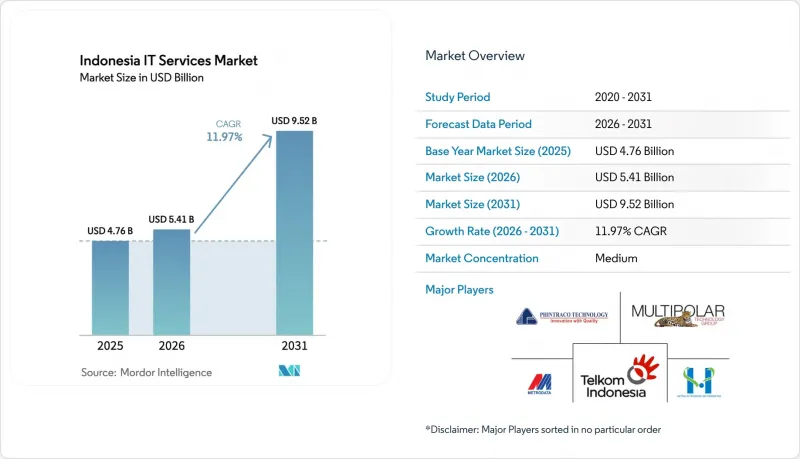
According to Mordor Intelligence, the Indonesia IT services market size is expected to increase from USD 4.76 billion in 2025 to USD 5.41 billion in 2026 and reach USD 9.52 billion by 2031, growing at a CAGR of 11.97% over 2026-2031.
This report is Segmented by Service Type (IT Consulting and Implementation, and More), Enterprise Size (Small and Medium Enterprises, and More), Industry (IT and Telecom, Manufacturing, and More), Deployment Model (On-Premise, Cloud, and Hybrid), Technology (Cloud Computing, Artificial Intelligence and Machine Learning, and More), and Geography. The Market Forecasts are Provided in Terms of Value (USD).
Indonesia IT Services Market Trends and Insights
Rapid Enterprise Digital-First Strategies
Indonesian corporations now replace incremental upgrades with holistic overhauls that bundle cloud ERP, customer data platforms, and AI-driven analytics into unified architectures. A 2025 IBM survey found 62% of domestic firms piloting AI, well above regional peers. Digital-native leaders such as GoTo Financial completed full cloud migrations in mid-2025, showing incumbents the performance gap that arises without end-to-end modernization. Multi-year managed-services contracts accompany these programs, securing predictable revenue and mitigating hardware refresh volatility. Certified integrators with ISO 27001 and SOC 2 documentation enjoy a bidding advantage because banks and telecom operators must pass strict regulatory audits. Consequently, service providers emphasize consult-build-operate models that embed long-term account control.
Surge in Cloud-Native Application Migration
Google Cloud's Jakarta region expansion in May 2025 catalysed a wave of microservices refactoring projects requiring Kubernetes and serverless skills. Microsoft's USD 1.7 billion commitment, including training for 840,000 Indonesians, signals confidence that platform-as-a-service demand will outpace lift-and-shift workloads. Enterprises adopting cloud-native patterns report 20% faster release cycles and 50% lower unplanned downtime, metrics that justify premium DevOps consulting fees. Bank Indonesia Regulation No.2/2024 compels banks to re-platform core systems on cloud infrastructure with domestic data residency, tripling average project value. Required certifications under ISO 27001 increase entry barriers, concentrating high-margin work among established integrators.
Persistent Domestic Skills Gap in Advanced Cloud and DevSecOps
Nearly half of large enterprises report shortages in cloud-security expertise despite surging AI adoption. Universities produce fewer than 5,000 cybersecurity graduates a year, while the National Cyber and Crypto Agency tracked 403 million anomalous traffic events in 2023. Until the AI roadmap delivers sizable cohorts, integrators import expatriate talent at two to three times local salaries, squeezing margins. Skill scarcity lengthens project timelines, particularly for SME clients that cannot absorb premium rates. Providers hedge by opening remote security-operations centers in lower-cost Asian locations, a move that introduces latency and data-sovereignty concerns.
Other drivers and restraints analyzed in the detailed report include:
- Government Making Indonesia 4.0 Incentives
- Accelerated Fintech and E-Commerce Expansion
- Ageing Legacy Infrastructure Outside Tier-1 Cities
For complete list of drivers and restraints, kindly check the Table Of Contents.
Segment Analysis
Cloud Services and SaaS Implementation held 29.47% of 2025 revenue in the Indonesia IT services market, showing enterprises' strong preference for utility pricing over capex-heavy on-premises deployments. Artificial Intelligence and Machine Learning engagements grow at 12.55% annually, thanks to banks, retailers, and manufacturers moving pilot models into production. IT Consulting and Implementation remains foundational, guiding clients through microservices re-architecture and business-process redesign. Business Process Outsourcing is shifting toward AI-assisted credit underwriting and claims processing, lifting provider margins. IT Outsourcing and Managed Services anchor recurring income, although price competition from offshore vendors pressures local firms to differentiate via 24/7 Indonesian-language support and on-site response.
Other Service Types, dominated by legacy hardware break-fix, continue to contract yet still underpin mission-critical systems that cannot migrate in a single release. Telkomsigma's pivot from classic integration to cloud-native consulting, and its AWS and Google Cloud partner badges, illustrates how incumbents can refresh portfolios while protecting embedded bases. Bank Indonesia's residency mandate accelerates movement from perpetual licenses to SaaS, positioning integrators that manage hybrid entitlements for long-term relevance. As AI accelerates, cloud and data-platform expertise becomes the primary gatekeeper to high-value transformation deals.
Large enterprises contributed 61.29% of 2025 revenue in the Indonesia IT services market, reflecting regulatory burdens, larger IT estates, and capacity to fund multi-million-dollar projects. Banks, telecom operators, and diversified conglomerates sign multi-tower deals that bundle consulting, migration, and managed services for 3-to-7-year terms. They increasingly rationalize supplier rosters, awarding core transformation work to firms offering certified security frameworks and audited delivery processes.
SMEs expand at a 12.97% CAGR as government digital-voucher schemes offset advisory fees and cloud providers launch SME pricing tiers. Typical engagements focus on point solutions such as inventory SaaS or IoT-enabled machinery telemetry, favouring modular delivery and rapid payback. Microsoft's nationwide skills academies nurture a future pool of cloud-ready SME owners, while hybrid models bridge connectivity gaps in provincial areas. The widening SME opportunity prompts local boutiques to package templated offerings with fixed-fee implementation, enhancing affordability without deep customization.
Complete Report Scope:
- By Service Type
- IT Consulting and Implementation
- Business Process Outsourcing Services
- IT Outsourcing and Managed Services
- Cloud Services and SaaS Implementation
- Other Service Types
- By Enterprise Size
- Small and Medium Enterprises
- Large Enterprises
- By Industry
- BFSI
- IT and Telecom
- Manufacturing
- Healthcare
- Government and Public Sector
- Retail and E-Commerce
- Energy and Utilities
- Education
- Other Industries
- By Deployment Model
- On-Premise
- Cloud
- Hybrid
- By Technology
- Cloud Computing
- Artificial Intelligence and Machine Learning
- Internet of Things
- Cybersecurity Services
- Big Data and Analytics
- Blockchain and Emerging Tech
- Other Technologies
List of Companies Covered in this Report:
- PT Sigma Cipta Caraka (Telkomsigma)
- PT Multipolar Technology Tbk
- PT Mitra Integrasi Informatika
- PT Metrodata Electronics Tbk
- PT Phintraco Technology
- PT Lintasarta
- Accenture Indonesia
- IBM Indonesia
- Microsoft Indonesia
- Hewlett Packard Enterprise Indonesia
- Fujitsu Indonesia
- Tata Consultancy Services Indonesia
- Wipro Indonesia
- PT Indosat Tbk (Indosat Ooredoo Hutchison Business Services)
- PT XL Axiata Tbk (XL Business Solutions)
- PT Biznet Gio Nusantara
- PT WOWrack Indonesia
- PT ABeam Consulting Indonesia
- PT Xapiens Teknologi Indonesia
- TDCX Indonesia
- PT Cloud4C Services Indonesia
- PT DCI Indonesia Tbk
- PT EdgeConneX Indonesia
- PT Equine Global
- PT Jatis Solutions
- PT Soltius Indonesia
Additional Benefits:
- The market estimate (ME) sheet in Excel format
- 3 months of analyst support
TABLE OF CONTENTS
1 INTRODUCTION
- 1.1 Study Assumptions And Market Definition
- 1.2 Scope of the Study
2 RESEARCH METHODOLOGY
3 EXECUTIVE SUMMARY
4 MARKET LANDSCAPE
- 4.1 Market Overview
- 4.2 Market Drivers
- 4.2.1 Rapid Enterprise Digital-First Strategies
- 4.2.2 Surge in Cloud-Native Application Migration
- 4.2.3 Government "Making Indonesia 4.0" Incentives
- 4.2.4 Accelerated Fintech and E-Commerce Expansion
- 4.2.5 Data-Center Build-Operate-Transfer Deals with SOEs
- 4.2.6 Mandated Domestic Disaster-Recovery Hosting for Critical Data
- 4.3 Market Restraints
- 4.3.1 Persistent Domestic Skills Gap in Advanced Cloud and DevSecOps
- 4.3.2 Ageing Legacy Infrastructure Outside Tier-1 Cities
- 4.3.3 Fragmented Provincial Procurement Standards
- 4.3.4 Rising Electricity Tariffs Impacting Hyperscale Economics
- 4.4 Industry Value-Chain Analysis
- 4.5 Regulatory Landscape
- 4.6 Technological Outlook
- 4.7 Porter's Five Forces Analysis
- 4.7.1 Bargaining Power of Buyers
- 4.7.2 Bargaining Power of Suppliers
- 4.7.3 Threat of New Entrants
- 4.7.4 Threat of Substitutes
- 4.7.5 Intensity of Competitive Rivalry
- 4.8 Impact of Macroeconomic Factors on the Market
5 MARKET SIZE AND GROWTH FORECASTS (VALUE)
- 5.1 By Service Type
- 5.1.1 IT Consulting and Implementation
- 5.1.2 Business Process Outsourcing Services
- 5.1.3 IT Outsourcing and Managed Services
- 5.1.4 Cloud Services and SaaS Implementation
- 5.1.5 Other Service Types
- 5.2 By Enterprise Size
- 5.2.1 Small and Medium Enterprises
- 5.2.2 Large Enterprises
- 5.3 By Industry
- 5.3.1 BFSI
- 5.3.2 IT and Telecom
- 5.3.3 Manufacturing
- 5.3.4 Healthcare
- 5.3.5 Government and Public Sector
- 5.3.6 Retail and E-Commerce
- 5.3.7 Energy and Utilities
- 5.3.8 Education
- 5.3.9 Other Industries
- 5.4 By Deployment Model
- 5.4.1 On-Premise
- 5.4.2 Cloud
- 5.4.3 Hybrid
- 5.5 By Technology
- 5.5.1 Cloud Computing
- 5.5.2 Artificial Intelligence and Machine Learning
- 5.5.3 Internet of Things
- 5.5.4 Cybersecurity Services
- 5.5.5 Big Data and Analytics
- 5.5.6 Blockchain and Emerging Tech
- 5.5.7 Other Technologies
6 COMPETITIVE LANDSCAPE
- 6.1 Market Concentration
- 6.2 Strategic Moves
- 6.3 Market Share Analysis
- 6.4 Company Profiles (includes Global Level Overview, Market Level Overview, Core Segments, Financials as available, Strategic Information, Market Rank/Share, Products and Services, Recent Developments)
- 6.4.1 PT Sigma Cipta Caraka (Telkomsigma)
- 6.4.2 PT Multipolar Technology Tbk
- 6.4.3 PT Mitra Integrasi Informatika
- 6.4.4 PT Metrodata Electronics Tbk
- 6.4.5 PT Phintraco Technology
- 6.4.6 PT Lintasarta
- 6.4.7 Accenture Indonesia
- 6.4.8 IBM Indonesia
- 6.4.9 Microsoft Indonesia
- 6.4.10 Hewlett Packard Enterprise Indonesia
- 6.4.11 Fujitsu Indonesia
- 6.4.12 Tata Consultancy Services Indonesia
- 6.4.13 Wipro Indonesia
- 6.4.14 PT Indosat Tbk (Indosat Ooredoo Hutchison Business Services)
- 6.4.15 PT XL Axiata Tbk (XL Business Solutions)
- 6.4.16 PT Biznet Gio Nusantara
- 6.4.17 PT WOWrack Indonesia
- 6.4.18 PT ABeam Consulting Indonesia
- 6.4.19 PT Xapiens Teknologi Indonesia
- 6.4.20 TDCX Indonesia
- 6.4.21 PT Cloud4C Services Indonesia
- 6.4.22 PT DCI Indonesia Tbk
- 6.4.23 PT EdgeConneX Indonesia
- 6.4.24 PT Equine Global
- 6.4.25 PT Jatis Solutions
- 6.4.26 PT Soltius Indonesia
7 MARKET OPPORTUNITIES AND FUTURE OUTLOOK
- 7.1 White-Space And Unmet-Need Assessment

